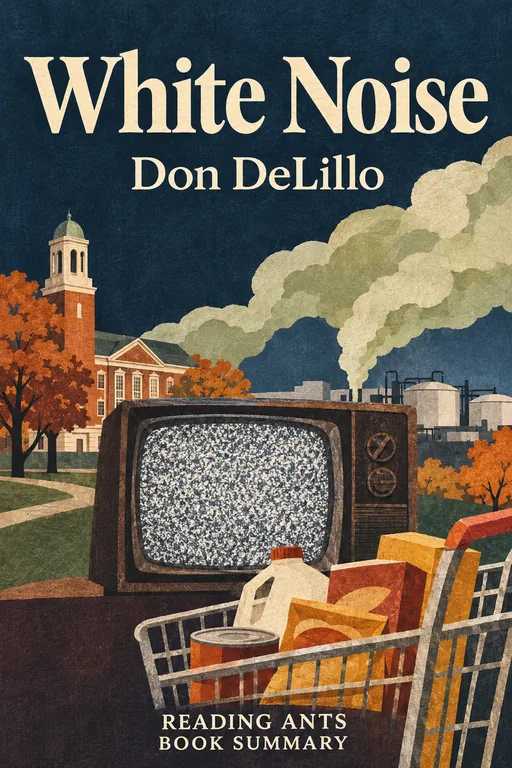
White Noise
Jack Gladney, a professor of "Hitler studies" at a small American college, tries to live a normal family life while an airborne toxic event, consumer culture and a terror of death crowd in on him.
Overview
White Noise is a novel by Don DeLillo, published in 1985, which won the National Book Award. It is a satirical, darkly comic story set in a Midwestern college town, in which a professor and his blended family face the stress of modern life, from supermarkets and television to a chemical disaster. The “white noise” of the title is the constant hum of media, products and information that surrounds the characters, and which DeLillo suggests helps them avoid the knowledge of death. The novel is short and sharply written, and it is often considered one of the key works of postmodern American fiction.
Main Characters
- Jack Gladney: the narrator, a professor of Hitler studies who fears death and cannot read German.
- Babette Gladney: his wife, a warm, easygoing woman who teaches posture and reads to the blind.
- Heinrich, Denise, Steffie and Wilder: the children of the combined families.
- Murray Jay Siskind: a visiting lecturer in popular culture and Jack’s friend.
- Willie Mink: the researcher behind Dylar, also known as Mr. Gray, who has been a subject of his own experiments.
- Winnie Richards: a scientist who offers calm perspective.
Full Summary
Waves and Radiation
The novel begins at the start of the school year, as station wagons arrive at the college. Jack Gladney has built a career in “Hitler studies,” although he has never learned German, and is anxious about it. He lives with Babette and a number of children from earlier marriages. Family life is full of chatter, television and supermarket trips, which Jack finds comforting. His colleague Murray, who is a former sportswriter who studies Elvis, explains to him how the supermarket is a place for spiritual renewal.
The Airborne Toxic Event
One night, a railroad tanker car collides and releases a black cloud of chemicals, which causes people to evacuate. The family flees, and Jack, who has been exposed, is told, on the strength of a computer printout, that the chemical may leave something dangerous in his body, though it is never clear what that means. The evacuation camp is a strange mixture of order and chaos. People watch the event on television, and are disappointed when it does not make the news. Jack begins to be preoccupied with his mortality.
The children follow the news on the car radio, and Heinrich calmly lectures his father about chemicals and risk. The family drives with other cars in a long line, and Jack, who stops along the way to get gas, is struck by how ordinary and how strange the whole evacuation feels, like a trip in a bad dream.
Babette’s Secret
Jack discovers that his wife has been taking a drug called Dylar, which is supposed to remove the fear of death, and that she obtained it by sleeping with a man named Willie Mink, who is a researcher in a motel. She is trying to overcome her own terror of dying. Jack is enraged and jealous, and wants the drug for himself. The two are bound by the same fear, and talk about it at length.
The Quest for Dylar
Jack tracks down Willie Mink, a shabby, sedated man living in a motel who has been tested on the drug, and who now spends his time watching television. In a surreal confrontation, Jack shoots him, but Mink shoots Jack’s wrist in return. Conscious of his own absurdity, Jack then takes the wounded Mink to a hospital, where nuns tend him. The nuns tell him that they do not believe in heaven, but pretend to, for the sake of the world, so that others can believe. The scene is both comic and sad.
Family Life
In between these events, the novel presents domestic scenes with sharp humor, such as the children discussing facts they pick up from television, the youngest child’s endless crying and a remarkable moment when Wilder rides his tricycle across a highway and survives. The most famous scene involves a barn billed as the most photographed in America, where tourists come only to photograph what others have photographed, and Murray says that no one can see the barn anymore.
Ending
The book ends in a supermarket, where the shelves have been rearranged and the old people go around confused. The characters are changed, but not much, and they continue their daily routine. The final lines describe the checkout line, the tabloid headlines and the sense of a population that clings to details to avoid thinking of the end.
Why It Matters
White Noise is often listed among the best American novels of the late twentieth century. Its insights into media saturation, consumer culture and the fear of death seemed prophetic. The novel was adapted into a film by Noah Baumbach in 2022. It is widely read in universities.
DeLillo’s unusual dialogue, in which characters speak in aphorisms and comic monologues, has influenced writers. The concept of the airborne toxic event has been used to discuss modern disasters.
Critics often point to the book as a forerunner of how we talk about information overload, and it has been quoted in discussions of television, advertising and the internet.
Key Takeaways
- Media and shopping can distract us from death. The noise hides fear.
- Fear of death shapes behavior. Jack and Babette are both afraid.
- Reality becomes second-hand. The photographed barn shows how images replace experience.
- Family offers warmth. The household provides comfort and comedy.
- Technology cannot fix mortality. Dylar fails.
What We Can Learn
The novel invites us to consider how much of our daily life consists of noise, such as screens, shopping and chatter, and what it protects us from feeling. This can help us to choose moments of quiet and reflection.
It also shows that facing the fear of death honestly is hard, and that people often try shortcuts. Understanding this can give us patience with ourselves and others.
Finally, it reminds us to look directly at the things around us, and not just at images of them.
Criticism and Counterpoints
Some critics find the novel’s characters cold or one-dimensional, and the dialogue too stylized. Others say that its satire of consumerism is dated, or that its view of women and domestic life is shallow. Some readers find it plotless, with a loose structure.
Certain scenes, such as the shooting, can feel forced. A few feel that its postmodern irony prevents deeper emotion. Still, it is regarded as a classic.
Who Should Read It
This book suits mature readers. It is short and funny, but deals with death and contains an affair and a shooting. It is a good introduction to DeLillo.
It can be enjoyed in short sittings.
Want the whole book?
A summary is a taste, not the meal. Here is where to find the full book.
You reached the end 🎉
Nicely done. Mark this one as read, and we will suggest what to read next.
Read this next
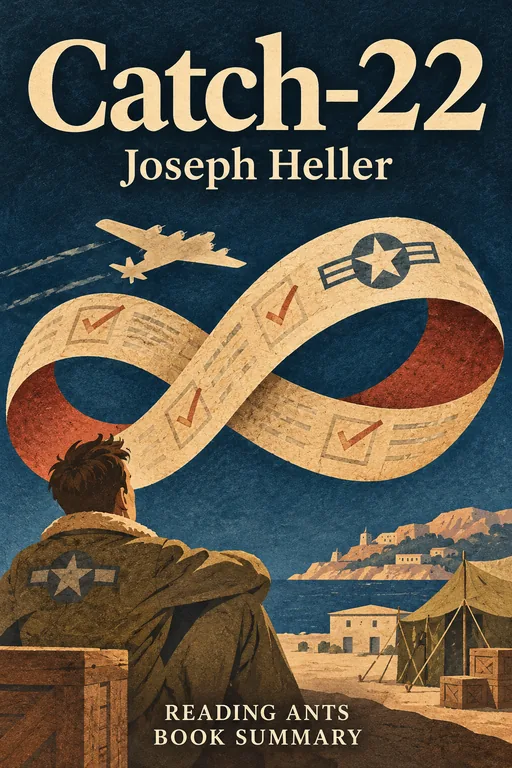
Catch-22
Joseph Heller
A bombardier named Yossarian tries to survive World War II by pretending to be crazy, but he is trapped by a military rule, Catch-22, that makes every escape impossible.
📜 Classics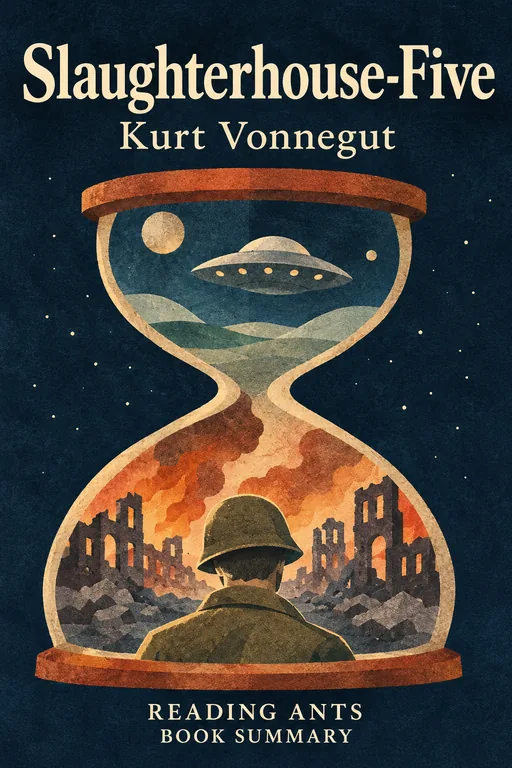
Slaughterhouse-Five
Kurt Vonnegut
Billy Pilgrim, a World War II soldier who survived the firebombing of Dresden, becomes "unstuck in time," bouncing between his past, present and future, and finds meaning in the idea that all moments exist forever.
📜 Classics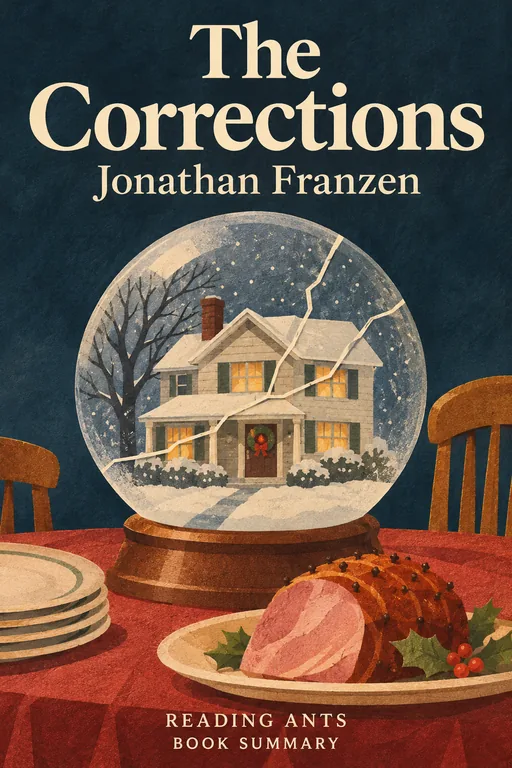
The Corrections
Jonathan Franzen
An aging Midwestern couple, Alfred and Enid Lambert, hope to bring their three grown children home for one last family Christmas, but each of the siblings is struggling with a crisis of their own.
✨ Modern Fiction
The Kite Runner
Khaled Hosseini
A wealthy boy in Kabul betrays his loyal best friend on the day of a kite tournament, and decades later, after fleeing to America, he returns to a Taliban-ruled Afghanistan to try to make things right.
✨ Modern Fiction
The Bluest Eye
Toni Morrison
In 1940s Ohio, a poor Black girl named Pecola Breedlove, who believes that she is ugly, prays for blue eyes, and the community's failure to protect her leads to tragedy.
✨ Modern Fiction
Song of Solomon
Toni Morrison
Macon "Milkman" Dead, a self-absorbed young man from Michigan, goes south in search of a family treasure and finds instead his family's history, and learns to take responsibility and to fly.
✨ Modern FictionWant something different?
Pick another topic and we will show you three books to start with.