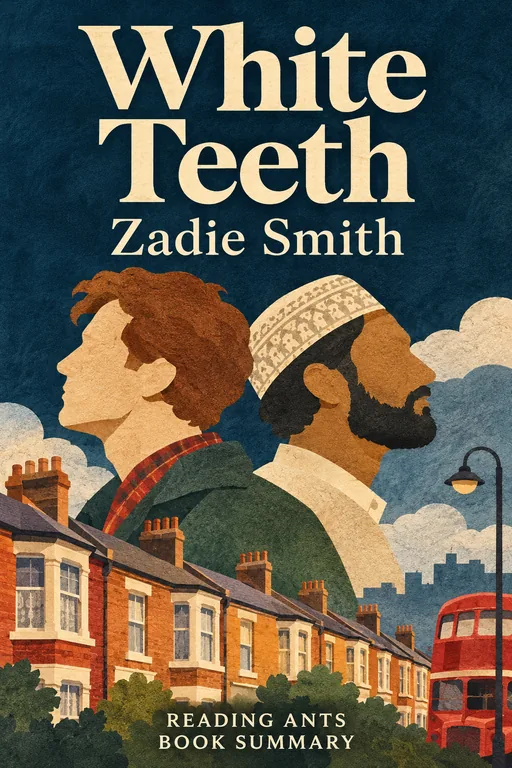
White Teeth
Two wartime friends, the Englishman Archie Jones and the Bangladeshi Samad Iqbal, and their families live and clash in multicultural North London over several decades, in a comic novel about identity, roots and chance.
Overview
White Teeth is the debut novel of Zadie Smith, published in 2000, when she was in her early twenties. It was an instant hit and won several prizes, including the Whitbread First Novel Award. The story is set mainly in the Willesden area of north-west London, and moves between the 1970s, the 1980s and the 1990s, with flashbacks to World War II and colonial India. It follows two families, the Joneses and the Iqbals, whose lives are tangled, and a third, the Chalfens, an intellectual white family. Smith’s style is exuberant and funny, and the book is a portrait of a changing Britain. It mixes comedy with serious questions about race, religion, science and family.
Main Characters
- Archie Jones: a gentle, passive Englishman who makes decisions by flipping a coin.
- Clara Bowden: his young Jamaican wife, who lost her teeth and has a strict mother.
- Irie Jones: their daughter, who is overweight and unsure of her place.
- Samad Iqbal: a Bangladeshi Muslim waiter, proud and conflicted, Archie’s war friend.
- Alsana Iqbal: his sharp-tongued wife.
- Magid and Millat Iqbal: their twin sons, one sent to Bangladesh and the other raised in London.
- Marcus and Joyce Chalfen: a pair of academics, who are earnest and meddling.
Full Summary
New Year’s Day
The novel opens on New Year’s Day 1975, with Archie Jones, who has just been left by his Italian wife, trying to kill himself in his car. He is saved by the owner of a halal butcher’s shop, who tells him to move his car. Archie decides to live, and flips a coin to choose what to do next. He goes to a party, where he meets Clara, a young Jamaican woman, and, impulsively, marries her. They are an unlikely couple, and soon have a daughter, Irie.
Archie and Samad
The story goes back to 1945, when Archie served in a tank crew with Samad Iqbal, a Bengali soldier. The two had a strange adventure at the end of the war, in which Archie, by an apparently random act, spared a Nazi-linked doctor, Dr. Perret, an event which later haunts them. After the war, they remain friends, and in the 1970s Samad, who works as a waiter, moves to London with his young wife, Alsana. Samad is unhappy: he feels that waiting tables is beneath him, and that his children are losing their roots.
The Twins
Samad, worried about the influence of Western society, decides to send one of his twin sons, Magid, back to Bangladesh, to grow up in a more traditional way. He chooses Magid, and keeps Millat in London, where the boy becomes a rebellious teenager, then a member of a militant Islamist group. Magid, in a twist, returns as a committed rationalist, who loves science and English culture, and wants to work in genetics.
Samad does this in secret, and Alsana, when she finds out, is furious and says that the boys should not be separated, but the decision is made. The decision, which turns out to have unexpected results, is one of the novel’s main sources of comedy and sorrow, since each twin ends up with the opposite qualities from those that his father intended.
The Chalfens
Irie Jones, who is struggling with her body and identity, becomes involved with the Chalfen family, who are wealthy and intellectual. Joyce Chalfen is a writer on gardening, and Marcus is a geneticist working on a project to genetically alter a mouse, the FutureMouse. Irie, Millat and Magid are all drawn in, and the Chalfens, who consider themselves open-minded, hold a control over their charges that is both generous and patronizing.
Collisions
The families are linked in many ways. Millat’s religious group, KEVIN, protests against Marcus’s mouse experiment as an affront to God. Meanwhile, Magid, in his new role, helps Marcus to design the project. Irie, who has fallen in love with both brothers and sleeps with both in quick succession, gets pregnant, and does not know who the father is. Archie, Samad and Alsana try to make sense of what their children are doing.
The Unveiling
The novel ends in a chaotic scene at a public event where Marcus is to unveil FutureMouse. Samad, Archie, the twins and others converge. Millat, who carries a gun, advances on the scientists’ table, and the doctor from Archie’s wartime past, Dr. Perret, turns out to be among them. Archie steps in front of Millat and is shot in the thigh, and as he falls he crushes the mouse’s cage, and the mouse escapes. The outcome is left uncertain, but the novel suggests that history, in the form of Archie’s earlier war choice, comes back and that chance rules. Irie’s baby will be born, and the future will be a mix.
Why It Matters
White Teeth announced Zadie Smith as a major voice in British writing, and became a defining novel of multicultural Britain. It was adapted into a 2002 television series. The book is often discussed for its energy, its humor and its broad picture of immigrant life, and many see it as a landmark in literature about identity.
Smith’s later books, such as On Beauty and NW, have also been praised, but White Teeth remains her best-known novel.
The novel presents the way in which people of different origins actually live together in cities, without making them symbols, and its comic mess is a truthful way to portray it.
Key Takeaways
- Identity is a mix. The characters combine many roots.
- Chance shapes lives. Archie’s coin tosses decide things.
- Children do not follow their parents’ plans. The twins go their own ways.
- Extremes in belief or science can be dangerous. Both are tested.
- Humor helps to face difficult topics. Smith blends comedy and seriousness.
What We Can Learn
The novel invites us to see how identity is complex, and how people can belong to more than one world. It encourages us to be open to differences and to realize that cultures mix and change.
It also warns of the dangers of certainty, whether religious or scientific. The characters who are the most certain, from Samad to Marcus, are often the most mistaken.
Finally, it shows that family bonds, though strained, can hold across generations.
It also shows how humor can be a bridge, since laughing at ourselves can help us to talk about things that would otherwise cause conflict.
Criticism and Counterpoints
Some critics found the novel overstuffed, with too many characters and plots, and a rushed ending. Others said that the characters are caricatures, particularly the Chalfens and the Muslim extremists, and that the book’s treatment of religion is shallow. Smith herself later said that she thought the book was flawed and immature.
Some readers also find the humor sometimes at the expense of the characters, and the discussion of race less deep than it seems. Still, many love its energy.
Who Should Read It
This book suits mature readers. It is long, funny and full of characters, with some sexual content and a suicide attempt at the start. It is a good choice for readers who like lively, sprawling novels.
Want the whole book?
A summary is a taste, not the meal. Here is where to find the full book.
You reached the end 🎉
Nicely done. Mark this one as read, and we will suggest what to read next.
Read this next
Midnight's Children
Salman Rushdie
Born at the exact moment India became independent, a boy named Saleem Sinai discovers that his life is mysteriously linked to the nation's history, and tells his story as a wild mix of family saga, politics and magic.
✨ Modern Fiction
The Namesake
Jhumpa Lahiri
Gogol Ganguli, the American-born son of Bengali immigrants, struggles with his unusual name and his divided identity as he moves between his parents' traditions and the life he wants for himself.
✨ Modern Fiction
Middlesex
Jeffrey Eugenides
Calliope Stephanides, a Greek American raised as a girl, discovers that she is intersex and becomes Cal, in a novel that traces the family history from a Greek village to the Detroit suburbs and a hidden gene.
✨ Modern Fiction
The Kite Runner
Khaled Hosseini
A wealthy boy in Kabul betrays his loyal best friend on the day of a kite tournament, and decades later, after fleeing to America, he returns to a Taliban-ruled Afghanistan to try to make things right.
✨ Modern Fiction
The Bluest Eye
Toni Morrison
In 1940s Ohio, a poor Black girl named Pecola Breedlove, who believes that she is ugly, prays for blue eyes, and the community's failure to protect her leads to tragedy.
✨ Modern Fiction
Song of Solomon
Toni Morrison
Macon "Milkman" Dead, a self-absorbed young man from Michigan, goes south in search of a family treasure and finds instead his family's history, and learns to take responsibility and to fly.
✨ Modern FictionWant something different?
Pick another topic and we will show you three books to start with.