 Reading Ants
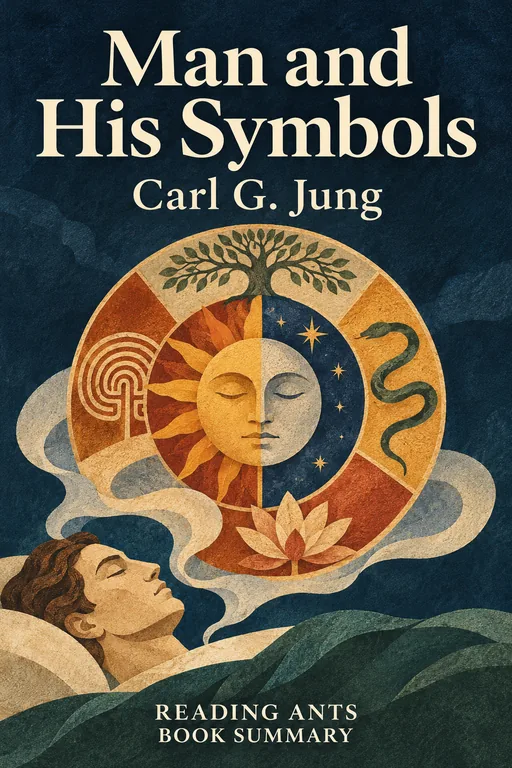
Man and His Symbols
Original title: Der Mensch und seine Symbole
Carl Jung and four of his followers explain, for general readers, how dreams and symbols express the unconscious mind, and how paying attention to them can help a person grow into a more whole self.
Overview
Man and His Symbols was published in 1964, three years after the death of Carl Jung, the Swiss psychiatrist who founded analytical psychology. It was the last work he undertook, and the one in which he agreed to speak directly to general readers. Jung wrote the opening chapter, “Approaching the Unconscious,” and four colleagues, Marie-Louise von Franz, Joseph Henderson, Jolande Jacobi and Aniela Jaffe, wrote the others. The book is richly illustrated with pictures from art, myth and religion. Where Freud saw dreams as disguised wishes, Jung saw them as natural messages from deeper parts of the mind.
Full Summary
1. The importance of dreams
The idea: Jung says that human beings are surrounded by symbols, such as the wheel and the cross, that point to something that cannot be fully explained. The unconscious produces such images in dreams, in a language that the conscious mind does not use. Jung thought that dreams are not meant to hide something, but to express it in the only way they can. To understand a dream, we should look at the dream itself, and the dreamer’s own associations, and not apply a fixed key.
In real life: A dream about a house with an unknown room may be a prompt to ask what part of yourself you have not explored.
2. The collective unconscious and archetypes
The idea: Jung’s best-known theory is that beneath each person’s private unconscious lies a collective unconscious, shared by all humanity, that holds inherited patterns, which he calls archetypes. They appear as recurring figures and themes in myths, religions and dreams across cultures, such as the hero, the wise old man, the great mother and the trickster. He believed that these patterns help to explain why similar stories arise in places that never had contact.
In real life: Hero stories in cultures around the world share a pattern, which may reflect something deep in human nature.
3. The shadow, the anima and the animus
The idea: Jung describes parts of the personality that we usually do not see. The shadow holds the traits that we reject or hide in ourselves, which we often project on others. The anima, in a man, and the animus, in a woman, stand for the inner image of the opposite sex, which can influence relationships and moods. Becoming aware of these figures, he says, lessens their hold and helps us to see others more clearly.
In real life: A trait that irritates you in another person may be one that you dislike in yourself.
4. The process of individuation
The idea: The central goal of Jungian psychology is individuation, the lifelong process of becoming a whole and unique person by integrating the conscious and unconscious parts of the self. Dreams guide this process, which often begins with a sense of suffering, or with a deadly boredom that makes everything feel empty even when life looks fine from outside. The symbol of the Self, often a circle or mandala, represents the wholeness that a person is moving toward. It is a gradual journey, not a quick fix.
In real life: A person who reaches midlife success and still feels restless may be ready to ask what else they need.
5. The role of symbols in religion and art
The idea: In later chapters, Jung’s colleagues discuss how symbols appear in religion, myth and the arts. Joseph Henderson describes the hero myths and the stages of initiation, which parallel the growth of the individual. Aniela Jaffe looks at symbolism in the visual arts, while Marie-Louise von Franz writes about the process of individuation, and Jolande Jacobi gives a case study of it. They suggest that myths and art give form to experiences that science alone cannot.
In real life: A painting or a song can express a feeling that you cannot describe in words.
6. Dreams and modern life
The idea: Returning to Jung’s own opening chapter, which sets the theme for the whole book, Jung considers the place of the symbolic in a modern world. He argues that as science has made the world seem more rational, people have lost their emotional link with nature and the old symbols, and now feel isolated, while the unconscious keeps producing symbols in dreams to make up for the loss. He urges readers to take the unconscious seriously, to pay attention to their own dreams, and to avoid ready-made guides to dream meaning, since no symbol can be separated from the person who dreams it.
In real life: Keeping a dream journal for a few weeks can show recurring images that you did not notice.
Why It Matters
Man and His Symbols is the most accessible introduction to Jung’s thought, and brought ideas such as the archetype, the shadow and individuation to a wide audience. These terms are now familiar in psychology, literature, film and popular culture, and Jung’s ideas influenced writers, artists and thinkers, including those studying myth. Personality tests such as the Myers-Briggs were inspired by his idea of psychological types. The book is also admired for its illustrations. Although many scientists regard Jung’s theories as unproven, they continue to attract readers who find in them a language for the inner life.
Key Takeaways
- Dreams are meaningful. They express the unconscious in symbols.
- Archetypes are shared patterns. Similar images occur across cultures.
- We have a shadow. Rejected traits are often projected on others.
- Individuation is the goal. It means becoming whole by integrating all parts of the self.
- Symbols nourish life. Myth and art help us to find meaning.
What We Can Learn
You can try keeping a notebook by your bed and writing down dreams, then looking for recurring images and feelings. Notice what annoys you in others, and ask whether it relates to something in yourself. Pay attention to the stories and symbols that move you, and think about why. Make time for creative activities, such as drawing or music, as a way to hear your inner voice. At the same time, hold interpretations loosely, as suggestions and not facts, and speak with a professional if dreams or feelings trouble you.
Criticism and Counterpoints
Many scientists say that Jung’s concepts, such as the collective unconscious and archetypes, are not testable and lack empirical support, and that the universal meanings of symbols are overstated, since they vary among cultures. Critics note that Jung drew heavily on myth, alchemy and religion, in ways that are open to interpretation, and that his interpretations can be arbitrary. His views on gender and on peoples of different cultures reflect his time, and his activities in the 1930s have been debated. Nevertheless, his ideas on the inner life continue to appeal to many.
Who Should Read It
This book is for readers interested in psychology, dreams, myth and art. It is easier to read than Jung’s other works, and its pictures help. Those who want a scientific treatment of dreaming should consult modern research, and those who prefer Freud’s approach may want to compare the two.
Want the whole book?
A summary is a taste, not the meal. Here is where to find the full book.
You reached the end 🎉
Nicely done. Mark this one as read, and we will suggest what to read next.
Read this next
The Interpretation of Dreams
Sigmund Freud
Sigmund Freud proposes that dreams are disguised fulfillments of hidden wishes, and that by analyzing them we can discover unconscious desires and conflicts, which he calls the royal road to the unconscious.
🧩 Mind & Psychology
The Power of Myth
Joseph Campbell with Bill Moyers
In a series of conversations with journalist Bill Moyers, the mythologist Joseph Campbell explains how the myths of the world express shared human experiences, and how they can still guide us toward the experience of being alive and help us follow our own path.
🕊️ Philosophy & Religion
Feeling Good: The New Mood Therapy
David D. Burns
Psychiatrist David Burns introduces cognitive therapy to a general audience, teaching that depression and anxiety are driven by distorted thoughts, and showing readers how to identify and challenge them in order to feel better.
🧩 Mind & Psychology
The Denial of Death
Ernest Becker
Cultural anthropologist Ernest Becker argues that the fear of death is the main force behind human behavior, and that much of what we do, from heroic deeds to work, religion and politics, is an attempt to deny our mortality.
🧩 Mind & Psychology
The Upanishads
Various
A collection of ancient Indian texts, composed over several centuries, which explore the nature of reality and the self, and teach that the innermost self of each person is one with the ultimate reality behind the universe.
🕊️ Philosophy & Religion
Thinking, Fast and Slow
Daniel Kahneman
Our minds run on two systems, a fast, intuitive one and a slow, careful one, and understanding how the fast system fools us can help us make better decisions about money, risk, work and happiness.
🧩 Mind & PsychologyWant something different?
Pick another topic and we will show you three books to start with.