 Reading Ants
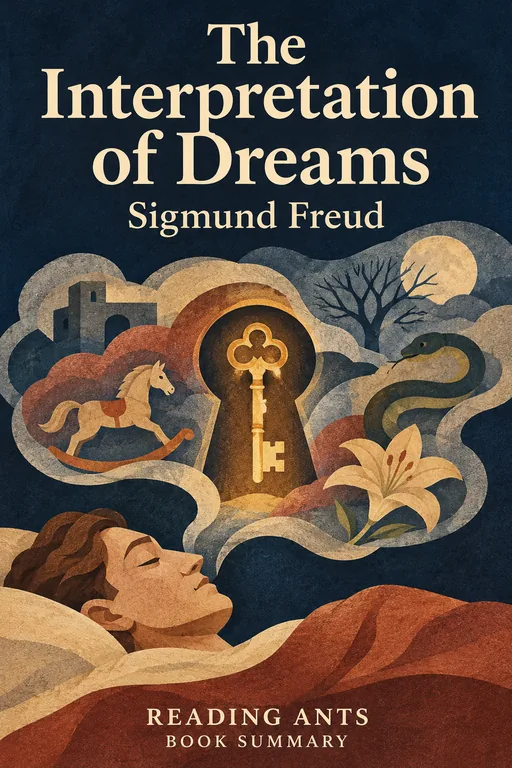
The Interpretation of Dreams
Original title: Die Traumdeutung (Wikisource-.html-Version der engl. Ausgabe von 1913)
Sigmund Freud proposes that dreams are disguised fulfillments of hidden wishes, and that by analyzing them we can discover unconscious desires and conflicts, which he calls the royal road to the unconscious.
Overview
The Interpretation of Dreams, in German Die Traumdeutung, was published in late 1899, though the title page bore the date 1900, by Sigmund Freud, an Austrian neurologist who founded psychoanalysis. The first edition sold slowly, taking about eight years to sell out, but the book became his most important early work, and he revised it many times. Freud draws on his own dreams, those of patients and earlier theories. He sets out a theory that dreams have meaning and can be decoded, against the common view that they are meaningless noise. The book is long and technical, but its main ideas had a huge influence on psychology and culture.
Full Summary
1. Dreams have meaning
The idea: Freud begins with a survey of earlier views on dreams, from ancient beliefs that they were messages from the gods to the scientific view of his time that they were random brain activity. He argues that dreams are psychological phenomena that have a meaning that can be discovered. He uses his own method of free association, in which the dreamer says whatever comes to mind about each element of a dream, to find the hidden connections.
In real life: A strange dream may seem random, but thinking about what it reminds you of can reveal something.
2. Wish fulfillment
The idea: Freud’s central thesis is that every dream is the fulfillment of a wish, usually one that the dreamer is not aware of. He starts with simple examples, such as dreams of eating when hungry, or of drinking when thirsty, as in the case of children’s dreams. In adults, he says, the wishes are more complex, and are often disguised, because they conflict with moral standards, and so they appear in a distorted form that can pass the mental censor.
In real life: A child who has gone without food for a day may dream of a favorite meal.
3. Manifest and latent content
The idea: He distinguishes between the manifest content, the dream as remembered, and the latent content, the hidden meaning of the wishes and thoughts behind it. The dream-work is the process by which the latent thoughts are transformed into the manifest dream. Understanding a dream means working backward from the manifest content to the latent. The dream, Freud says, is a compromise between the wish and the censor.
In real life: A dream about missing a train might be about anxiety over a change in life.
4. The dream-work: condensation, displacement and symbols
The idea: Freud describes the mechanisms of the dream-work. In condensation, several ideas or people are combined into one image. In displacement, the emotional importance of an element is shifted to something trivial, so that the dream seems to be about the wrong thing. Dreams also use visual images, and some symbols, which he says have a common meaning, though he warns that individual associations are also needed. A further step is secondary elaboration, in which the mind tidies up the dream to make it more orderly and sensible.
In real life: A person in a dream who is a mixture of your teacher and your uncle may represent feelings about both.
5. Childhood wishes and the Oedipus idea
The idea: Freud argues that many dream wishes originate in childhood, and are often linked to infantile desires. In this book he first presents the idea that children have feelings of love toward one parent and rivalry toward the other, which he later called the Oedipus complex, from the Greek tragedy of Oedipus, who unknowingly killed his father and married his mother. He sees this as a universal pattern which helps to explain the power of the tragedy and of certain dreams.
In real life: Early family relationships may affect the way we feel and dream as adults.
6. Dreams and the unconscious mind
The idea: In the last, more theoretical chapter, Freud outlines a model of the mind with conscious and unconscious parts, in which the unconscious works by different rules, including condensation and the loosening of logical connections, and where the censor keeps certain material out of awareness. He calls the interpretation of dreams the royal road to the unconscious. This provides a basis for psychoanalytic therapy.
In real life: Slips of the tongue may also hint at hidden thoughts, a theme that Freud developed in later books.
Why It Matters
The Interpretation of Dreams is one of the most influential books of the twentieth century. It introduced the ideas of the unconscious, repression and the symbolism of dreams to modern culture, and gave rise to psychoanalysis, which shaped psychology, psychiatry, literature, art and film for decades. Terms such as “Freudian slip” and “repression” entered everyday language. Even though many of its claims are now rejected or heavily revised, it changed how people think about the mind, and about the importance of early experience and hidden motives. It remains a classic of intellectual history.
Key Takeaways
- Dreams can be studied. Freud treated them as meaningful.
- Wishes drive dreams. In his view, they express hidden desires.
- The surface hides a deeper meaning. Manifest content disguises latent thoughts.
- The mind uses mechanisms of disguise. Condensation and displacement transform ideas.
- The unconscious matters. Much mental life is outside awareness.
What We Can Learn
Even if you doubt Freud’s theory, you can keep a dream diary and see whether patterns emerge, and think about what your dreams tell you about your concerns. Notice how you feel when you wake, and what recent events they may refer to. Take note of the idea that we are not always aware of why we feel or act as we do, and be curious about your own motives. At the same time, treat dream interpretations as suggestions, not facts, and talk with a professional if dreams or nightmares are troubling you.
Criticism and Counterpoints
Modern science largely rejects Freud’s claim that all dreams are wish fulfillments, and neuroscientists propose that dreams relate to memory consolidation and emotional processing during sleep, particularly in REM sleep, though the debate about their function continues. Critics say that Freud’s method of interpretation is not testable, and that it allows the analyst to read in whatever he wishes. His emphasis on sexuality and on universal symbols has been challenged, as have his claims about the Oedipus complex. Feminist and cultural critics have objected to many assumptions. Still, his influence on culture is undeniable.
Who Should Read It
This book is for readers interested in the history of psychology and ideas, and for those who want to read a foundational work of psychoanalysis. It is long and dense, with many dream examples from the Vienna of Freud’s time. Many readers prefer to start with a summary or with Freud’s shorter works, and to read it with a critical mind.
Want the whole book?
A summary is a taste, not the meal. Here is where to find the full book.
You reached the end 🎉
Nicely done. Mark this one as read, and we will suggest what to read next.
Read this next
Feeling Good: The New Mood Therapy
David D. Burns
Psychiatrist David Burns introduces cognitive therapy to a general audience, teaching that depression and anxiety are driven by distorted thoughts, and showing readers how to identify and challenge them in order to feel better.
🧩 Mind & Psychology
The Problems of Philosophy
Bertrand Russell
Bertrand Russell gives a short, clear introduction to the big questions of philosophy about reality, knowledge and truth, and argues that the value of philosophy lies in widening our minds, not in giving final answers.
🕊️ Philosophy & Religion
Beyond Good and Evil
Friedrich Nietzsche
Nietzsche challenges the assumptions of earlier philosophers and moralists, argues that our values are shaped by hidden drives and perspectives, and calls for free spirits who dare to question good and evil themselves.
🕊️ Philosophy & Religion
The Year of Magical Thinking
Joan Didion
Joan Didion writes with precision and restraint about the year after her husband's sudden death, when she also faced her daughter's grave illness, and she examines how grief can warp thinking and time.
👤 Real Lives
Maybe You Should Talk to Someone
Lori Gottlieb
Psychotherapist Lori Gottlieb, after her own sudden breakup, becomes a patient herself, and weaves her story with those of her clients to show that everyone needs help understanding their lives, and that change is possible.
🧩 Mind & Psychology
Thinking, Fast and Slow
Daniel Kahneman
Our minds run on two systems, a fast, intuitive one and a slow, careful one, and understanding how the fast system fools us can help us make better decisions about money, risk, work and happiness.
🧩 Mind & PsychologyWant something different?
Pick another topic and we will show you three books to start with.