 Reading Ants
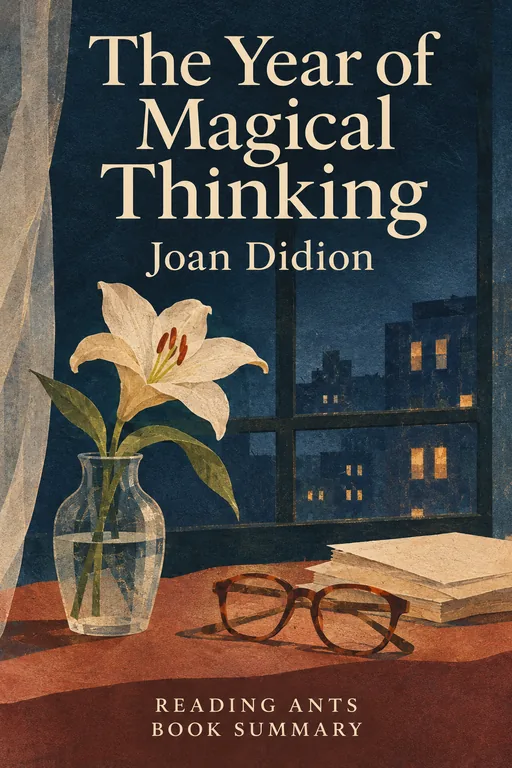
The Year of Magical Thinking
Joan Didion writes with precision and restraint about the year after her husband's sudden death, when she also faced her daughter's grave illness, and she examines how grief can warp thinking and time.
Overview
The Year of Magical Thinking was published in 2005 by Joan Didion, a respected American essayist and novelist. On the evening of December 30, 2003, her husband, the writer John Gregory Dunne, died of a heart attack at their home in New York, while their only daughter, Quintana, was seriously ill in a hospital. The book is Didion’s attempt to understand what happened and how it felt. She is a writer who looks at facts, and she approaches her own grief with the same attention, reading medical studies and noting her own odd behavior. The book won the National Book Award and became a classic of writing about loss.
Full Summary
The Ordinary Instant
Didion begins with the moment of her husband’s death. She and John were sitting down to dinner, after visiting their daughter in the hospital, and he stopped talking, slumped over, and was gone. She describes the call to emergency services, the arrival of the paramedics and the hospital in a flat, almost dreamlike style. Later in the book she comes upon notes that John wrote on the day he died, and she wishes they had spent that day together. She comments on how life can change in an instant, “an ordinary instant,” and how we think of ourselves as safe until something happens.
A Daughter in Danger
Their daughter, Quintana, had been hospitalized in an intensive care unit days before, after pneumonia that developed into septic shock, and she was still unconscious when her father died. As Didion deals with her husband’s death, she has to keep making decisions about her daughter’s care, and she cannot fully mourn. Quintana later regains consciousness, but she remains very ill and has more hospital stays. Didion describes her fear and her sense of being an observer of her own life, taking notes, because that is what she knows how to do.
Magical Thinking
The title refers to Didion’s habit of thinking in ways that she knows are irrational. For instance, she cannot give away her husband’s shoes, because he will need them when he comes back. She avoids certain actions, as though they could bring about or undo events. Didion recognizes that such ideas are a form of magic, an effort to reverse the irreversible. She notes that, while she appears functional, for many months she is actually somewhat crazy, and describes this honestly.
Research and Memory
As a way to cope, Didion reads books on grief and on death, and clinical studies on the physical effects of bereavement. She finds that some theories explain her state, and others do not. She also remembers moments from her marriage: the early years in California, the writing they did together, the daily routines, the way that their lives were linked. Each memory has a double meaning, since it brings both comfort and pain. She sees how grief shapes time, so that the past comes back in waves.
A Second Crisis
Months after her husband’s death, when Quintana has begun to recover, she suffers a new crisis. After flying to Los Angeles, she falls and hits her head as she gets off the plane, and a bleeding in the brain means she needs emergency surgery there. Didion faces a second period of terror and fatigue, with new decisions in the hospital. She describes the medical details precisely, as a way of holding on to control. In the end, her daughter lives through the operation, but the recovery is long.
The Anniversary and Letting Go
As the year of mourning comes to an end, Didion reflects on what she has learned. She finished writing on December 31, 2004, a year and a day after her husband died, and the closing pages find her free of the worst of her irrational thinking, though no clarity replaces it. She comes to see that we keep the dead alive in order to keep them with us, but that to go on living we must eventually let them go. The book does not offer neat consolation, but ends with a quiet acceptance and the sense that life, in its constant change, continues.
Why It Matters
The Year of Magical Thinking is regarded as one of the most important books about grief in recent decades. Its clear and unsentimental style makes it a model for writing about loss, and it names experiences, like irrational thoughts and the sense of time breaking down, that many mourners recognize. It was adapted into a stage play, starring Vanessa Redgrave. Didion later wrote a second book, Blue Nights, about her daughter, who died in 2005, after the manuscript was finished. The book is a comfort to many readers because it tells the truth about grief, and does not rush it.
Key Takeaways
- Grief can feel like madness. Irrational thoughts are common after a loss.
- Life changes in an instant. A normal evening can become a catastrophe.
- Writing and research are ways to cope. Didion studies grief to understand it.
- There is no timetable. Mourning does not end neatly.
- Memory is bittersweet. Good memories bring both pain and comfort.
What We Can Learn
If someone close to you is grieving, the book teaches us to be patient and not to expect them to behave normally. If you are grieving, it tells you that strange thoughts and feelings are common, and that you are not alone. Writing down what you feel and think can help. Allow yourself to remember, even when it hurts, and be kind to yourself. Seek support from friends, family or a counselor, since grief can be heavy. Remember also that a person’s way of mourning is individual, and that Didion’s controlled style is only one of many.
Criticism and Counterpoints
Some readers find the book too cool and controlled, and feel that it does not convey the depth of emotion. One mixed review compared its tone to that of an official investigative report. Others have noted that Didion’s circumstances, with access to top hospitals and well-known friends, differ from those of most mourners. Many others, though, consider that the restraint is the book’s strength, and that it conveys sorrow through understatement, with few moments of raw emotion on the page.
Who Should Read It
This book is for readers who like thoughtful essays and memoir, and who are interested in how people deal with loss. It is short but emotionally heavy. Those who are newly bereaved may find it comforting or too painful, so should read it when ready.
Want the whole book?
A summary is a taste, not the meal. Here is where to find the full book.
You reached the end 🎉
Nicely done. Mark this one as read, and we will suggest what to read next.
Read this next

Crying in H Mart
Michelle Zauner
Musician Michelle Zauner remembers her Korean mother, their complicated bond, her mother's death from cancer, and how cooking Korean food helped her to feel close to the person she lost.
👤 Real Lives
When Breath Becomes Air
Paul Kalanithi
Paul Kalanithi, a young neurosurgeon, writes about facing terminal lung cancer at thirty-six and asks what makes a life meaningful when time is short.
👤 Real Lives
Reasons to Stay Alive
Matt Haig
Novelist Matt Haig describes how he lived through severe depression and anxiety, how he found his way back, and why he believes that hope is always possible, even when it feels out of reach.
🍎 Health
Being Mortal
Atul Gawande
Surgeon and writer Atul Gawande argues that modern medicine is good at fighting death but poor at helping people live well as they age and approach the end, and that doctors and families should focus on what matters most to the person.
👤 Real Lives
The Diving Bell and the Butterfly
Jean-Dominique Bauby
Jean-Dominique Bauby, the editor of a French fashion magazine, dictated this short memoir by blinking his left eyelid after a stroke left him almost completely paralyzed, and it shows how a mind can remain free when the body is locked.
👤 Real Lives
Man's Search for Meaning
Viktor E. Frankl
A psychiatrist who survived the Nazi concentration camps explains that even in the worst suffering, people can choose their attitude, and that finding a reason to live is what gives us the strength to endure.
👤 Real LivesWant something different?
Pick another topic and we will show you three books to start with.