 Reading Ants
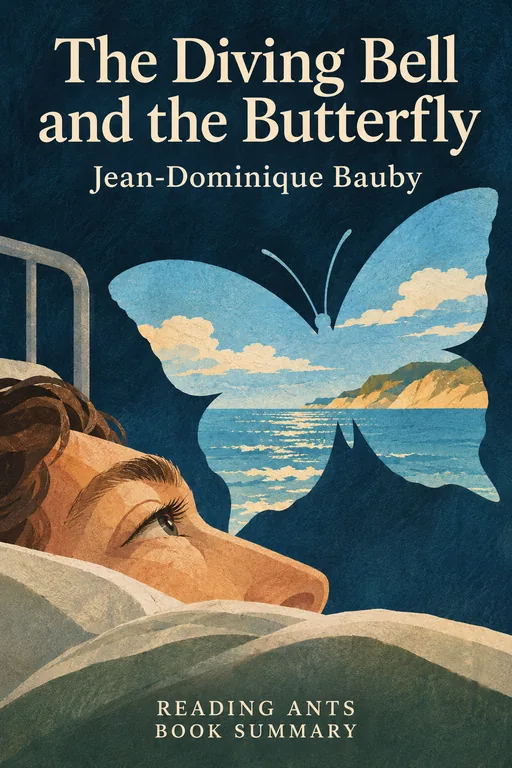
The Diving Bell and the Butterfly
Original title: Le Scaphandre et le Papillon
Jean-Dominique Bauby, the editor of a French fashion magazine, dictated this short memoir by blinking his left eyelid after a stroke left him almost completely paralyzed, and it shows how a mind can remain free when the body is locked.
Overview
The Diving Bell and the Butterfly is a memoir published in French in 1997 by Jean-Dominique Bauby. In December 1995, at the age of forty-three, Bauby, who was the editor-in-chief of the French edition of Elle magazine, suffered a massive stroke. When he came out of a coma after about three weeks, he found that he was almost entirely paralyzed and could not speak. This condition is called locked-in syndrome. He could only move his left eyelid. Using this movement, he wrote the book, letter by letter, with a patient transcriber, Claude Mendibil, who recited a special alphabet until he blinked at the right letter. It was published in March 1997, and he died two days later.
Full Summary
Waking Up
Bauby describes waking in a hospital room by the sea, at the maritime hospital of Berck in northern France, and slowly realizing what has happened to him. He comes out of a deep coma and stays confused for weeks. His body will not respond, and he cannot speak, even though his mind is clear. He describes the sensation as being in a diving bell, an enclosed chamber for going underwater, which isolates him from the world. He hopes at first that he will eat and speak again. One of his eyes has to be stitched shut to protect it, and he is fed through a tube.
Small Steps in the Hospital
The book describes the daily routine in the hospital: baths, feeding through a tube, exercises by the physiotherapist and the care of the nurses. He is moved in a wheelchair, and he notices that people tend to look away from him. He watches the other patients in the physiotherapy room and feels compassion for them, and he is struck by the history of the old hospital. His speech therapist, Sandrine, teaches him a way to communicate: someone recites the letters of the alphabet, arranged by how often they are used in French, and he blinks when the right letter is reached. It is slow and tiring, but it gives him a voice.
The Butterfly of the Mind
Though his body is trapped, Bauby finds that his imagination is free, which he compares to a butterfly. He travels in his mind to places he has been, and he imagines meals he would like to eat. He remembers his life before the stroke, which included travel and a job at a fashion magazine, and he reflects on what he took for granted. He recalls moments with his children, his father and friends, with both humor and regret. Some of his dreams and memories are comic, such as a long-ago pilgrimage to Lourdes with a girlfriend.
Visitors and Memories
Friends and family visit him, and the book describes how some find it hard to face him and others bring comfort. He writes about his elderly father, with whom he speaks by telephone, and he remembers shaving his father in the last week before the stroke, and how the roles have reversed. His two children, Théophile and Céleste, visit him one Father’s Day, and he grieves that he cannot touch his son’s hair. He also writes about the friends who write him letters, and he sends a collective letter to his friends.
Dictating the Book
Bauby had signed a contract to write a book before the stroke, and he decides to fulfill it. He had wanted to write a modern version of The Count of Monte Cristo in which the hero would be a woman, and he feels a kinship with a paralyzed character in that novel who also communicates by blinking. His publisher sends Claude Mendibil, who comes to his room and takes dictation letter by letter as he blinks. The work goes on for about two months, around three hours a day, and takes roughly two hundred thousand blinks. The book is an act of freedom, and a way to prove that he is still himself. The text is made of short chapters, clear and witty and often moving.
The End
The later chapters include a dream of visiting a wax museum, a recollection of the day of his stroke in December 1995, and a final chapter in which he wonders whether some key exists that could unlock his diving bell, and decides that he must look elsewhere. He writes with humor about the indignities of his condition, and with tenderness about the people who care for him. The book was published in March 1997, and Bauby died of pneumonia two days later. His book remains as a testimony to his courage and spirit.
Why It Matters
The Diving Bell and the Butterfly is a short book of great power, and has been translated into dozens of languages. It showed the world what a person with locked-in syndrome experiences, and it changed the way many people think about disability and communication. The book inspired a film in 2007, which won awards. It is also a reminder of how much we depend on our ability to communicate, and of how the imagination can survive when the body fails. It is often cited as proof of the human spirit, and has been used by teachers, doctors and caregivers.
Key Takeaways
- The mind can remain free. Imagination and memory gave Bauby a world beyond his body.
- Communication is precious. Blinking allowed him to share his thoughts.
- Small pleasures matter. He learned to treasure simple things.
- Patience makes impossible tasks possible. The book was written one letter at a time.
- Compassion matters. The way people treat the ill shows who they are.
What We Can Learn
The book invites us to appreciate our health, our abilities and the people in our lives, and to avoid taking small things for granted. It also tells us how to treat those who are ill or disabled, with patience and respect, and to look for ways to include them in conversation. You can try to imagine how it would feel to be unable to speak, and what you would say. Make a point of telling people you love them now. And remember that creativity can flourish in difficult conditions, if we are determined and have support.
Criticism and Counterpoints
Some critics note that the book describes one exceptional case, and that Bauby’s circumstances, as a well-connected editor with a loving circle of friends, were not typical. The 2007 film was criticized by some of Bauby’s close friends as unfaithful to real events, especially in how it portrayed the women in his life, so the film should not be taken as a record of his life. Still, most readers see it as a remarkable and truthful work, whose beauty lies in its simplicity.
Who Should Read It
This book is for readers of all backgrounds who like short, thoughtful memoirs, and it can be read in one sitting. It deals with illness and death, but does so with grace and humor. Those who are caring for someone with a severe illness might find it especially meaningful, though it could also be hard emotionally.
Want the whole book?
A summary is a taste, not the meal. Here is where to find the full book.
You reached the end 🎉
Nicely done. Mark this one as read, and we will suggest what to read next.
Read this next
The Year of Magical Thinking
Joan Didion
Joan Didion writes with precision and restraint about the year after her husband's sudden death, when she also faced her daughter's grave illness, and she examines how grief can warp thinking and time.
👤 Real Lives
When Breath Becomes Air
Paul Kalanithi
Paul Kalanithi, a young neurosurgeon, writes about facing terminal lung cancer at thirty-six and asks what makes a life meaningful when time is short.
👤 Real Lives
Man's Search for Meaning
Viktor E. Frankl
A psychiatrist who survived the Nazi concentration camps explains that even in the worst suffering, people can choose their attitude, and that finding a reason to live is what gives us the strength to endure.
👤 Real Lives
Being Mortal
Atul Gawande
Surgeon and writer Atul Gawande argues that modern medicine is good at fighting death but poor at helping people live well as they age and approach the end, and that doctors and families should focus on what matters most to the person.
👤 Real Lives
Flowers for Algernon
Daniel Keyes
A kind man with a low IQ becomes a genius through an experimental operation, and then has to watch his gift fade away.
🚀 Sci-Fi & Fantasy
The Diary of a Young Girl
Anne Frank
A Jewish teenage girl hiding from the Nazis in a secret apartment in Amsterdam records two years of fear, family quarrels, first love and big dreams in a diary that became one of the most famous books in the world.
👤 Real LivesWant something different?
Pick another topic and we will show you three books to start with.