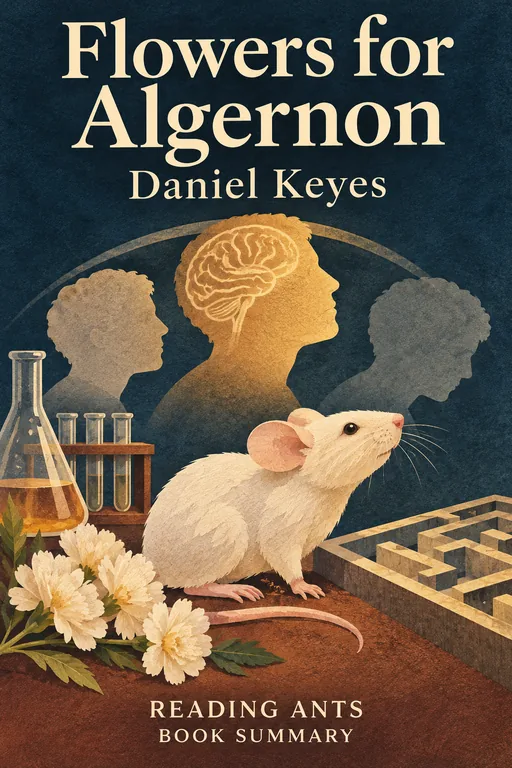
Flowers for Algernon
A kind man with a low IQ becomes a genius through an experimental operation, and then has to watch his gift fade away.
Overview
Flowers for Algernon is a novel by Daniel Keyes, published in 1966, and it grew out of a short story that won a Hugo Award in 1960. It is told through the “progress reports” of Charlie Gordon, a thirty-two-year-old man with an intellectual disability who works at a bakery. At the start, his writing is full of spelling mistakes, and it gradually improves as an experiment changes his mind. The book asks what makes a person valuable: intelligence, kindness or something else. It is a gentle, moving story, and one of the most widely read science-fiction novels in schools.
Main Characters
- Charlie Gordon: a sweet, eager man who wants to be smart.
- Algernon: a laboratory mouse who has had the same experiment as Charlie.
- Alice Kinnian: Charlie’s teacher at the adult learning center.
- Dr. Strauss and Professor Nemur: the scientists who run the experiment.
- Fay Lillman: a free-spirited artist who lives in Charlie’s building.
- Charlie’s family: his mother Rose, his father Matt and his younger sister Norma.
Full Summary
Progress Reports
The book opens with Charlie’s first progress report. He writes in simple, misspelled sentences, and he explains that he has been chosen for a special operation that will make him smart. Charlie has always wanted to be smart so that people would like him. He works at a bakery, where his co-workers play tricks on him and laugh, and he thinks they are his friends. He attends a class at a learning center, where his teacher, Alice Kinnian, recommends him to Dr. Strauss and Professor Nemur, who are looking for a volunteer.
Charlie is tested, and he races a mouse named Algernon through a maze. Algernon always wins. But after the operation, Charlie begins to learn quickly. He beats Algernon in the maze, and he starts to read.
Growing
As the weeks pass, Charlie’s reports improve. His spelling and grammar get better, he reads books and his thoughts become deeper. His IQ rises, and he starts to understand things he had not seen before, such as the way his co-workers had been laughing at him, not with him. He is hurt and angry, and he realizes that he was not as happy as he thought.
At the same time, Charlie falls in love with Alice, but he is awkward with her. His intelligence grows faster than his emotional maturity. He has the mind of a genius, but his emotions have not caught up, after years of shame and mistreatment, and this makes it hard for him to relate to others. He begins to remember his childhood, including his mother, who was ashamed of him, and his sister, who did not understand.
The Genius
Charlie’s intelligence soon passes that of the scientists. He learns languages, studies mathematics and reads widely. He becomes arrogant, and he looks down on the people around him, including the doctors who made him smart. He no longer needs their help, and he begins to see the flaws in their research. At a scientific convention he sees that Nemur treats him like an exhibit, and he takes Algernon away.
He discovers a problem in the experiment: the effect may not last. He studies Algernon, who has begun to behave strangely, and he finds that the mouse is losing its intelligence. He realizes that he is likely to have the same fate, and he works to find out why. He writes a paper describing the flaw, which is later named the Algernon-Gordon effect, after the mouse and Charlie. He can predict his decline, but he cannot stop it.
Love and Loneliness
Charlie’s relationships are difficult. He cares for Alice, but he is afraid of intimacy, and he pulls away. He meets Fay, a lively artist, and they begin a relationship that is freer and less demanding. In a diner, he sees a disabled dishwasher being mocked by the customers, and he stands up for him. He also visits his mother, who is now ill and confused, and his sister, and he tries to make peace with his past.
Charlie notices that when he was less intelligent, people laughed at him, but now that he is more intelligent, they are afraid of him. He has lost his friends, and he is lonely. He realizes that intelligence alone does not bring love, and that kindness matters more than knowledge.
The Decline
When Algernon dies, Charlie knows that his own time is short. He buries the mouse in the yard, and he begins to lose his abilities. His reading slows, he forgets words and he finds that he cannot understand the books he once loved. He tries hard to hold on, but he cannot stop it.
In his final reports, Charlie’s writing returns to its first, simple form. He knows what is happening, and he is frightened, but he is also gentle. He decides to go to a state home, the Warren Home, so that his friends and family do not have to watch him decline.
The Last Report
In his last progress report, Charlie writes in short, misspelled lines. He says goodbye to the people he has known, and he asks that someone put flowers on Algernon’s grave. The ending is simple and heartbreaking, and it leaves the reader thinking about what Charlie gained and lost.
Why It Matters
Flowers for Algernon is a classic of American science fiction, widely read in schools. Its structure, told entirely through Charlie’s own writing, is a remarkable technical achievement, because the reader can see his mind change from the style alone. The story asks what we owe to people with disabilities, and what it means to measure a person’s worth by their intelligence.
The novel has been adapted for film, television and the stage, and its title has become a common reference in conversations about experiments and ethics. Its questions remain important in debates about medicine, genetics and the treatment of people who are different.
Key Takeaways
- Kindness matters more than intelligence. Charlie’s worth does not depend on his IQ, and his story shows how people can use or ignore someone who is different.
- People judge each other unfairly. Charlie’s co-workers laugh at him before the operation.
- Science has ethical limits. The scientists treat Charlie like an experiment.
- Intellect and emotion are separate. Charlie grows smart faster than he grows wise.
- Every life has value. Charlie remains worthy at every stage.
What We Can Learn
The book invites us to treat everyone with respect, whatever their abilities. Charlie’s co-workers think that mocking him is harmless fun, but the book shows how deeply it hurts him. In daily life, we can choose to include people instead of laughing at them.
It also shows that being clever is not the same as being good or wise. Charlie’s cleverness makes him lonely and arrogant for a while, until he realizes that he needs other people. A mind that is connected to others is worth more than one that is only brilliant.
Finally, the story reminds us to value the time that we have. Charlie knows that his intelligence is short-lived, and he uses it as well as he can. We, too, can try to live with attention and gratitude.
Criticism and Counterpoints
Some critics say that the book treats intellectual disability as a tragedy and a state to be cured, which many disability advocates find troubling. Others point out that the science is not realistic, and that the female characters, including Alice and Fay, are defined mainly by their relationships with Charlie. A few readers find the early reports hard to read because of the spelling, and the middle section, in which Charlie is arrogant, can seem long.
Still, the book is widely praised for its compassion, and many readers say that it changed how they think about people.
Who Should Read It
This book is for teenagers and adults who enjoy moving, thoughtful stories. It is short, and the language is easy, but the story is sad. It is a good choice for readers who want to think about kindness and intelligence, and for classrooms and book clubs.
Want the whole book?
A summary is a taste, not the meal. Here is where to find the full book.
You reached the end 🎉
Nicely done. Mark this one as read, and we will suggest what to read next.
Read this next
Frankenstein
Mary Shelley
A young scientist creates a living being from dead body parts, then abandons it in horror, and his rejected creation, longing for love, turns to revenge.
🚀 Sci-Fi & Fantasy
The Curious Incident of the Dog in the Night-Time
Mark Haddon
A mathematically gifted teenager investigates a neighbor's dead dog, uncovering family deceptions and proving to himself that he can navigate a frightening journey alone.
🎒 Young Adult
Of Mice and Men
John Steinbeck
Two traveling farmworkers during the Great Depression, quick-witted George and the huge, gentle but mentally disabled Lennie, dream of owning their own small farm, but their dream ends in tragedy.
📜 Classics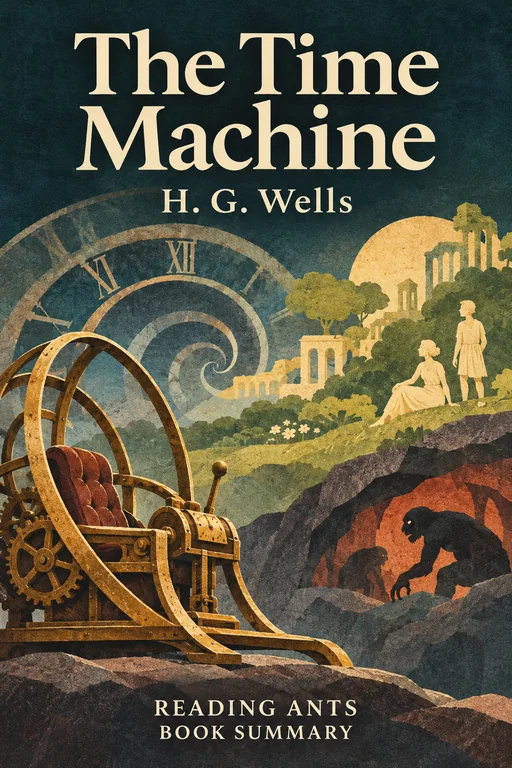
The Time Machine
H. G. Wells
A Victorian inventor, known only as the Time Traveller, builds a machine that carries him to the year 802,701, where he finds humanity split into two species, the gentle Eloi and the monstrous Morlocks, and then to a dying Earth.
🚀 Sci-Fi & Fantasy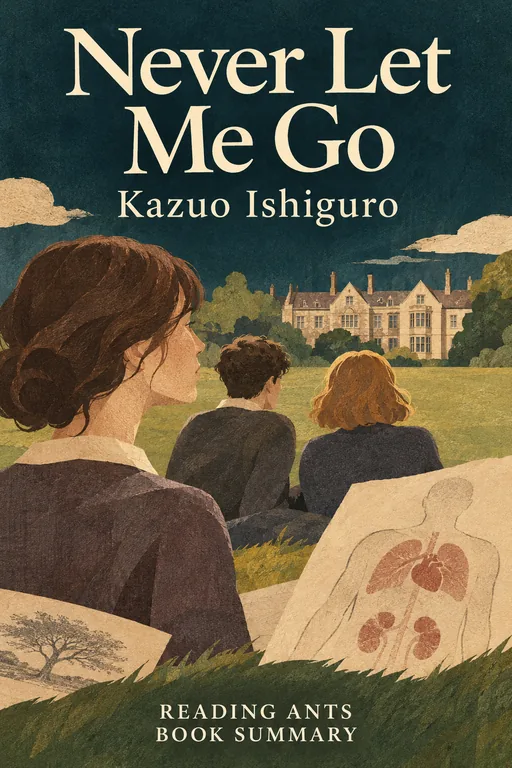
Never Let Me Go
Kazuo Ishiguro
Looking back on her childhood at an English boarding school, a young woman gradually reveals that she and her friends were created to donate their organs, and that they accept their fate without ever trying to escape.
✨ Modern Fiction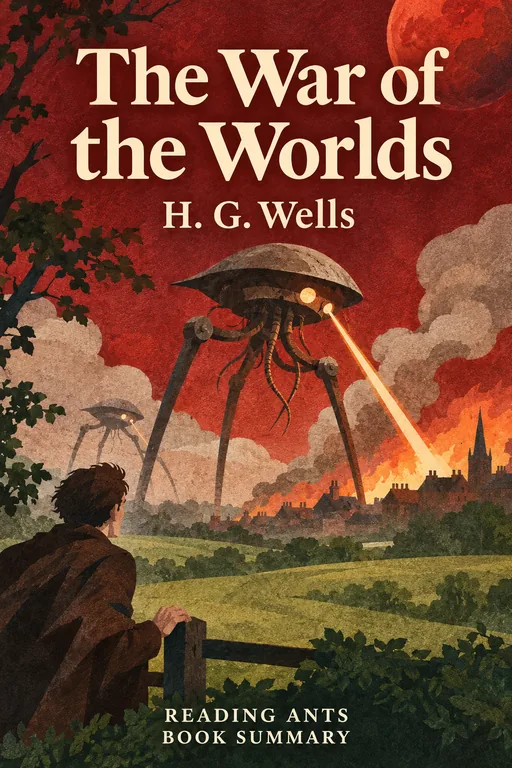
The War of the Worlds
H. G. Wells
Martians land in the English countryside with war machines and heat-rays that overwhelm human armies, until the invaders are brought down by the one thing humans never expected: Earth's smallest germs.
🚀 Sci-Fi & FantasyWant something different?
Pick another topic and we will show you three books to start with.