 Reading Ants
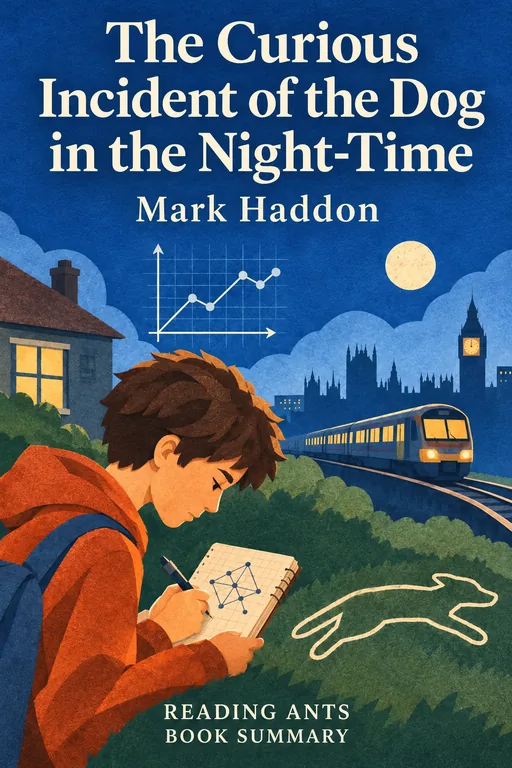
The Curious Incident of the Dog in the Night-Time
A mathematically gifted teenager investigates a neighbor's dead dog, uncovering family deceptions and proving to himself that he can navigate a frightening journey alone.
Overview
The Curious Incident of the Dog in the Night-Time is presented as a book written by fifteen-year-old Christopher Boone. He likes mathematics, patterns, truth and clear rules, and finds figurative language, touch and unpredictable social behavior difficult. After finding his neighbor’s dog Wellington killed with a garden fork, he investigates despite his father’s prohibition. The mystery exposes painful lies about Christopher’s mother and forces him to travel alone from Swindon to London. Mark Haddon has said the novel is not intended as a diagnostic textbook, and Christopher is not formally diagnosed in the text. His voice should therefore be read as one fictional individual’s perspective, not a universal portrait of autism or neurodivergence.
Main Characters
- Christopher Boone: the narrator, an excellent mathematician who writes the investigation as a school project.
- Ed Boone: Christopher’s father, a loving but overwhelmed caregiver whose lies and violence destroy trust.
- Judy Boone: Christopher’s mother, who left after struggling with family pressure and writes him letters that Ed hides.
- Siobhan: Christopher’s teacher, who helps him understand communication and shape his book.
- Mrs. Shears: the owner of Wellington and a former source of support for Ed.
- Mr. Shears: Mrs. Shears’s former husband, now living with Judy.
- Mrs. Alexander: a neighbor who cautiously gives Christopher important information.
Full Summary
Wellington
Christopher finds Wellington dead on Mrs. Shears’s lawn and holds the dog. A police officer misreads his distress and touches him; Christopher hits the officer reflexively and is arrested, then released with a warning. He decides to investigate the killing and write a mystery book.
His chapters use prime numbers, diagrams, logic problems and digressions. These are not decorative puzzles: they show how he organizes experience. He states his own preferences directly, while readers sometimes infer emotions or motives he does not name.
The Investigation
Ed orders Christopher to stop asking about Wellington. Christopher interprets the command narrowly and questions other neighbors. Mrs. Alexander reveals that Judy had a relationship with Mr. Shears before leaving. Christopher had been told that his mother died from a heart problem.
When Ed discovers the book, he becomes furious, strikes Christopher and confiscates it. Christopher later searches Ed’s room for the manuscript. Instead, he finds letters addressed to him in Judy’s handwriting, sent from London after the date of her supposed death.
The Letters and Confession
Christopher reads enough letters to understand that Judy is alive and that Ed hid her attempts to contact him. The scale of the contradiction makes him physically ill. Ed finds him and confesses that he lied because he did not know how to explain Judy’s departure.
Ed also admits killing Wellington in anger after his hoped-for relationship with Mrs. Shears failed. He asks Christopher to trust him, but the confession has the opposite effect. If his father killed the dog and lied about Judy, Christopher can no longer rely on the household rules that made home feel safe.
The Journey to London
Christopher decides that living with Ed is more dangerous than traveling to Judy, despite his fear of unfamiliar places. He takes his pet rat Toby, navigates the station, buys a ticket and boards a train. Noise, crowds, signs and police questions overwhelm him, and he uses counting and focused reasoning to continue.
The journey is suspenseful because ordinary transport presents genuine barriers, not because Christopher lacks intelligence. He solves one problem at a time, hides when he fears being returned and reaches Judy’s address in London. His achievement depends on preparation, persistence and some assistance as well as individual skill.
A Disrupted Reunion
Judy is shocked to learn that Ed claimed she was dead and hid her letters. She brings Christopher into the flat she shares with Mr. Shears, but the crowded situation quickly becomes tense. Mr. Shears resents the disruption, and Judy must confront how little stability she can offer.
Christopher is also distressed because the trip threatens his planned advanced mathematics examination. Judy eventually leaves Mr. Shears and returns with Christopher to Swindon. Her return does not erase why she left or immediately make her an effective caregiver, but she begins taking practical responsibility.
Rebuilding Trust
Christopher takes the mathematics exam after initial confusion and believes he has done well. Ed repeatedly apologizes and understands that trust cannot be demanded. He gives Christopher a puppy and proposes that they rebuild their relationship through small, predictable steps.
The family remains separated, financially strained and emotionally damaged. The puppy is not a payment that cancels Ed’s actions. It is part of a routine in which Christopher can decide how much contact feels safe. Repair depends on consistent future conduct rather than one dramatic confession.
Christopher’s Book
Christopher receives the top grade on his mathematics exam. He reflects that he solved Wellington’s murder, found his mother, traveled to London, wrote a book and passed the test. These achievements support his belief that he can pursue further exams and become a scientist.
His conclusion is hopeful because it is specific. He does not announce that social uncertainty has disappeared or that his parents are transformed. Instead, he uses evidence from completed difficult tasks to imagine a larger future. The mystery becomes a record that he can act effectively even when trusted adults fail him.
Why It Matters
The novel uses form to place readers inside a distinctive method of attention. Diagrams, numbered chapters and literal explanations challenge assumptions about what a conventional narrator should notice. Christopher sometimes understands information others miss, while other characters infer social meanings he does not state. Neither mode is complete by itself.
The family plot also complicates a simple inspirational reading. Christopher’s needs create real stress, but adult frustration does not excuse deception, striking him or killing an animal. Judy and Ed are neither ideal caregivers nor monsters; their failures arise within isolation and inadequate support, while remaining their responsibility. The book asks what trust requires when words and routines have been broken.
Key Takeaways
- Different communication is still communication. Christopher states needs clearly even when others expect conventional emotional signals.
- Trust depends on reliable action. Ed cannot repair major lies by asking Christopher to ignore the evidence.
- Independence can include support. Christopher’s journey is his achievement, though clear information and assistance also matter.
- Caregiver strain needs support, not excuses. Overwhelm should prompt help before it becomes harmful behavior.
- Specific success builds confidence. Christopher’s future plans grow from tasks he can name and evaluate.
What We Can Learn
Ask people what environments, communication methods and forms of touch work for them instead of assuming one standard. Clear instructions, advance notice and sensory accommodations can increase access without reducing expectations. When someone is overwhelmed, adding physical contact or figurative language may make communication harder.
For caregivers, honesty should be adapted to a young person’s understanding rather than replaced with a convenient falsehood. If safety has been damaged, the harmed person should influence the pace of repair. The novel also encourages strengths-based support: Christopher’s mathematical ability is not valuable because it cancels difficulty, and his difficulties do not cancel competence.
Criticism and Counterpoints
Many readers identify Christopher as autistic, but the text gives no formal diagnosis and cannot represent a broad spectrum. Some autistic critics value the perspective; others find traits exaggerated, stereotyped or filtered through a non-autistic author’s assumptions. The book should not be used as a clinical guide.
Its mystery centers adult failures yet sometimes uses Christopher’s differences to generate comedy or surprise for outside readers. The relatively hopeful ending leaves practical questions about housing, caregiving and family support unresolved.
Who Should Read It
This novel suits readers from about thirteen upward who enjoy unusual narration, family drama, mathematics and mystery. It includes animal killing, parental deception, hitting and intense sensory distress. Discussion should avoid treating Christopher as a template for all autistic or neurodivergent people.
Want the whole book?
A summary is a taste, not the meal. Here is where to find the full book.
You reached the end 🎉
Nicely done. Mark this one as read, and we will suggest what to read next.
Read this next
Flowers for Algernon
Daniel Keyes
A kind man with a low IQ becomes a genius through an experimental operation, and then has to watch his gift fade away.
🚀 Sci-Fi & FantasyThe Catcher in the Rye
J. D. Salinger
After being expelled from his boarding school, a lonely, sarcastic sixteen-year-old wanders New York City for three days, struggling with grief, phoniness and the frightening idea of growing up.
📜 Classics
Wonder
R. J. Palacio
A ten-year-old boy born with a rare facial difference goes to school for the first time, and through bullying, friendship and courage he helps everyone around him learn to choose kindness.
🧸 Children's Books
The Outsiders
S. E. Hinton
After a deadly clash between rival social groups, teenager Ponyboy Curtis learns that loyalty can sustain people without making violence noble or erasing their shared humanity.
🎒 Young Adult
The Giver
Lois Lowry
In a perfectly controlled community with no pain, choice or color, a boy about to turn twelve is chosen to hold the memories of the past, and discovers the terrible price his people pay for their safety.
🎒 Young Adult
The Book Thief
Markus Zusak
Death narrates how a foster child in Nazi Germany steals books, learns the power of words and forms loving bonds that war eventually destroys.
🎒 Young AdultWant something different?
Pick another topic and we will show you three books to start with.