 Reading Ants
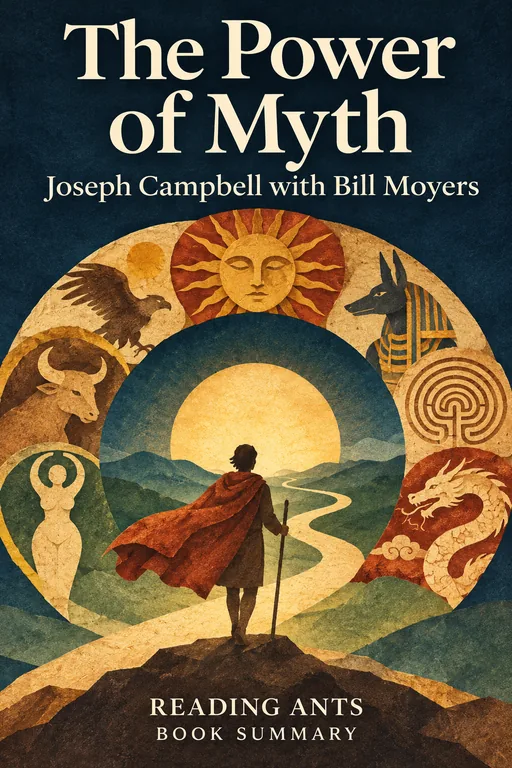
In a series of conversations with journalist Bill Moyers, the mythologist Joseph Campbell explains how the myths of the world express shared human experiences, and how they can still guide us toward the experience of being alive and help us follow our own path.
Overview
The Power of Myth was published in 1988, and is based on a television series of interviews between Bill Moyers and Joseph Campbell, a scholar who taught at Sarah Lawrence College for decades and spent his life studying myths from many cultures. The interviews were recorded in 1985 and 1986, partly at George Lucas’s Skywalker Ranch and later at the American Museum of Natural History. Campbell died in 1987, before the series was broadcast. The book, edited by Betty Sue Flowers, collects their talks in eight chapters, from “Myth and the Modern World” to “Masks of Eternity,” on topics such as the hero’s journey, love, death and religion. Campbell speaks with enthusiasm and storytelling skill, while Moyers asks questions in the role of an interested student.
Full Summary
1. What myths are for
The idea: Campbell says that myths are stories about the deep questions of human life: where we come from, how to live and how to face death. He argues that they serve four functions: to awaken a sense of awe before the mystery of existence, to give a picture of the universe, to support and validate a particular social order, and to teach the individual how to live a human lifetime in any circumstances. The social function, he says, has taken over in our world and is out of date, so the last one matters most today. Modern people, he says, are no longer well acquainted with the stories of the spiritual tradition, and without these guide-signs must work out their inner problems alone.
In real life: A story that helps a child to face fear, such as a tale of a hero in the dark, is working as a kind of myth.
2. The hero’s journey
The idea: One of Campbell’s best-known ideas is that hero stories around the world follow a common pattern: a hero leaves the ordinary world, faces trials, receives help, gains a gift or insight, and returns to share it. He sees this as a metaphor for personal growth, in which we must leave the familiar, face fears and return transformed. The pattern has been seen in tales from the story of the Buddha to the legends of King Arthur’s knights, and in modern films such as Star Wars.
In real life: Starting at a new school, struggling and finding your place resembles a small hero’s journey.
3. Follow your bliss
The idea: Campbell famously advises people to “follow your bliss,” meaning to find what gives them a deep sense of aliveness and to pursue it. He says that when we do so, it can feel as though hidden hands are helping us, and that doors open where we did not know they would be. He took the idea from the Sanskrit words for being, consciousness and bliss: he could not be sure of the first two, but he knew where his own rapture lay. He does not mean pursuing excitement, but a deep happiness that fits our nature, and he warns that staying with it may mean years of disappointment.
In real life: A student who loves to draw may find unexpected help once he commits to practice.
4. Myths of love and marriage
The idea: In talks about love, Campbell says that marriage is a union of two people who become one, not simply a social contract. He interprets stories of romance and of the pairing of masculine and feminine as symbols of wholeness, the reunion of what was once one. He traces romantic love in the West to the twelfth-century troubadours, who treated falling in love as a personal, spiritual experience, and he discusses the story of Tristan and Isolde. He notes that marriage requires the sacrifice of the ego to a relationship that is larger than either individual. The discussion also covers the role of women in myth, with images of the goddess.
In real life: A long friendship often depends on caring for the “us” more than for oneself.
5. Religion, symbols and the divine
The idea: Campbell says that the images of the world’s religions are metaphors that point beyond themselves to a transcendent reality, and that problems arise when they are taken literally and not symbolically. He compares the stories of different traditions, such as the virgin birth and the death and rebirth of a god, to show similar themes. He suggests that the divine is within, and that mythic symbols can serve as a way to connect with it.
In real life: A poem about the sea may express something that a scientific description cannot.
6. Modern myth and the future
The idea: Early in the book, Campbell is asked what the myths of the modern age might be. He says that the biblical picture of the universe belongs to a much earlier age and no longer fits our knowledge, and that no new mythology can arrive quickly, because things change too fast. Each person, he says, must find the part of myth that relates to his or her own life, and the old story of the spiritual quest is still good. He adds that the only myth worth thinking about is one that speaks of the whole planet and everyone on it, and that the sight of the Earth from the moon, with no borders between nations, might be its symbol.
In real life: Seeing an image of the Earth from space can change how people think about borders.
Why It Matters
The Power of Myth was a popular book, and the television series, one of the most popular in the history of American public television, brought Campbell to a huge audience. It introduced the idea of the hero’s journey to many readers, and influenced writers, filmmakers and storytellers, most famously George Lucas, who cited Campbell as an influence on Star Wars. The book encouraged people to read myths and legends from around the world and to see their relevance. Campbell’s advice to follow one’s bliss became a popular slogan. The conversations remain a lively and accessible entry into comparative mythology, and the questions they raise about meaning continue to resonate.
Key Takeaways
- Myths express shared human concerns. They address birth, love, death and the experience of being alive.
- The hero’s journey is a pattern of growth. Leaving, struggle and return mirror life.
- Follow what makes you feel alive. A calling can open unexpected doors.
- Symbols point beyond themselves. Religious images are best read as metaphors.
- We need living stories. Every age needs myths that fit its knowledge.
What We Can Learn
Try to notice the stories that shape your life, in books, films and in your family, and ask what they teach. When you are going through a challenge, think of it as part of a journey in which you are growing. Pay attention to what gives you a sense of excitement and meaning, and look for small ways to follow it. Read some myths from different cultures, and compare them. At the same time, think critically about the claim that all myths share a pattern, and consider the differences among traditions.
Criticism and Counterpoints
Scholars of religion and anthropology say that Campbell’s universal pattern, the monomyth, is too general, and overlooks the particular history and meaning of each culture’s stories. Critics have charged that he selected examples to fit his theory, and that his use of psychological ideas, such as those of Carl Jung, is uncritical. Others have noted that his view of women in myth reflects the assumptions of his time, and some have accused him of holding conservative or prejudiced views. His advice to follow your bliss raises the question, which Moyers himself puts to him in the book, of what would happen to institutions if everyone simply followed their desires. Despite this, the book remains popular for its inspiration.
Who Should Read It
This book is for readers who love stories, religion and ideas, and for writers looking for inspiration. It reads like a conversation and is easy to follow. Those who want scholarly rigor in the study of myths should also read academic works and not rely on Campbell alone.
Want the whole book?
A summary is a taste, not the meal. Here is where to find the full book.
You reached the end 🎉
Nicely done. Mark this one as read, and we will suggest what to read next.
Read this next
The Hero with a Thousand Faces
Joseph Campbell
Joseph Campbell argues that hero myths from around the world share one basic pattern, the monomyth, a journey of departure, initiation and return that reflects the stages of human growth.
🕊️ Philosophy & Religion
The Upanishads
Various
A collection of ancient Indian texts, composed over several centuries, which explore the nature of reality and the self, and teach that the innermost self of each person is one with the ultimate reality behind the universe.
🕊️ Philosophy & Religion
The Epic of Gilgamesh
Anonymous
A proud, powerful king of ancient Mesopotamia gains a true friend, loses him to death, and journeys to the edge of the world in search of eternal life, only to learn that what lasts is the life and legacy we leave behind.
🎭 Epics, Drama & Poetry
The Odyssey
Homer
After the Trojan War, the clever hero Odysseus struggles for ten years against monsters, gods and temptations to return home to his faithful wife and son, then must win back his house from the men trying to steal it.
🎭 Epics, Drama & Poetry
The Alchemist
Paulo Coelho
A young Spanish shepherd follows a recurring dream across the desert to the Egyptian pyramids in search of treasure, and learns that the journey toward one's dream is itself the greatest treasure.
🌍 World Literature
The Art of War
Sun Tzu
The greatest victory is the one won without fighting, achieved through careful planning, knowing both yourself and your opponent, and using deception, flexibility and timing.
🕊️ Philosophy & ReligionWant something different?
Pick another topic and we will show you three books to start with.