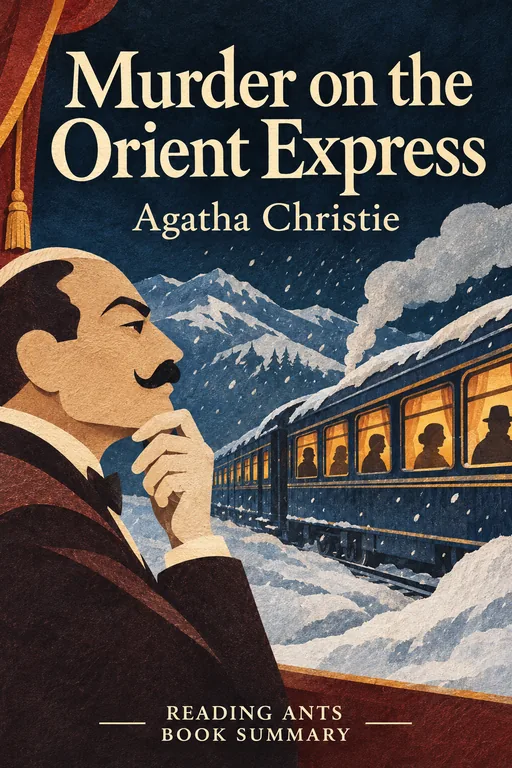
Murder on the Orient Express
When a wealthy American is murdered on a snowbound train, the Belgian detective Hercule Poirot must work out which of the passengers is the killer, and discovers a shocking truth about many of them.
Overview
Murder on the Orient Express is one of the most famous detective novels ever written, by the British author Agatha Christie, published in 1934. Poirot, traveling home from the Middle East, takes the luxurious Orient Express from Istanbul. During the night, the train is stopped by a snowdrift in Yugoslavia, and in the morning, a rich and unpleasant American, Samuel Ratchett, is found dead in his locked compartment, stabbed twelve times. With the train stuck in the snow and the killer still on board, Poirot has to question the passengers, a varied group of different nationalities, and use his “little gray cells.” The solution is one of the most surprising in crime fiction.
Main Characters
- Hercule Poirot: the vain, brilliant Belgian detective with a famous mustache.
- Samuel Ratchett: the wealthy American victim, who has received threatening letters.
- Monsieur Bouc: a director of the train company and an old friend of Poirot.
- Dr. Constantine: a Greek doctor who examines the body.
- Hector MacQueen: Ratchett’s young American secretary.
- Edward Masterman: Ratchett’s English valet.
- Princess Dragomiroff: an elderly Russian aristocrat.
- Mary Debenham: a calm English governess.
- Colonel Arbuthnot: a British army officer.
- Mrs. Hubbard: a talkative American woman.
Full Summary
The Journey
Poirot boards the Orient Express in Istanbul and finds the train unusually full for the season. Among the passengers are people of many nationalities and social classes. A wealthy American, Ratchett, offers Poirot a large sum to protect him from threats, but Poirot refuses, saying that he dislikes Ratchett’s face.
That night, the train is stopped by a heavy snowfall. Poirot, awakened by a noise, hears a cry and a ringing bell in the next compartment. A woman in a red dressing gown passes in the corridor.
The Body
In the morning, Ratchett is found dead, stabbed twelve times in his locked compartment. The wounds are of different depths and angles, as if the killer, or several, struck in a frenzy. The window is open, but there are no footprints in the snow. Monsieur Bouc asks Poirot to solve the crime before the train reaches the next station and the police take over.
Poirot discovers that Ratchett was really a gangster named Cassetti, who years earlier kidnapped and murdered a three-year-old girl, Daisy Armstrong, the child of a wealthy American family. Because of his influence, he escaped justice. The Armstrong case destroyed the family: Daisy’s pregnant mother died in childbirth, her father killed himself, and a young maid, wrongly suspected, took her own life.
The Suspects
Poirot interviews each passenger, noting small inconsistencies. The passengers’ stories seem to fit together too neatly. Everyone seems to have an alibi, and several of them, it turns out, had links to the Armstrong family: as servants, a nurse, a chauffeur, a governess, friends or relatives.
The Clues
Poirot collects strange clues. Ratchett’s watch has stopped at a quarter past one, but it may have been set to mislead. A half-burned note, rescued from a washbasin, contains part of the name Daisy Armstrong. A pipe cleaner has been dropped near the body, a handkerchief marked with an initial lies nearby, a conductor’s uniform turns up in a passenger’s suitcase, and a scarlet kimono that nobody admits to owning is found in Poirot’s own luggage. Mrs. Hubbard insists that a man was in her room in the night. Little by little, Poirot notices that every passenger’s alibi is supported by another passenger’s, and that nobody has a connection to Ratchett on the surface.
The Solution
Poirot gathers everyone in the dining car and offers two solutions. The first is that an unknown stranger boarded the train, killed Ratchett and escaped. The second, the true one, is that a group of the passengers and train staff took part: each of them, in different ways, was connected to the Armstrong family, and together they planned and carried out the murder, each stabbing Cassetti once, so that no single person could be proved guilty. They were twelve jurors, delivering the verdict that the law could not.
The Decision
Poirot leaves the decision to Monsieur Bouc and Dr. Constantine, who agree that the first solution is the better one for the authorities. Poirot withdraws from the case, and the novel ends with the question of justice and mercy left open.
Why It Matters
Murder on the Orient Express is among the best-known detective novels in the world and is often named the greatest of Christie’s work. It was inspired partly by the real kidnapping of the Lindbergh baby in 1932, as well as by Christie’s own experiences traveling on the Orient Express. It has been adapted for the screen several times, including a famous 1974 film directed by Sidney Lumet and a 2017 version directed by Kenneth Branagh.
The book shows Christie’s skill at plotting, creating a classic closed-circle mystery in which every suspect has a secret. It also raises a moral question that has made it endure: is a crime ever justified when the law fails? Agatha Christie, whose books have sold billions of copies, is the best-selling novelist of all time.
Key Takeaways
- Justice can be complicated. The passengers take the law into their own hands.
- Everyone has secrets. Poirot uncovers hidden connections.
- Small clues matter. A pipe cleaner and a handkerchief lead to the truth.
- Cooperation can be powerful. The conspirators act together.
- Mercy and law may conflict. Poirot chooses to let them go.
What We Can Learn
The story invites us to think about justice. When the legal system fails to punish a terrible crime, is it right to seek revenge? Many readers find themselves unsure, which is part of the book’s appeal.
It also shows the value of paying attention to detail and not accepting easy explanations. Poirot succeeds because he notices inconsistencies and asks questions.
Finally, the book reminds us to listen to people’s stories. Behind each passenger’s calm exterior lies a history of loss.
Criticism and Counterpoints
Some readers find the characters, especially the foreign passengers, rather stereotyped, a common feature of crime fiction of the time. Others feel that the large cast makes it hard to keep track of everyone.
The central twist, that all the suspects are guilty, can feel contrived to some, since it requires many coincidences. Critics have also pointed out the questions it raises about vigilante justice, which the book answers sympathetically. Many readers consider it one of the greatest crime plots.
Who Should Read It
This novel suits readers from about 10 upward who enjoy puzzles and mysteries. It is a good introduction to Agatha Christie. Readers who prefer not to know the ending should avoid spoilers.
Want the whole book?
A summary is a taste, not the meal. Here is where to find the full book.
You reached the end 🎉
Nicely done. Mark this one as read, and we will suggest what to read next.
Read this next
And Then There Were None
Agatha Christie
Ten people lured to an isolated island are accused of past crimes and killed one by one, following the lines of a nursery rhyme, until no one is left.
🔍 Mystery & Thriller
The Murder of Roger Ackroyd
Agatha Christie
In the English village of King's Abbot, a wealthy man is found stabbed in his study, and the Belgian detective Hercule Poirot, who has retired to grow vegetable marrows, is persuaded to investigate, with a surprise ending that changed detective fiction.
🔍 Mystery & Thriller
Death on the Nile
Agatha Christie
On a luxury steamer cruising the Nile, a rich young bride, Linnet Doyle, is shot dead in her cabin, and Hercule Poirot must discover which of the passengers, many of whom had reason to hate her, is the killer.
🔍 Mystery & Thriller
The Hound of the Baskervilles
Arthur Conan Doyle
Sherlock Holmes and Dr. Watson investigate a family curse involving a monstrous spectral dog on the dark, foggy moors of Devon, and discover that the legend is being used to cover a very human crime.
🔍 Mystery & Thriller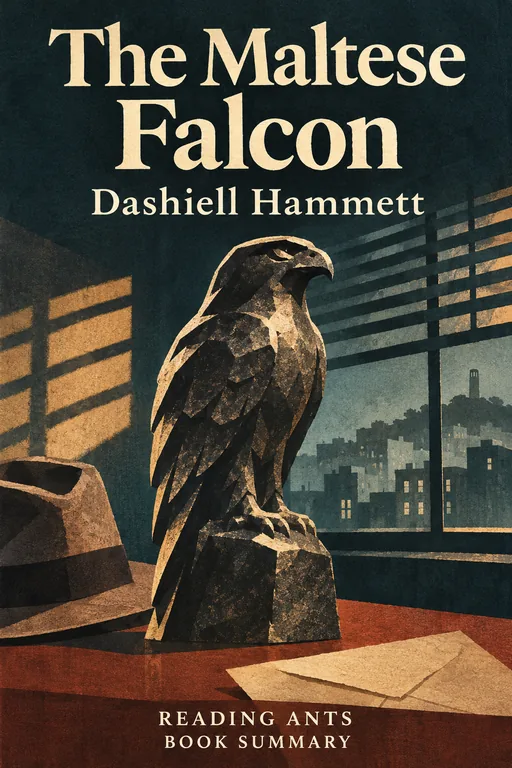
The Maltese Falcon
Dashiell Hammett
San Francisco private detective Sam Spade is drawn into the murder of his partner and the hunt by a gang of ruthless crooks for a priceless statue, the Maltese falcon, and must decide how far to trust the woman who hired him.
🔍 Mystery & Thriller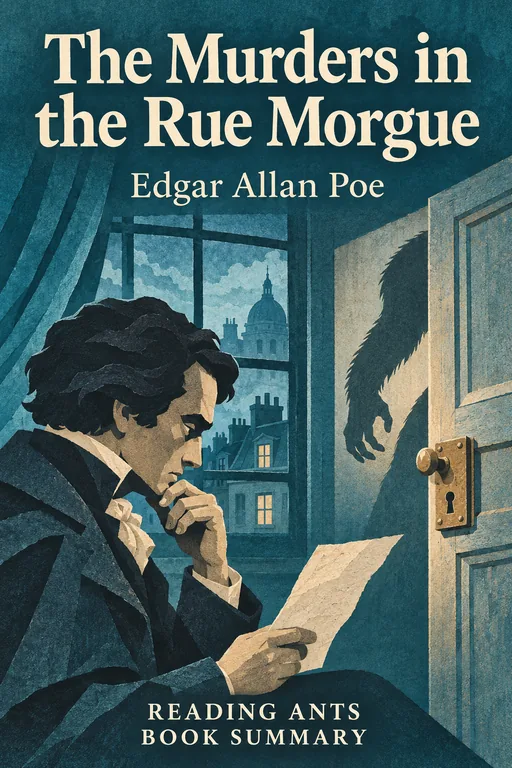
The Murders in the Rue Morgue
Edgar Allan Poe
In Paris, a brilliant amateur detective, C. Auguste Dupin, solves the baffling murder of a mother and daughter in a locked room by thinking carefully about what the evidence really shows, and reaches a startling conclusion.
🔍 Mystery & ThrillerWant something different?
Pick another topic and we will show you three books to start with.