 Reading Ants
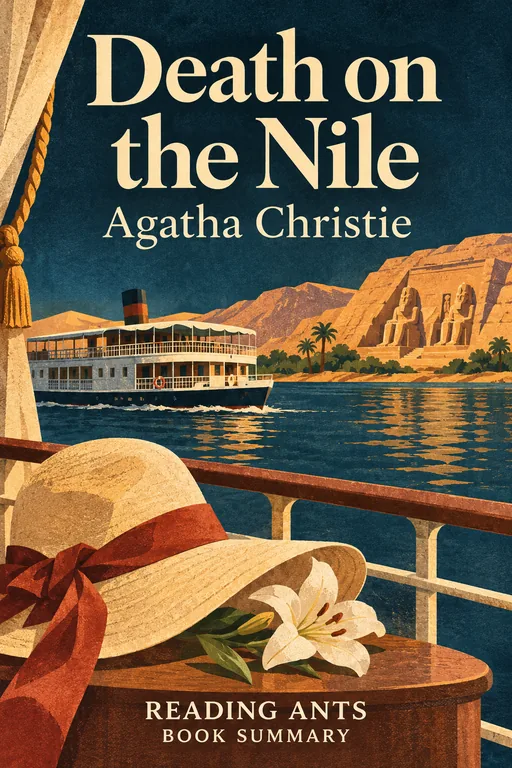
Death on the Nile
On a luxury steamer cruising the Nile, a rich young bride, Linnet Doyle, is shot dead in her cabin, and Hercule Poirot must discover which of the passengers, many of whom had reason to hate her, is the killer.
Overview
Death on the Nile is a detective novel by Agatha Christie, published in 1937, and featuring Hercule Poirot. It is set in Egypt in the 1930s, during a holiday cruise on the steamer SS Karnak, and takes place on the Nile and at temples such as Abu Simbel. The cast of suspects is gathered on the boat, and each has a secret. It is one of Christie’s best-loved novels, and was filmed in 1978, with Peter Ustinov, and in 2022, with Kenneth Branagh. The setting is as much a pleasure as the puzzle.
Main Characters
- Hercule Poirot: the Belgian detective, on holiday, who finds himself on the boat.
- Linnet Ridgeway (Doyle): a beautiful, rich, spoiled young heiress.
- Simon Doyle: her handsome new husband, who was previously engaged to her friend.
- Jacqueline de Bellefort: Simon’s former fiancée, who stalks the couple.
- Colonel Race: an intelligence officer who joins Poirot.
- Mrs. Allerton and Tim: a mother and her son, travelers.
- Salome Otterbourne and Rosalie: a romance novelist and her daughter.
- Dr. Bessner, Andrew Pennington and Mr. Fleetwood: other passengers and associates.
Full Summary
A Wedding and a Shadow
In England, Jacqueline de Bellefort asks her wealthy friend Linnet Ridgeway to give her fiancé, Simon Doyle, a job. Linnet does, and then, within weeks, she marries him herself. Jackie, humiliated, begins to follow the newlyweds on their honeymoon, appearing at hotels and on the Nile, to their increasing alarm. She tells Poirot that she loves Simon and that she is determined to haunt them.
The Cruise
Poirot, on holiday in Egypt, hears the story. The Doyles go on a Nile steamer, and Jackie, anticipating their move, has boarded the same boat ahead of them. Other passengers include Linnet’s trustee, her maid, an American woman who is suspicious of her, a doctor and a novelist who drinks. Linnet is unpopular, because she is so rich and proud. During a shore excursion, a boulder falls from a cliff, narrowly missing her.
Poirot watches the group as the boat moves past temples and villages, and notices the tensions: Linnet’s trustee seems nervous, the novelist drinks too much and her daughter is bitter, and a young man, Tim Allerton, hides something. The slow river journey gives the novel a calm, sunlit surface that makes the crimes seem more shocking.
The Murder
One night, after a quarrel in the lounge, in which Jackie shoots Simon in the leg, Linnet is found shot through the head in her cabin. Jackie seems to have an alibi, since she was kept under watch by a nurse in her own cabin. The pearls that Linnet wore are missing. Poirot and Colonel Race set about interviewing the passengers, each of whom had a motive.
The shot, the missing pearls and the odd details in the cabin make the case a puzzle. Poirot lists each passenger’s possible reasons, and each person’s whereabouts, and notices that one of the clues, a small bottle, has been moved. The inquiry is orderly and absorbing, and prepares the surprise of the end.
More Deaths
A second killing follows: the maid, who was about to tell Poirot what she had seen, is stabbed. Then Mrs. Otterbourne, the novelist, who had seen something, is shot before she can speak. Poirot realizes that the killer is ruthless and prepared. He sorts through the clues, such as the two nail polish bottles in Linnet’s cabin and the missing pistol, and begins to see how the crime was done.
Poirot’s Solution
Poirot gathers the passengers and presents his solution. The murderer is Simon Doyle, who, with Jackie, had planned the crime to get Linnet’s money. Jackie, who is still in love with him, was to be the obvious suspect, and also to have an alibi by being kept under watch, while Simon killed his wife and made a convincing show of being wounded himself.
Poirot explains how the shots were fired, why the timing mattered, and what each of the earlier incidents, including the falling boulder, meant. Among the key details are red ink that faked Simon’s leg wound and a velvet stole that muffled a shot, with the pistol thrown overboard. Separately, Tim Allerton’s theft of the pearls is a subplot. He presents the case, step by step, to a silent room.
The End
Faced with the evidence, Simon and Jackie are cornered, and as the steamer arrives back at Shellal and the passengers disembark, Jackie uses a second pistol to shoot Simon and then herself, in a final act that spares them a trial. Poirot, who had known that she had a second pistol and had earlier tried to dissuade her from turning to evil, chose to let her take her own life. The pearls turn out to have been taken by Tim Allerton, a professional thief, and the passengers disperse.
Why It Matters
Death on the Nile is one of the best-known Poirot novels, and has been adapted several times. It is a model of the “closed circle” mystery, in which a limited group of suspects is gathered in a confined setting, a form that Christie perfected. The Egyptian setting added glamour and was influenced by Christie’s own travels with her archaeologist husband.
The book is regularly ranked among her best, and is a favorite starting point for new readers of her work.
Christie visited Egypt herself, and the details of the boats, temples and local life give the book a feel of authenticity. The recent films have introduced it to a new audience, and its picture of a luxury cruise remains one of the most famous settings in detective fiction.
Key Takeaways
- Appearances are deceiving. The apparent culprit is a decoy.
- Passion can lead to crime. Jealousy and greed drive the plot.
- Careful attention solves mysteries. Poirot notices small inconsistencies.
- Wealth attracts envy. Linnet’s riches make her a target.
- A confined setting heightens tension. The boat limits escape.
What We Can Learn
The novel invites us to be careful about assumptions, and to examine the evidence before we decide who is guilty. It shows how an obvious suspect can distract us from the truth.
It also teaches that crimes of passion and of greed often grow from small resentments that are allowed to fester.
Finally, it suggests that observing details, like the way people behave, can reveal much.
It also shows that those who plot together can be undone by small slips, and that honest observation is a better guide than a good story.
Criticism and Counterpoints
Some modern readers find the book’s picture of Egypt and of local people patronizing, and its use of period language offensive in places. Others find that the many characters and red herrings make the plot hard to follow, and the solution depends on coincidences and an elaborate scheme that is unlikely in real life.
A few feel that the characters are types, and that Poirot’s manner is irritating. Some dislike the way the story treats the female characters. Still, it remains a favorite.
Who Should Read It
This book suits readers from about ten, though younger readers may find the plot complicated. It is an enjoyable puzzle with some violence. It is best for readers who like clever mysteries.
Want the whole book?
A summary is a taste, not the meal. Here is where to find the full book.
You reached the end 🎉
Nicely done. Mark this one as read, and we will suggest what to read next.
Read this next
Murder on the Orient Express
Agatha Christie
When a wealthy American is murdered on a snowbound train, the Belgian detective Hercule Poirot must work out which of the passengers is the killer, and discovers a shocking truth about many of them.
🔍 Mystery & Thriller
The Murder of Roger Ackroyd
Agatha Christie
In the English village of King's Abbot, a wealthy man is found stabbed in his study, and the Belgian detective Hercule Poirot, who has retired to grow vegetable marrows, is persuaded to investigate, with a surprise ending that changed detective fiction.
🔍 Mystery & Thriller
And Then There Were None
Agatha Christie
Ten people lured to an isolated island are accused of past crimes and killed one by one, following the lines of a nursery rhyme, until no one is left.
🔍 Mystery & Thriller
A Study in Scarlet
Arthur Conan Doyle
Dr. John Watson meets the eccentric consulting detective Sherlock Holmes and shares his rooms at 221B Baker Street, and together they investigate a mysterious murder in an empty London house, in the first Sherlock Holmes story.
🔍 Mystery & Thriller
The Murders in the Rue Morgue
Edgar Allan Poe
In Paris, a brilliant amateur detective, C. Auguste Dupin, solves the baffling murder of a mother and daughter in a locked room by thinking carefully about what the evidence really shows, and reaches a startling conclusion.
🔍 Mystery & Thriller
The Hound of the Baskervilles
Arthur Conan Doyle
Sherlock Holmes and Dr. Watson investigate a family curse involving a monstrous spectral dog on the dark, foggy moors of Devon, and discover that the legend is being used to cover a very human crime.
🔍 Mystery & ThrillerWant something different?
Pick another topic and we will show you three books to start with.