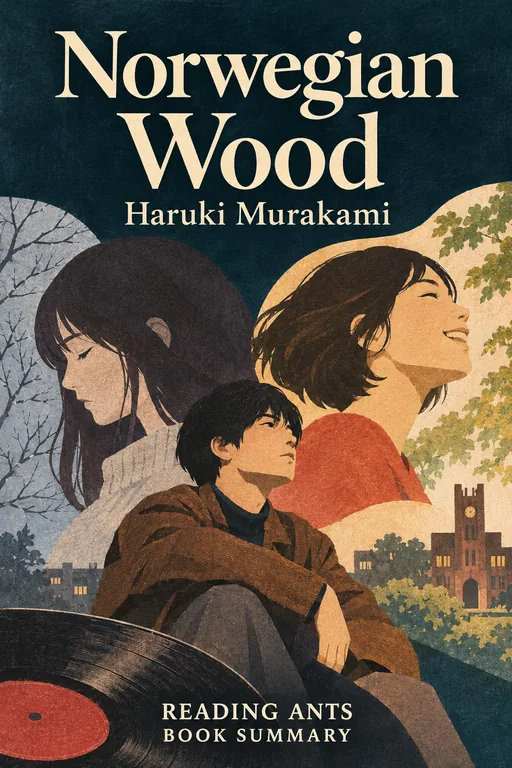
Norwegian Wood
Original title: ノルウェイの森
Remembering his student years, Toru Watanabe struggles between a grief-bound love for fragile Naoko and the imperfect possibility of life represented by energetic Midori.
Overview
Norwegian Wood is a coming-of-age novel set mainly in late-1960s Tokyo. Hearing the Beatles song “Norwegian Wood” causes the adult Toru Watanabe to remember Naoko, the girlfriend of his dead best friend Kizuki. Toru and Naoko grow close through grief, but her mental health deteriorates and she enters a secluded treatment community. Meanwhile, Toru meets Midori Kobayashi, whose directness and appetite for life challenge his emotional withdrawal. The novel treats love as real but insufficient to cure illness. Its repeated suicides and sexual encounters are not a simple contrast between romance and death; they show young people trying, sometimes harmfully, to reach one another while carrying pain they cannot explain.
Main Characters
- Toru Watanabe: a reserved university student and retrospective narrator shaped by Kizuki’s death.
- Naoko: Kizuki’s former girlfriend, whose bond with Toru combines affection, memory and severe psychological distress.
- Midori Kobayashi: Toru’s candid classmate, caring for a sick father while demanding honesty from life and love.
- Kizuki: Toru’s best friend and Naoko’s boyfriend, whose suicide structures the survivors’ relationships.
- Reiko Ishida: Naoko’s older companion at the sanatorium, a musician with her own history of breakdown.
- Nagasawa: Toru’s charismatic, emotionally detached dorm acquaintance.
- Hatsumi: Nagasawa’s devoted girlfriend, harmed by his refusal of commitment.
Full Summary
Kizuki’s Absence
At seventeen, Toru is close to Kizuki and Naoko, a couple whose bond seems complete. Kizuki dies by suicide without explanation. Toru leaves Kobe for university in Tokyo, but the death changes his understanding of life: death is no longer a distant opposite but something already contained within living.
Toru later meets Naoko by chance. They begin taking long Sunday walks through Tokyo, speaking little but sharing the loss neither can resolve. On Naoko’s twentieth birthday, she talks intensely and then sleeps with Toru. The encounter brings no stable new beginning. Soon afterward, she leaves university and enters treatment.
Letters and the Sanatorium
Naoko writes from Ami Hostel, a rural therapeutic community. Toru visits and meets Reiko, who explains the community’s routines and shares parts of her own painful history. Toru promises Naoko that he will wait, though neither knows what recovery or a future relationship would require.
Naoko describes difficulty joining physical desire, language and emotional safety. Toru cares for her, but his wish to rescue or wait for her cannot substitute for treatment. Reiko becomes a bridge between them, listening without claiming that love alone will make Naoko well.
Midori’s Demands
In college, Toru befriends Midori. She is playful, provocative and unusually direct, but her humor exists beside exhaustion. Her mother has died, and she helps care for her hospitalized father, who also dies. She wants attention that is active and specific rather than abstract sympathy.
Toru is drawn to her but remains committed in his mind to Naoko. His hesitation hurts Midori because he accepts closeness while withholding a clear choice. Student protests and strikes occur around them, but Toru sees much of the rhetoric as performance. His private grief isolates him from both political community and ordinary campus life.
Models of Detachment
Nagasawa admires Toru’s independence and takes him on nights of casual sex. He pursues a diplomatic career and refuses fidelity to Hatsumi, even though she loves him. Toru participates while recognizing emptiness in their behavior. His detachment protects him from vulnerability but also risks making other people instruments of his confusion.
Hatsumi’s warmth leaves a lasting impression. Years later, Toru learns that she died by suicide after marrying someone else. Her fate broadens the novel’s pattern beyond Naoko: charm and social success do not reveal what pain a person carries, and Nagasawa’s honesty about selfishness does not free him from responsibility for its effects.
Naoko’s Death
Naoko’s condition worsens despite periods of apparent calm. She eventually dies by suicide. Toru, unable to absorb the news, travels alone for weeks, sleeping outdoors and moving without direction. His journey does not purify grief; he remains disoriented and dependent on strangers’ small kindnesses.
Reiko writes and later visits Tokyo. She and Toru play the songs Naoko loved as a private funeral, remembering her through music rather than pretending to explain her death. They sleep together before Reiko leaves to begin a new life. The encounter combines mourning, affection and ambiguity rather than neatly resolving Toru’s loss.
Calling Midori
Toru recognizes that choosing life requires responding to Midori, whom he has neglected while grieving. He calls and tells her that he loves her and wants to begin again. Midori asks where he is. Looking around, Toru cannot identify his location and feels suspended among people moving through the city.
The novel ends uncertainly there. The call is an attempt to reconnect, not proof that Toru has healed or that Midori will accept him. His inability to say where he is captures both trauma and transition: he has turned toward another person but has not yet found stable ground from which to meet her.
Why It Matters
The novel brought Murakami a huge readership with a comparatively realistic story rather than the surrealism associated with much of his other fiction. Its music, clothing, food and urban spaces make memory concrete, while the adult framing shows how a song can reopen an entire emotional world.
More importantly, it refuses the idea that sincere love automatically rescues someone from mental illness. Toru’s grief is genuine, but he must learn that devotion to the dead can become withdrawal from the living. Midori is not simply a symbol of health; she has losses and needs of her own. Her insistence on reciprocity challenges Toru to move from passive sensitivity toward responsible action.
Key Takeaways
- Love is not treatment. Care can accompany someone in pain but cannot replace professional support or guarantee survival.
- Grief changes time. Toru’s memories keep the dead emotionally present while ordinary life continues around him.
- Detachment has consequences. Emotional distance may feel honest, yet it can still injure people seeking mutual commitment.
- The living deserve attention. Remembering those who died should not make current relationships permanently secondary.
- Choosing life is an ongoing act. Toru’s final call begins a possibility rather than completing recovery.
What We Can Learn
When supporting someone with serious mental illness, avoid promising that affection alone will fix the problem. Listen, encourage qualified help and respect the limits of what one relationship can carry. If there is immediate danger, seek emergency or crisis support rather than keeping it private.
Toru’s behavior also shows that quietness is not the same as kindness. Being thoughtful internally matters less if another person receives uncertainty and neglect. Clear communication can be painful, but indefinite ambiguity transfers the cost to others. In grief, routines, community and concrete care may help more than romanticizing isolation. Moving forward does not betray the dead; it acknowledges that memory and present responsibility can coexist.
Criticism and Counterpoints
The novel repeatedly links female characters with suicide, psychological crisis and sexual availability, while Toru’s perspective controls how readers understand them. Some sexual episodes are uncomfortable or ethically troubling, and women’s pain can appear to advance his development. Naoko’s treatment community is literary invention, not a reliable model of mental-health care.
The student movement remains mostly background and is filtered through Toru’s cynicism. Readers may also find the contrast between Naoko and Midori too schematic, despite the complexity each receives. The ending deliberately withholds reassurance.
Who Should Read It
This is suited to older teens and adults interested in memory, grief, complicated romance and quiet coming-of-age fiction. Readers affected by suicide or mental-health crises should consider the extensive content warnings. Anyone seeking a cheerful romance or a clinically accurate account of treatment may prefer another book.
Want the whole book?
A summary is a taste, not the meal. Here is where to find the full book.
You reached the end 🎉
Nicely done. Mark this one as read, and we will suggest what to read next.
Read this next

The Bell Jar
Sylvia Plath
A talented young woman named Esther Greenwood, who seems to be on the path to success in 1950s America, sinks into depression and a suicide attempt, and slowly begins to recover.
📜 ClassicsThe Catcher in the Rye
J. D. Salinger
After being expelled from his boarding school, a lonely, sarcastic sixteen-year-old wanders New York City for three days, struggling with grief, phoniness and the frightening idea of growing up.
📜 Classics
Normal People
Sally Rooney
Marianne and Connell, two teenagers from a small town in the west of Ireland, begin a secret relationship at school, and over the next four years, as they move to Trinity College in Dublin, they drift together and apart.
✨ Modern Fiction
The Great Gatsby
F. Scott Fitzgerald
A mysterious millionaire throws lavish parties on Long Island in the hope of winning back the woman he loved years ago, but his dream collides with the careless cruelty of the rich.
📜 Classics
The Little Prince
Antoine de Saint-Exupery
A pilot stranded in the desert meets a small boy from a tiny planet, who teaches him that the most important things in life, like love and friendship, can only be seen with the heart.
🌍 World Literature
Things Fall Apart
Chinua Achebe
Okonkwo, a proud and fearsome leader in an Igbo village in Nigeria, struggles against his own fears and against the arrival of British missionaries and colonial rulers, who change his world forever.
🌍 World LiteratureWant something different?
Pick another topic and we will show you three books to start with.