 Reading Ants
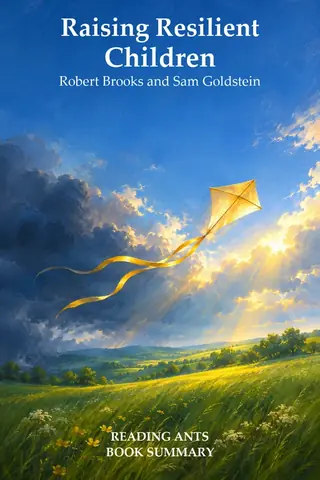
Raising Resilient Children
Two clinical psychologists argue that the most important gift a parent can give is a resilient mindset, built through empathy, strengths, mistakes treated as lessons, real responsibility and at least one adult who believes in the child.
Overview
Raising Resilient Children: Fostering Strength, Hope, and Optimism in Your Child was published in 2001 by Robert Brooks and Sam Goldstein, both clinical psychologists who have worked with children and families. Brooks is also known for his work at Harvard Medical School. They define a resilient child as an emotionally healthy one who can face challenges and recover from setbacks. Their book is a practical handbook for parents. It presents ten parenting “guideposts” for building the inner resources that help children cope, and it is full of everyday examples and suggestions. The authors take a hopeful view: children with difficulties are not doomed, and development goes on long after the early years.
Full Summary
1. The resilient mindset
The idea: The authors say that resilience is less a trait that children are born with than a mindset made of beliefs about oneself and others. Resilient children tend to feel hopeful and valued, set realistic goals, and focus on what they can control instead of what they cannot. They see mistakes as chances to learn, believe that they can solve problems, practice thinking before acting, feel they can contribute to others, and are comfortable asking for support. Mindset and behavior feed each other, so a hopeful child copes in constructive ways while a discouraged child often gives up, avoids or lashes out.
In real life: A girl fails her first swimming test. A resilient girl says she will practice the kicking part, a discouraged one says she is just bad at it. The words a parent uses afterward shape which story takes hold.
2. The charismatic adult
The idea: The authors take the term charismatic adult from the psychologist Julius Segal. It means an adult from whom a child gathers strength. Brooks argues that, across many studies of people who overcame hardship, the most common ingredient was at least one adult who believed in them. This adult accepts the child, focuses on strengths and helps the child through success and failure. Parents are the first candidates, but teachers, coaches and other caregivers can fill the role too, including for children with learning difficulties.
In real life: A boy who struggles with reading may remember the teacher who always asked him about his drawings. That small act of interest can last for years.
3. Empathy and active listening
The idea: Two guideposts concern communication: being empathic, and communicating and listening effectively. The authors stress that empathy does not mean agreeing with everything a child does. It means trying to appreciate and validate the child’s point of view. Brooks suggests that parents think about what words they hope their children would use to describe them, and check whether their everyday comments match. He also advises thinking about how questions are phrased, such as not leading with homework the moment a child walks in.
In real life: A teenager slams the door after a bad day. Instead of demanding an explanation, a parent says it looks like a rough one and offers to talk later.
4. Changing negative scripts
The idea: Parents often fall into repeated reactions, the authors call them negative scripts, that rarely help: the same lecture, the same warning, the same tone. The book encourages parents to notice what they hear themselves saying and edit it. The hope is that when the adult changes the script, the child has room to respond differently.
In real life: A father who always says that his daughter is lazy might try asking what makes the first ten minutes of homework so hard. The conversation changes, and so does the mood.
5. Islands of competence
The idea: Every child has areas of strength, which Brooks calls islands of competence. Adults tend to focus on deficits and how to fix them, especially for children with learning problems, but the authors advise building on strengths. The hope is that success in a strong area gives a child confidence to face a weaker one. The book encourages parents to begin conversations with what is going well before turning to problems, and to help children see themselves as more than their difficulties.
In real life: A boy who struggles in math but loves caring for animals might be asked to plan the feeding schedule at a shelter. The experience of success carries over into schoolwork.
6. Mistakes as lessons
The idea: A whole chapter in the book treats mistakes as valuable learning experiences. The authors argue that children who fear mistakes avoid challenges, while those who see mistakes as part of learning keep trying. Treating mistakes as lessons goes together with teaching problem-solving and decision-making. Brooks advises that parents resist the urge to rush in and fix every problem or do tasks for children.
In real life: After a poor test result, a parent might ask what the child learned about how to study, and plan one change together, instead of reacting with disappointment.
7. Responsibility and contributing to others
The idea: Resilient children feel that they matter. The authors say that giving children real responsibilities, and chances to help others, builds a sense of purpose and dignity. According to a summary of the book, when children were asked what made them feel competent, a common answer was being asked to help others in some way. Brooks has also written that adults often recall positive school memories of being given helpful jobs.
In real life: A shy ten-year-old who is asked to show a new classmate around feels proud and useful, and the new student gains a friend.
8. Discipline that builds self-discipline
The idea: The final guidepost described in the sources is to discipline in a way that promotes self-discipline and self-worth. The aim is not only to make a child behave today but to help the child grow into someone who can manage their own behavior and who still feels valued. Families with warmth, emotional support and reasonable structure and limits help the mindset to take root. The closing chapter extends this work to schools, where parents and teachers can reinforce resilience together.
In real life: A parent who sets a clear rule about screens, explains it once, and applies the agreed consequence calmly, teaches more than one who shouts and then gives in.
Why It Matters
Raising Resilient Children presents the idea of resilience, long studied by researchers, in a practical form for parents and teachers. Its focus on strengths rather than deficits suits children who learn differently, and its emphasis on the charismatic adult gave parents and teachers a concrete role. Publishers Weekly praised the many real-life examples and down-to-earth strategies, and another reviewer called its tools thoughtful. Its central message is that children cope better when someone believes in them and they are trusted with responsibility. It also reminds adults that their own words and habits are part of the environment children grow in.
Key Takeaways
- Resilience is a mindset. Hope, a sense of control and the ability to learn from mistakes can be taught and practiced.
- One adult can change a life. A child needs at least one person who believes in them, and many adults can play that part.
- Build on strengths. Islands of competence give children the confidence to face their weak areas.
- Edit your scripts. Notice the repeated phrases that do not work and change them.
- Give real responsibility. Helping others and contributing give children purpose and dignity.
What We Can Learn
Begin by listening. Next time your child comes home upset, say what you notice before offering a fix. Pick out one strength your child has, and look for a way to use it this week, perhaps by giving a job at home or in the community. Catch one negative script, such as a standard warning, and try a different sentence. When your child makes a mistake, ask what could be done differently, and share one of your own mistakes. You do not need to be perfect: warm, present and consistent is enough. If you are a teacher, coach or relative, you can be the adult who believes in a child. Small acts of attention, repeated over time, matter more than grand gestures.
Criticism and Counterpoints
Reviewers have noted that the ideas, though helpful, are not entirely new, and that the book is not a quick-fix manual. Publishers Weekly found the joint voice of two authors writing as “we” somewhat flat. Like many parenting guides of its time, it relies on clinical experience, examples and the authors’ framework more than on testing its own advice, and the idea of resilience can be misused to suggest that children should simply cope with hard circumstances. Families facing poverty, trauma, serious illness or a child’s mental health crisis often need professional and community support, not only better parenting habits.
Who Should Read It
This book is for parents, teachers, coaches and counselors who want a hopeful, practical approach. It is especially useful for those raising children who struggle with school, confidence or learning differences. It is clearly organized, but people who prefer short, step-by-step advice or research-heavy reading may find it a little general.
Want the whole book?
A summary is a taste, not the meal. Here is where to find the full book.
You reached the end 🎉
Nicely done. Mark this one as read, and we will suggest what to read next.
Read this next
How to Raise an Adult
Julie Lythcott-Haims
A former dean at Stanford University argues that modern parents who do too much for their children, from homework to college applications, are leaving them anxious and unprepared, and she urges them to step back and let young people learn to stand on their own.
🎓 Parenting & Education
The Self-Driven Child
William Stixrud and Ned Johnson
A neuropsychologist and a test-prep tutor argue that children become calmer and more motivated when parents give them a real sense of control over their own lives, while staying close as a steady, supportive consultant.
🎓 Parenting & Education
Mindset: The New Psychology of Success
Carol S. Dweck
Psychologist Carol Dweck shows that people who believe abilities can grow, a growth mindset, learn, cope with failure and achieve more than people who believe their talents are fixed.
🌱 Self-Improvement
The Whole-Brain Child
Daniel J. Siegel and Tina Payne Bryson
Understanding how a child's brain develops helps parents respond to tantrums, fears and conflicts in ways that connect, calm and teach, so that different parts of the brain work together.
🎓 Parenting & Education
How Children Succeed
Paul Tough
Journalist Paul Tough argues that qualities like perseverance, curiosity and self-control matter more for children's success than test scores alone, and that these qualities can be nurtured, especially for children who face hardship.
🎓 Parenting & Education
How to Talk So Kids Will Listen and Listen So Kids Will Talk
Adele Faber and Elaine Mazlish
Parents can get better cooperation and closer relationships by acknowledging children's feelings, describing problems instead of blaming, and using simple, respectful communication skills.
🎓 Parenting & EducationWant something different?
Pick another topic and we will show you three books to start with.