 Reading Ants
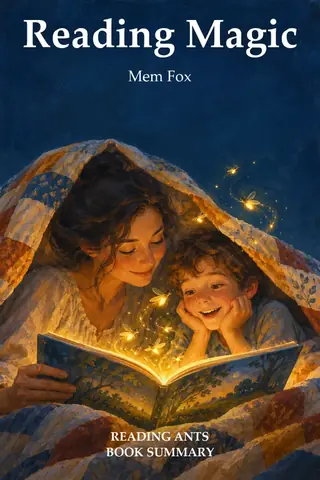
An Australian children's author and literacy teacher argues that reading aloud to children every day, warmly and from the earliest age, gives them the print, language and general knowledge they need to learn to read, and she shows parents how to do it.
Overview
Reading Magic was written by Mem Fox, the Australian author of picture books such as Time for Bed and Where Is the Green Sheep? and a former professor of literacy studies at Flinders University, with illustrations by Judy Horacek. It first appeared in 2001. The edition read here is the updated and revised one, subtitled Why Reading Aloud to Our Children Will Change Their Lives Forever, with a new foreword and chapters on phonics and on boys. The book has seventeen short chapters, a list of twenty books children love, and many stories, some about her own daughter, Chloé. It is dedicated to Jim Trelease, the author of The Read-Aloud Handbook. Its tone is cheerful and its message is simple: read aloud, daily, with love.
Full Summary
1. The Foot Book miracle and the magic in action
The idea: In 1975 Fox’s four-year-old daughter Chloé came home from school announcing that she could read, and Fox recalls that she could. Fox says that she and her husband had read to Chloé often, though she did not begin until Chloé was about ten months old. Fox says this led her to study how children learn. Reading aloud is more than a pleasant activity: Fox sees it as a way to build the language and interest in books that help children learn to read. She tells how, during a television filming, a three-year-old who had never been taught filled in the words of a story, and how a game with a boy made him “win” and want to go on. In the revised foreword she notes that interest in reading aloud has exploded since 2001.
In real life: A three-year-old on camera reads out “It’s time for bed,” and the cameraman gasps.
2. Birth, brains and the power
The idea: Reading problems, Fox says, are hard to fix but easy to prevent, and prevention starts long before school, since the first day of school is almost too late. She draws on brain research showing that the early years shape how well a child hears the sounds, tunes and rhythms of language. Experts say children need to hear around a thousand stories before they learn to read for themselves, which sounds daunting until you do the sums. A school head reads to her whole school every Friday, and Fox shows that even adult students sit spellbound. When a teacher asks a boy who has done wrong what punishment would be fair, he suggests that she stop reading aloud to him.
In real life: A boy who is asked what a fair punishment would be answers that his teacher could stop reading aloud to him.
3. Keep it regular, and do it like this
The idea: The best time to start is the day a baby is born, says Fox. She recommends at least three stories a day, one favorite, one familiar and one new, which adds up to a thousand in a year, though the same book three times is fine. She urges parents to read the same book again and again, and to keep books at hand for times when children must be well behaved, such as in church or at a restaurant. On technique, she suggests using the voice as an actor would, with different voices for characters and with special care over the first line, which should welcome the child to the ritual. She also advises dragging out the last line slowly.
In real life: A student who has an unplanned baby reads her course books aloud, and the baby is lulled by the sound.
4. Getting the most out of it, and the proof
The idea: Reading a book to a child is already enough, but Fox suggests extras. Parents can play word and letter games, such as the games she builds around her book Tough Boris, swapping a letter to turn one word into another, using fridge magnets and keeping scrap paper around so children can write. She argues for a stories-to-words-to-letters order, uses the names of letters rather than their sounds when playing, since a letter has many sounds but its name never changes, and says never to let tension spoil the fun. In “The Proof” she gives an example from a parent who wrote to her website about a toddler who knew his books almost by heart and spoke well by twenty-one months.
In real life: A parent lets the child fill in a missing word on her own, and hugs her for trying.
5. The first and second secrets: print and language
The idea: Fox says reading is making sense of print, not just saying the words aloud. She names three “secrets”: the magic of print, of language and of general knowledge. Print is learned by seeing a lot of it, and children can recognize whole words, like a two-year-old who read a long word on the back of a bus. Language is learned from songs, rhyme and repetition: children who can hear that two words rhyme find reading easier. She laments dull school readers whose stories lack interest, and shows how knowing English helps a reader guess a missing word in a sentence.
In real life: Fox suggests saying rhymes such as “Mary Had a Little Lamb” and “Jack and Jill” with a six-year-old and finds that the girl knows none of them.
6. The third secret and putting them together
The idea: The third secret is general knowledge, all the things a child has learned about the world since birth. A reader who knows what a coal chute is finds a sentence about one easy, while a child who has never seen one does not. Fox describes reading as a grand guessing game in which print, language and world knowledge work together, and one of them can rescue the others. She shows how reading lists of random words is harder than reading in sentences, and says that hearing a story several times helps a child grasp the plot and the names.
In real life: A reader misses the typo in a caption about “the collected woks of Shakespeare” because she expects the sentence to say works.
7. Books, television and troubleshooting
The idea: A father asks why he would buy books for a daughter who cannot read, which leads Fox into advice on choosing books. A beloved book read to tatters can make a reader, so children should own favorite books. Look for rhythm, rhyme, repetition and strong language, and read a book aloud before judging it, accept that any book a child loves is a good one, and include fairy tales in their original, unsanitized form, read or told so that the child feels safe. Television, she says, is not bad in itself, but what matters is the pleasure and learning children get. When school troubles arrive, she suggests continuing to read aloud for years, praising effort instead of pouncing on mistakes and playing writing games.
In real life: A young father out shopping with a librarian asks why he should buy books for a daughter who is about to turn five and cannot yet read, and Fox uses the question to argue that books belong in the house.
8. Phonics and boys
The idea: A chapter on phonics explains the terms in plain language and contrasts whole word and whole language approaches. She calls phonics useful but not essential, says that phonics-first or phonics-only teaching does harm and that advanced readers do not rely on it, since English spelling is full of oddities like bough, cough and through. She uses a car metaphor: only a few adults understand the engine. The last chapter says boys love reading aloud as much as girls, if we start young, and that fathers matter a great deal. A list of twenty books closes the volume.
In real life: A father who finally reads the book starts reading aloud every night, and his son’s reading takes off.
Why It Matters
Reading Magic is one of the best-known books on reading aloud, especially in Australia and the English-speaking world. Fox is a famous picture book author, and her authority comes from both her teaching and her writing for children. The book turned a simple message into friendly, practical advice: reading aloud is easy, cheap and powerful.
It reached parents who might never read an academic study, and its cheerful style and lack of jargon made it a popular gift for new parents. It sits alongside Jim Trelease’s The Read-Aloud Handbook in a tradition that says reading aloud is the best start for a lifelong reader.
Key Takeaways
- Read aloud every day. A short daily habit, kept up for years, matters more than occasional long sessions.
- Aim for many stories. Three a day, including a favorite, a familiar book and a new one, adds up quickly.
- Read with feeling. Voice, face and body make stories alive, and shared joy is the point.
- Three secrets work together. Children need print, language and general knowledge, and all three come naturally from stories, talk and outings.
- Keep it a pleasure. Love and fun matter more than lessons or tests.
What We Can Learn
Start small and keep going. Find ten minutes in the day, such as before bed, and read aloud to a child, a younger brother or sister, or a grandparent who enjoys it. Choose books with good stories and fun language, reread the favorites and do not worry if the child asks for the same book again.
Talk about the pictures and the plot, sing songs and say rhymes, and take children to new places so that they know more of the world. Do not turn reading into a test. If you are an older student, reading aloud to a younger child is a lovely gift to give. If you are a teacher, the same ideas work in a classroom: choose a story, read it with feeling and leave time to talk.
Criticism and Counterpoints
Some readers find the book more cheerful than rigorous. A reviewer from a library blog wished it gave studies and references for readers who wanted to go deeper, because Fox relies mostly on personal stories. Library Journal called it a cheerleading book about reading aloud and thought it a marginal purchase for public libraries.
Another reader felt that it put too much weight on the earliest years, as if the chance to teach a child to read were mostly decided by then. Parents without time, or without books, may find the advice hard to follow, and the evidence on beginning reading gives explicit instruction in letter-sound relationships and decoding a larger role than Fox does. Reading aloud builds vocabulary, background knowledge and comprehension alongside that instruction.
Who Should Read It
This book is for parents of babies, toddlers and young children, for grandparents, for teachers and for older children who want to read to younger ones. It is short, funny and easy to read. If you want a scholarly treatment of how children learn to read, with research evidence, you will need to add another book, but for encouragement and practical ideas, it is a good place to start.
Want the whole book?
A summary is a taste, not the meal. Here is where to find the full book.
You reached the end 🎉
Nicely done. Mark this one as read, and we will suggest what to read next.
Read this next
The Read-Aloud Handbook
Jim Trelease
Jim Trelease argues that reading aloud to children, every day and from the earliest age, is the best way to build their vocabulary, imagination and love of books, and he shows parents and teachers how to do it.
🎓 Parenting & Education
Why Don't Students Like School?
Daniel T. Willingham
Cognitive scientist Daniel Willingham uses research on how the mind works to explain why thinking is hard, why knowledge matters and how teachers and students can make learning more effective and enjoyable.
🎓 Parenting & Education
How Children Learn
John Holt
Teacher John Holt watches young children closely and concludes that they learn best through their own curiosity, play and mistakes, and that adult pressure, fear and unrequested teaching often get in the way.
🎓 Parenting & Education
The Absorbent Mind
Maria Montessori
Maria Montessori, a doctor and educator, explains that young children take in the world around them effortlessly, like a sponge, and that adults should prepare an environment in which they can learn freely through activity and concentration.
🎓 Parenting & Education
Creative Schools
Ken Robinson and Lou Aronica
Ken Robinson and Lou Aronica argue that schools are held back by a factory-style model of standardized testing, and call for an approach built on personalization, creativity and the real interests of students and teachers.
🎓 Parenting & Education
How to Talk So Kids Will Listen and Listen So Kids Will Talk
Adele Faber and Elaine Mazlish
Parents can get better cooperation and closer relationships by acknowledging children's feelings, describing problems instead of blaming, and using simple, respectful communication skills.
🎓 Parenting & EducationWant something different?
Pick another topic and we will show you three books to start with.