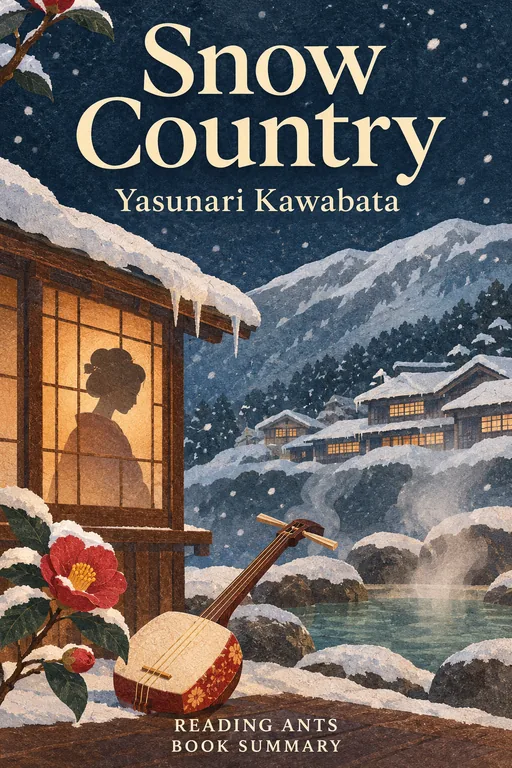
Snow Country
Original title: 雪国
A wealthy Tokyo idler repeatedly visits a remote hot spring town in the snowy mountains, where a geisha gives her heart to him, though he is unable to love in return.
Overview
Snow Country is a short novel by the Japanese writer Yasunari Kawabata, published in installments from 1935 and in a complete version in 1948. It is set in a hot spring resort in the mountains of Japan, in a region with very heavy snow, in the 1930s. The story is slow, delicate and full of images of nature, and it focuses on the feelings of three people, Shimamura, Komako and Yoko. It is regarded as one of the masterpieces of modern Japanese writing, and helped Kawabata to win the Nobel Prize in Literature in 1968, the first Japanese writer to do so.
Main Characters
- Shimamura: a wealthy man from Tokyo, who writes about Western ballet without ever seeing it, and who is cold and detached.
- Komako: a young geisha in the hot spring town, passionate, proud and lonely.
- Yoko: a young woman with a beautiful voice, who cares for a sick man.
- Yukio: the sick young man, who is dying, and who is connected to both women.
Full Summary
The Train
The novel opens with the famous image of a train coming out of a long tunnel into a snow-covered land. Shimamura is traveling to the hot spring town, and, on the train, he notices a young woman, Yoko, who is looking after a sick man. Her face is reflected in the dark window, and the night scenery shows through her, in a way that fascinates him.
He is on his way to see the town again, and to see a woman he met the previous summer.
Komako
Komako, the geisha, is young and honest, and she stands out from the others in the town. When Shimamura first met her, she was not yet a full geisha. Now she has become one. Shimamura hears a story that she did so to earn money for the care of her music teacher’s son, Yukio, who is dying, though Komako herself disputes it.
She welcomes Shimamura with joy, and reproaches him for not writing. She plays the shamisen for him, and she tells him of her lonely life. She wants to love him, and he is touched, but he knows that he cannot give her what she wants.
The Relationship
Shimamura is married, and has a family in Tokyo. His visits to the mountains are an escape from his empty life. He describes Komako’s efforts to love him as a “waste,” a kind of beautiful, hopeless effort. He sees her as an illusion in the snow.
Komako, who is drunk some nights, comes to his room and cries. She says that he is cruel, and he does not answer. Their relationship is deep and sad, since each one knows that it cannot last.
Yoko
Yoko, who has been caring for Yukio, is a strange presence in the town. Her voice is clear and beautiful, and Shimamura finds himself drawn to her. Komako is jealous, and she tells him that Yoko is a fragile, obsessive girl, who will go mad.
Yukio dies, and Komako does not go to his bedside, as she is with Shimamura. She is troubled by guilt, and by the sense that she is wasting her life.
Winter in the Town
As the season turns, the snow deepens, and the town grows quiet. Shimamura spends long afternoons in his room at the inn, looking at the white mountains and at the frozen rooftops. He visits the weaving workshops, where women make fine cloth by hand, and he learns that the cloth is bleached in the snow. He is struck by the patience of this work, and he thinks of it as a kind of beauty that is vanishing.
Komako practices her music every day, and she keeps a diary in which she writes about every novel she reads. She says that all of it is a waste, but she cannot stop. Shimamura listens, and he is moved, though he does not know what to say.
The Fire
Shimamura, who plans to leave, runs with Komako to a cocoon warehouse that has been used as a cinema, and that is already on fire. The crowd rushes out, and Komako and Shimamura see Yoko fall from a balcony. Komako takes up Yoko’s body and carries her. Shimamura, who is watching, feels a sense of dizziness, as if the Milky Way is pouring down upon him.
The book ends there, without saying whether Yoko lives or dies. The reader is left with the sense that something is ending, and that Shimamura will leave.
Why It Matters
Snow Country is one of the books that made modern Japanese literature known to the world. The Nobel committee praised Kawabata’s mastery of narrative and the sensitivity with which his work expresses the essence of the Japanese mind. The novel’s style, with its silence, delicate images, and focus on mood, has influenced many writers. The opening line about the train and the snow is one of the most quoted in Japanese literature. It has been made into several films and has been translated into many languages. Kawabata worked on the book on and off for more than ten years, revising it again and again, and it shows how a very short book can take as long to write as a very long one. For many readers abroad, it is the first example of Japanese literature in which the silence and the open ending are the point.
Key Takeaways
- Beauty is fleeting. The book dwells on the transience of things.
- Love can be one-sided. Komako gives, and Shimamura withholds.
- Detachment can be a kind of emptiness. Shimamura cannot feel deeply.
- Nature mirrors feeling. The snow, the mountains and the river reflect the characters’ moods.
- Silence says much. What is not said is as important as what is.
What We Can Learn
The book invites us to notice the quiet beauty of small things, such as snow, light and sound. It also shows the sadness of detachment: Shimamura holds back from commitment, and in doing so, wastes the chance of real connection.
We can also learn to think about how our actions affect others who may care for us more than we care for them. Finally, the book encourages patience and attention, qualities that are valuable in reading and in life. It is a reminder that you do not need a dramatic event to have a deep experience, and that a train ride, a snowfall or a quiet conversation can hold as much meaning as a big adventure.
Criticism and Counterpoints
Some readers find the novel too slow and vague, with little plot and an unclear ending. The portrayal of Komako, a geisha who is dependent on a wealthy visitor, can be seen as passive, and the book mainly takes the man’s viewpoint. Others note that the translation of the Japanese style into English can lose its subtlety. Some find Shimamura’s cold attitude unsympathetic, and ask why a book that takes such care over the feelings of a man who gives so little should be so admired. Defenders answer that the book is not asking us to approve of him, but to see how a person can wall himself off from love.
Who Should Read It
This book is for mature readers who like short, quiet and poetic novels. It is more like a series of impressions than a conventional story. Those who prefer plot-driven books may be bored, while readers who love atmosphere will appreciate it.
Want the whole book?
A summary is a taste, not the meal. Here is where to find the full book.
You reached the end 🎉
Nicely done. Mark this one as read, and we will suggest what to read next.
Read this next
Kokoro
Natsume Soseki
A young student befriends a quiet, haunted older man known as "Sensei," and learns, from a long letter, the secret of guilt and betrayal that has shadowed his life.
🌍 World Literature
No Longer Human
Osamu Dazai
A man who feels like an alien among other people hides behind a mask of clowning, and sinks, through drink, drugs and failed relationships, into despair.
🌍 World Literature
Norwegian Wood
Haruki Murakami
Remembering his student years, Toru Watanabe struggles between a grief-bound love for fragile Naoko and the imperfect possibility of life represented by energetic Midori.
🌍 World Literature
The Tale of Genji
Murasaki Shikibu
A gifted prince's loves, losses and descendants reveal the beauty and cruelty of court life, where every relationship is shaped by rank, time and impermanence.
🌍 World Literature
The Remains of the Day
Kazuo Ishiguro
An elderly English butler on a road trip across the countryside looks back on his life of strict duty and gradually realizes how much he gave up, including love, in service of a master who may not have deserved his loyalty.
✨ Modern Fiction
The Little Prince
Antoine de Saint-Exupery
A pilot stranded in the desert meets a small boy from a tiny planet, who teaches him that the most important things in life, like love and friendship, can only be seen with the heart.
🌍 World LiteratureWant something different?
Pick another topic and we will show you three books to start with.