 Reading Ants
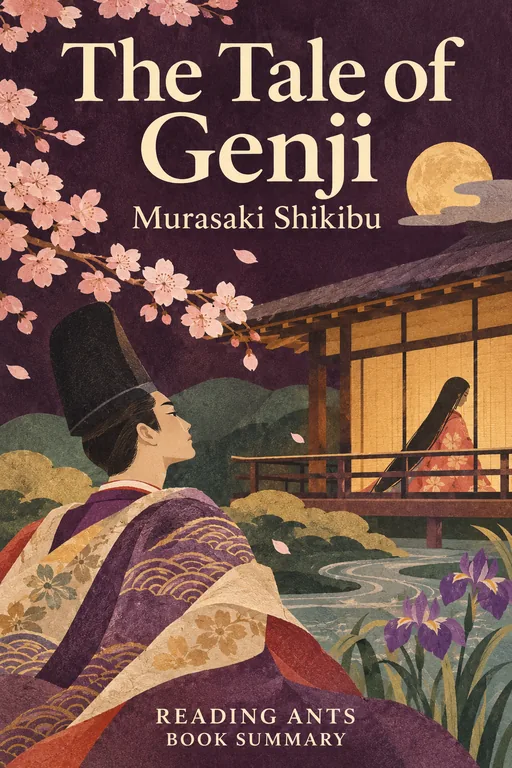
The Tale of Genji
Original title: 源氏物語
A gifted prince's loves, losses and descendants reveal the beauty and cruelty of court life, where every relationship is shaped by rank, time and impermanence.
Overview
Written in Japan’s Heian period, The Tale of Genji follows the courtly life of Hikaru Genji and, after his death, a younger generation. Genji is handsome, accomplished and emotionally perceptive, but his pursuit of women often relies on immense privilege and coercion. Poetry, music, clothing and seasonal detail carry meanings that direct speech cannot. The narrative does not build toward one simple quest; it traces relationships changing over decades as beauty fades, political fortunes shift and people grieve. Names vary across translations because many characters are identified by titles or residences rather than personal names. The final Uji chapters move away from Genji to Kaoru, Niou and Ukifune, giving the unfinished-seeming ending a darker, more uncertain emotional world.
Main Characters
- Hikaru Genji: an emperor’s gifted son reduced to commoner status for political reasons.
- Lady Fujitsubo: Genji’s father’s consort, who resembles Genji’s dead mother and becomes his forbidden love.
- Murasaki: a girl Genji raises and later makes his most important partner.
- Aoi: Genji’s high-ranking first wife, separated from him by pride and distance.
- The Rokujo Lady: an older, dignified lover whose jealousy gains a frightening supernatural expression.
- The Akashi Lady: a woman whose daughter eventually strengthens Genji’s family position.
- Kaoru: a thoughtful young man of the later chapters, publicly treated as Genji’s son.
- Niou: an imperial prince and Kaoru’s charming, competitive friend.
- Ukifune: a vulnerable young woman caught between Kaoru and Niou.
Full Summary
The Shining Prince
Genji is born to an emperor and a beloved consort without strong family protection. After his mother dies, political danger leads the emperor to remove Genji from imperial succession. He becomes a commoner while remaining close to court and gains fame for beauty, poetry and music.
The emperor later marries Fujitsubo, who resembles Genji’s mother. Genji develops a forbidden attachment to her, and their secret relationship produces a son believed to be the emperor’s. This hidden parentage gives Genji both joy and guilt. His public marriage to Aoi is cold, and he seeks intimacy through many other relationships.
Murasaki and the Women
Genji encounters young Murasaki, Fujitsubo’s niece, and takes her into his household so he can shape her education. She grows into his closest companion. Their bond contains genuine affection, but its beginning and Genji’s control over her life make the relationship deeply unequal.
Other pursuits have varied consequences. Some women welcome Genji, while others have little power to refuse or protect their privacy. His involvement with the Rokujo Lady causes pain when his attention shifts. During Aoi’s pregnancy, a spirit associated with Rokujo’s jealousy attacks her; Aoi dies after giving birth, leaving Genji with a son and belated grief.
Exile and Return
Genji’s affair with a politically protected woman helps his enemies force him from the capital. He goes into exile at Suma, where isolation, storms and memory humble the celebrated courtier. At nearby Akashi he forms a relationship with the Akashi Lady. Their daughter will later be raised partly by Murasaki and enter imperial life.
Political circumstances change, and Genji returns in triumph. His secret son has become emperor and eventually learns the truth of his parentage. Although the revelation increases Genji’s influence, it also repeats the burden of concealed relationships. Genji rises to extraordinary rank and builds an estate where women connected to him live in separate quarters, an arrangement displaying care, ambition, wealth and control at once.
Splendor and Impermanence
At the height of his power, Genji organizes ceremonies, artistic gatherings and relationships across his estate. His daughter by the Akashi Lady becomes an imperial consort, fulfilling ambitions that once seemed impossible. Yet success cannot make his household emotionally secure. The women depend on his choices, and Murasaki increasingly recognizes the limits of her position.
Genji later marries the Third Princess for political reasons, wounding Murasaki. Another man, Kashiwagi, secretly approaches the princess, and she bears Kaoru, whom Genji publicly accepts. The situation repeats Genji’s own youthful secret with Fujitsubo, forcing him to experience the uncertainty he once caused others.
Murasaki’s Death
Murasaki wishes to become a nun, but Genji resists losing her companionship. Her health declines, and she eventually dies. Genji’s grief overwhelms the pleasures and achievements that structured his life. The narrative then passes over his own death rather than turning it into a grand final scene.
This gap suits the novel’s vision of impermanence. The shining prince who occupied every social space simply becomes absent. His descendants inherit titles, secrets and patterns of desire, but not his exact world. The story continues because no individual, however celebrated, is its permanent center.
Kaoru, Niou and the Uji Sisters
The later chapters focus on Kaoru and Prince Niou. Kaoru is serious and troubled by uncertainty about his parentage; Niou is more openly charming and impulsive. Both become involved with sisters living in reduced circumstances at Uji. Courtship again combines poetry and tenderness with unequal power.
After losses among the sisters, Kaoru turns his attention to Ukifune, while Niou also pursues her. She is divided between them and unable to control the situation safely. Their rivalry treats her partly as the object through which each man understands himself.
Ukifune Disappears
Overwhelmed, Ukifune disappears and is believed to have drowned herself. She survives, is cared for by religious women and seeks refuge in becoming a nun. Kaoru eventually hears that she may be alive and sends a message through her brother.
Ukifune refuses or fails to answer, and the novel ends without reunion or firm explanation. Kaoru wonders whether someone else is hiding her, still interpreting her absence through male rivalry. Her silence may be the only control she can claim. The unresolved ending leaves desire, withdrawal and spiritual escape in tension rather than granting the courtly world a comforting conclusion.
Why It Matters
Often described as an early great novel, The Tale of Genji gives extraordinary depth to consciousness, memory and changing relationships. Its emotional action frequently occurs through a poem, a scent, the color of a robe or the timing of a reply. This indirectness reveals a society where expression is highly refined and tightly constrained.
The book is also an invaluable literary vision of Heian court culture, especially women’s writing and experience, though it is fiction rather than a complete social history. Its beauty does not erase its critique. Genji’s sensitivity coexists with entitlement, and women bear many consequences of his freedom. The later chapters deepen that unease by making the romantic pattern feel exhausted and spiritually dangerous.
Key Takeaways
- Beauty is inseparable from change. Seasons, relationships and political fortunes matter because none can be held permanently.
- Sensitivity does not guarantee ethical behavior. Genji understands feelings yet often uses privilege to override others’ choices.
- Indirect communication carries power. Poems and silences can express what rank and convention forbid people to say openly.
- The next generation inherits unfinished patterns. Kaoru and Niou repeat forms of pursuit without simply becoming Genji.
- Withdrawal may be resistance. Ukifune’s silence challenges a world that keeps defining her through men’s desires.
What We Can Learn
Emotional intelligence should be judged by conduct, not elegance. Recognizing another person’s sadness is not enough if we continue benefiting from the conditions that cause it. The novel asks readers to notice power differences inside relationships that may look beautiful from outside.
It also rewards careful attention. Tone, timing and what remains unanswered can matter as much as explicit statements. Yet modern readers should not romanticize indirectness when direct consent and communication are possible. Finally, grief in the novel suggests that trying to possess people cannot prevent loss. Respecting another person’s independence is a better response to impermanence than tightening control.
Criticism and Counterpoints
The enormous cast, shifting titles and long sequence of relationships can be difficult to follow, and translation choices significantly shape characterization. The narrative’s refined tone may make coercion and age inequalities seem gentler than they are. Genji’s relationship with Murasaki begins when she is a child under his control, which requires direct ethical scrutiny.
The novel concentrates on a tiny court elite; most labor and poverty remain outside its focus. Calling it the world’s “first novel” can also oversimplify the many ancient traditions of long prose fiction.
Who Should Read It
This is for patient readers drawn to psychological fiction, court culture, poetry and subtle accounts of time. A translation with character lists is helpful. Mature teens and adults should be prepared for coercive and age-unequal relationships, grief and a slow, episodic structure rather than a conventional plot.
Want the whole book?
A summary is a taste, not the meal. Here is where to find the full book.
You reached the end 🎉
Nicely done. Mark this one as read, and we will suggest what to read next.
Read this next
Dream of the Red Chamber
Cao Xueqin
The rise and decline of an aristocratic household unfolds through a sensitive boy's bonds with two remarkable young women, revealing beauty made fragile by family power and impermanence.
🌍 World Literature
Anna Karenina
Leo Tolstoy
In imperial Russia, a married aristocrat falls passionately in love with a dashing officer and loses her place in society, while a thoughtful landowner seeks a meaningful life through love, work and faith.
🌍 World Literature
The Remains of the Day
Kazuo Ishiguro
An elderly English butler on a road trip across the countryside looks back on his life of strict duty and gradually realizes how much he gave up, including love, in service of a master who may not have deserved his loyalty.
✨ Modern Fiction
The Little Prince
Antoine de Saint-Exupery
A pilot stranded in the desert meets a small boy from a tiny planet, who teaches him that the most important things in life, like love and friendship, can only be seen with the heart.
🌍 World Literature
Things Fall Apart
Chinua Achebe
Okonkwo, a proud and fearsome leader in an Igbo village in Nigeria, struggles against his own fears and against the arrival of British missionaries and colonial rulers, who change his world forever.
🌍 World Literature
One Hundred Years of Solitude
Gabriel Garcia Marquez
Seven generations of the Buendía family live, love, fight and repeat the same mistakes in the magical Colombian town of Macondo, from its founding to its final destruction.
🌍 World LiteratureWant something different?
Pick another topic and we will show you three books to start with.