 Reading Ants
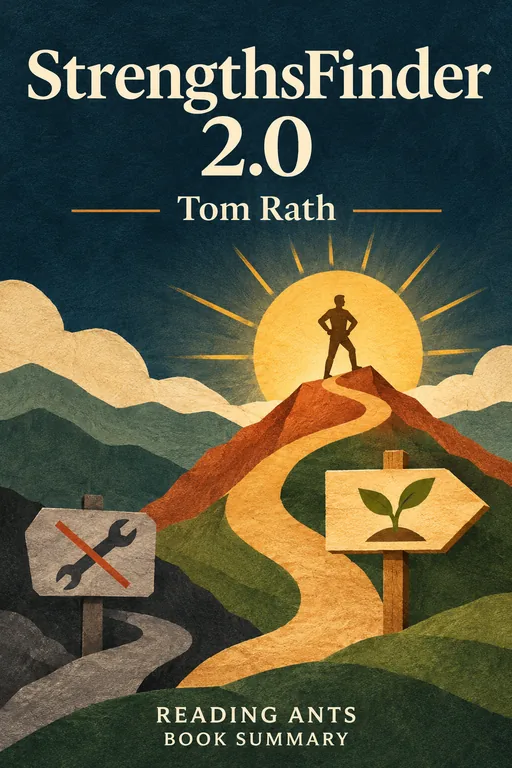
Tom Rath argues that people achieve more by building on what they naturally do best than by trying to fix their weaknesses, and he offers a test and a set of thirty-four "themes" to help readers find their strengths.
Overview
StrengthsFinder 2.0 was published in 2007 by Gallup Press. Its author, Tom Rath, worked for the research and polling company Gallup. The book builds on earlier Gallup work, associated with Donald Clifton and the 2001 book Now, Discover Your Strengths, which first included an early version of the test. Readers of the new book take an updated, faster online version, which names their top five talent themes out of thirty-four and offers personalized reports. The book itself describes all the themes and gives ideas for action. Its core message is simple: success comes from developing your strengths, not from trying to become well-rounded.
Full Summary
1. Focus on strengths, not weaknesses
The idea: Rath says that many schools, families and workplaces spend most of their time pointing out weaknesses and trying to repair them. He suggests that a better approach is to find your talents and to build on them. People can only improve in a limited way in areas where they are weak, but they can grow a great deal in areas where they have natural ability.
In real life: A student who is good at explaining ideas might gain more from joining a debate team than from spending every spare hour on a subject they dislike.
2. Talent, practice and strength
The idea: Rath explains that the test measures talent, not strength. Talents are natural patterns that stay fairly stable through adult life, while a strength is a talent that you have built up with knowledge, skills and practice. Talent acts as a multiplier of the time you invest. He illustrates this with a five-point scale: someone with modest talent, rated 2, who works as hard as possible, rated 5, reaches a ceiling of 10, whereas someone with 5 in both areas reaches 25. Hard work can bring basic competence where talent is thin, but the most successful people start from dominant talent and then add to it.
In real life: A person who is naturally good at remembering faces still has to practice meeting people to become a great host.
3. The thirty-four themes
The idea: Gallup groups talents into thirty-four themes, each with a short name. Examples include Achiever, for people who feel driven to accomplish things; Learner, who loves to learn; Empathy, who senses other people’s feelings; Strategic, who sees patterns and options; and Includer, who wants everyone to feel part of the group. For each theme, the book gives a description, comments from people who have it, ideas for action, and tips for working with people who have it.
In real life: One friend always organizes the group and finishes the task, while another keeps everyone cheerful. Both are strengths, but they are different.
4. Your top five
The idea: After taking the test, a reader gets a list of their top five themes. Rath notes that there are over thirty-three million possible combinations of top five themes, and that the online report adds personalized insights about how each theme shows up in you, with ten ideas for action per theme. He says the purpose is not to label you with strengths, but to show where you have the greatest potential to develop them. If you retake the test, a couple of your top five may change, though a new one was probably already in your top ten.
In real life: If one of your top themes is Communication, you might look for chances to present, to write or to teach, since this is probably where you will shine.
5. Use strengths in teams
The idea: Rath argues that people do better when they have a chance to do what they do best, and that having a manager who focuses on your strengths matters a great deal. He cites a Gallup study in which workers whose manager focused on their strengths were far less likely to be actively disengaged than those whose manager focused on weaknesses or ignored them. He gives the example of a shoemaker in Mexico who was very good at making shoes but poor at selling, and who tripled his output after teaming up with a natural salesman. Each theme chapter also has tips for working with colleagues who have that theme.
In real life: A school play needs a person who plans, a person who inspires others and a person who spots problems. They should not all have the same gifts.
6. Build a plan to grow
The idea: The book encourages the reader to act on the results, and it includes ideas for action for each theme, such as choosing roles that use it and finding partners with complementary strengths. Rath also says it helps to know your areas of lesser talent: you can work around them, find a partner who is strong there, or stop doing tasks that are a poor fit. He adds that strong talents can create blind spots, so it pays to watch for them.
In real life: If you dislike detailed paperwork, you might use a checklist, or ask a friend who enjoys it to help, while you spend more time on what you do best.
Why It Matters
StrengthsFinder 2.0 sold very widely, and it helped to make the focus on strengths a common idea in schools, businesses and coaching. Many organizations have used the assessment, now often called CliftonStrengths, to help staff understand their talents and to make teams. The book’s reach is partly due to its easy method: a short test, simple language and practical tips. It matters because it offers a hopeful, positive way to think about development, in contrast to the habit of listing everything that is wrong. For many people, learning a name for what they do well has been helpful in choosing a career or a role. The book also started many conversations about how to work with people who are different from us.
Key Takeaways
- Build on talent. You will usually grow more in areas where you are naturally strong.
- Strength takes practice. Talent becomes strength when combined with learning and effort.
- Names help. Having words for your talents makes it easier to use them on purpose.
- Teams need different people. A mix of strengths gives a group more range.
- Manage weaknesses, do not obsess over them. Work around them, or find help.
What We Can Learn
Think about the activities that give you energy, that you learn quickly and that you do almost without effort. These are clues to your strengths. Ask friends or family what they think you do well. Look for ways to use these talents more at school, at work or in hobbies. When you work on a team, share your strengths openly, and ask others about theirs. At the same time, do not use “that is not my strength” as an excuse to avoid every challenge. Sometimes we need to work on weaker areas to meet basic needs, and you can grow in unexpected ways.
Criticism and Counterpoints
Some psychologists question how well the test has been checked for accuracy and whether the thirty-four themes are the best way to describe personality. Critics note that the results depend on how you answer and on your mood, and that the descriptions are positive and general, so most people recognize themselves in them. The advice to ignore weaknesses can be overdone, since some weak skills, such as basic communication or reliability, may need work. The book also comes with a commercial test, which some feel limits independence. Used with care, the results can start useful reflection.
Who Should Read It
This book is for students, workers, teachers and managers who want to understand themselves and others better. It is easy to read, and the test only takes a short time. Readers who prefer scientific detail or who do not find labels helpful may want to treat it as a conversation starter.
Want the whole book?
A summary is a taste, not the meal. Here is where to find the full book.
You reached the end 🎉
Nicely done. Mark this one as read, and we will suggest what to read next.
Read this next
Atomic Habits
James Clear
Big changes in life come not from huge leaps but from tiny habits repeated every day, and you can build good habits (and break bad ones) by designing your life so the right choices are obvious, attractive, easy and satisfying.
🌱 Self-Improvement
Mindset: The New Psychology of Success
Carol S. Dweck
Psychologist Carol Dweck shows that people who believe abilities can grow, a growth mindset, learn, cope with failure and achieve more than people who believe their talents are fixed.
🌱 Self-Improvement
The 7 Habits of Highly Effective People
Stephen R. Covey
Lasting success in life and work comes not from quick tricks or a charming personality but from good character, built through seven habits that move us from depending on others, to standing on our own, to working well with others.
🌱 Self-Improvement
Drive: The Surprising Truth About What Motivates Us
Daniel H. Pink
Daniel Pink argues that, for creative and complex work, carrots and sticks such as bonuses are less effective than the inner drive provided by autonomy, mastery and purpose, and that businesses and schools should be redesigned around them.
🧩 Mind & Psychology
Grit
Angela Duckworth
Psychologist Angela Duckworth argues that success depends not only on talent but on grit, a combination of passion and long-term perseverance, and shows how people can grow it in themselves and others.
🌱 Self-Improvement
The Lean Startup
Eric Ries
Startups succeed not by following a detailed plan but by quickly testing their ideas with real customers, learning from the results and changing direction when needed.
💼 BusinessWant something different?
Pick another topic and we will show you three books to start with.