 Reading Ants
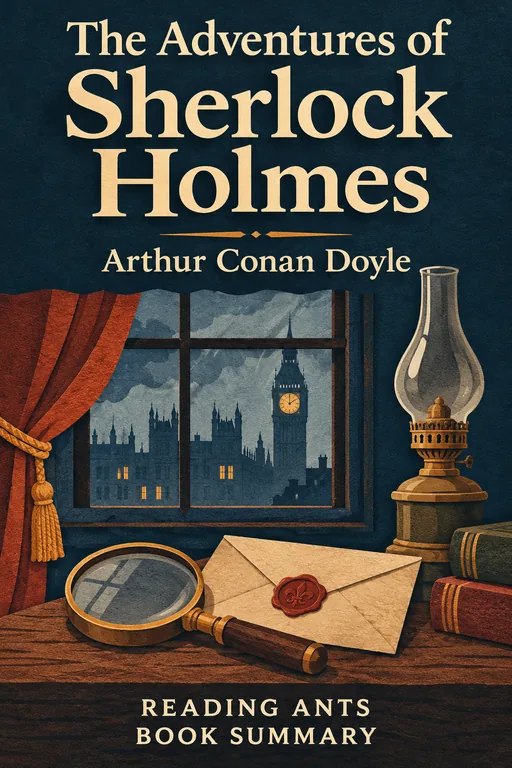
The Adventures of Sherlock Holmes
A collection of twelve short stories in which the brilliant London detective Sherlock Holmes uses observation and logic to solve puzzling cases, narrated by his friend and companion, Dr. John Watson.
Overview
The Adventures of Sherlock Holmes is a collection of twelve short stories first published in The Strand Magazine in 1891 and 1892, and as a book in 1892. They made Sherlock Holmes one of the most famous fictional characters in the world. Holmes lives at 221B Baker Street in Victorian London with Dr. Watson, a retired army doctor who writes up their cases. Each story is a self-contained puzzle, usually beginning when a visitor arrives with a strange problem. Holmes solves it through close attention to tiny details and a method he calls deduction. Arthur Conan Doyle, himself a doctor, modeled Holmes partly on one of his medical-school professors.
Main Characters
- Sherlock Holmes: the sharp, eccentric “consulting detective.”
- Dr. John Watson: Holmes’s friend and narrator, who shares rooms with him at first and later marries.
- Mrs. Hudson: their landlady.
- Inspector Lestrade: a Scotland Yard detective who often asks for help.
- Irene Adler: the clever woman who outwits Holmes.
- Mycroft Holmes: Holmes’s older brother, who appears in other stories, not in this collection.
- Professor Moriarty: Holmes’s great enemy, who appears later in the series, not in this collection.
Full Summary
A Scandal in Bohemia
The first story introduces Irene Adler, a singer and adventuress. The King of Bohemia, who is about to be married, asks Holmes to retrieve a compromising photograph that she is keeping. Holmes disguises himself and tries to find the picture, but Irene sees through his trick and leaves the country with her new husband. She outwits Holmes, who afterward always speaks of her as “the woman,” a person whose cleverness he always respected.
The Red-Headed League
A pawnbroker named Jabez Wilson is offered a well-paid job copying the encyclopedia, joining a mysterious league of men with red hair. When the job suddenly ends, Wilson turns to Holmes. Holmes deduces that the league is a trick to get Wilson out of his shop, because criminals are digging a tunnel from his cellar to a neighboring bank. Holmes and the police catch the thieves red-handed.
A Case of Identity
A young woman, Mary Sutherland, asks Holmes to find her fiancé, who disappeared on the way to their wedding. Holmes discovers that the “fiancé” was her stepfather in disguise, who was trying to keep control of her inheritance by making sure she never married. Holmes confronts him but decides he cannot be punished by law.
The Boscombe Valley Mystery and The Five Orange Pips
In The Boscombe Valley Mystery, a young man is accused of killing his father, and Holmes shows that the real culprit is someone from the father’s past. In The Five Orange Pips, a man receives a letter containing five orange seeds, a threat connected to the Ku Klux Klan in America. Several of his relatives have died after receiving similar warnings. Holmes tries to protect the next target, but arrives too late.
The Man with the Twisted Lip
A respectable man, Neville St. Clair, has vanished, and his wife believes he is dead. Holmes investigates an opium den and a beggar with a twisted lip, and realizes that the man has been living a double life: he earns a better income begging in the street, disguised as a disfigured beggar, than as a journalist. Holmes spares him from prosecution.
The Blue Carbuncle
On the second morning after Christmas, Holmes examines a lost hat and a Christmas goose. When a precious blue gem is found inside the goose’s crop, he traces the goose’s history through the markets of London to find the thief. Instead of handing him over to the police, he lets him go, since it is the season of forgiveness.
The Speckled Band
A frightened young woman, Helen Stoner, tells Holmes that her sister died mysteriously two years before, after whispering the words “the speckled band.” Now Helen herself hears the same strange whistle at night. Holmes discovers that her stepfather, a violent doctor, has been using a venomous snake trained to climb through a ventilator to kill his stepdaughters, so he can keep their inheritance. Holmes turns the snake back on its owner.
The Engineer’s Thumb, The Noble Bachelor, The Beryl Coronet and The Copper Beeches
In the remaining stories, Holmes solves a series of puzzles. A hydraulic engineer loses his thumb to counterfeiters, who escape before the police arrive. A wealthy lord’s bride vanishes from her wedding breakfast, and Holmes finds that she is alive, because her first husband, whom she believed dead, has returned. A banker’s precious coronet is damaged, and his own son is suspected; Holmes shows that the real culprit is a rogue who has seduced the banker’s niece, and that the son was shielding her. A governess is hired to wear a particular dress, sit in a particular spot and cut her hair, and discovers that the family is hiding their imprisoned daughter, and that she was meant to impersonate her. In each, Holmes’s logic reveals the truth beneath the strange appearance.
Why It Matters
The Adventures of Sherlock Holmes is one of the most influential works of detective fiction. Sherlock Holmes became so popular that when Doyle tried to kill him off in 1893, the public protested, and he was forced to bring him back. Holmes is one of the most portrayed characters in film and television, with hundreds of adaptations, and the address 221B Baker Street has become one of the world’s most famous fictional addresses, where a museum now stands.
The stories established the template for the modern detective: a brilliant observer, his admiring friend, the clever deduction at the end. They also helped popularize the use of scientific methods in crime solving, and they inspired many real forensic techniques. Their short, gripping form shaped the magazine short story for decades.
Key Takeaways
- Observation is a skill. Holmes notices details others overlook.
- Logic can solve puzzles. Careful reasoning replaces guesswork.
- Things are not always what they seem. Many solutions involve disguises and misdirection.
- Justice can include mercy. Holmes sometimes lets people go.
- Friendship supports genius. Watson’s loyalty and help matter.
What We Can Learn
The Holmes stories encourage us to look closely at the world. Practicing observation, noticing small details about people and places, can sharpen our attention and our reasoning.
They also teach the value of questioning easy answers. Holmes never accepts the obvious explanation without evidence, a lesson for anyone facing misleading information.
Finally, Watson shows the value of being a loyal friend. He doesn’t have Holmes’s brilliance, but his support, honesty and willingness to ask questions are essential, and many great detectives and scientists work best in teams.
Criticism and Counterpoints
Some modern readers find Holmes’s reasoning less rigorous than it appears: he often jumps to conclusions that happen to be right because the author controls the plot. Real detectives point out that deduction rarely works as neatly as in the stories.
The stories also reflect Victorian attitudes, including stereotypes about foreigners, women and different races, which are uncomfortable to modern readers. Some stories, such as The Five Orange Pips, use real-life groups in a simplistic way. Many readers nevertheless enjoy the cleverness and atmosphere.
Who Should Read It
These stories suit readers from about 10 upward who enjoy puzzles and mysteries. They can be read one at a time, which makes them good for short sessions. They are an ideal introduction to classic detective fiction.
Want the whole book?
A summary is a taste, not the meal. Here is where to find the full book.
You reached the end 🎉
Nicely done. Mark this one as read, and we will suggest what to read next.
Read this next
The Hound of the Baskervilles
Arthur Conan Doyle
Sherlock Holmes and Dr. Watson investigate a family curse involving a monstrous spectral dog on the dark, foggy moors of Devon, and discover that the legend is being used to cover a very human crime.
🔍 Mystery & Thriller
A Study in Scarlet
Arthur Conan Doyle
Dr. John Watson meets the eccentric consulting detective Sherlock Holmes and shares his rooms at 221B Baker Street, and together they investigate a mysterious murder in an empty London house, in the first Sherlock Holmes story.
🔍 Mystery & Thriller
The Murders in the Rue Morgue
Edgar Allan Poe
In Paris, a brilliant amateur detective, C. Auguste Dupin, solves the baffling murder of a mother and daughter in a locked room by thinking carefully about what the evidence really shows, and reaches a startling conclusion.
🔍 Mystery & Thriller
The Big Sleep
Raymond Chandler
Private detective Philip Marlowe is hired by a wealthy, dying general to deal with a blackmailer, and is drawn into a tangle of murders, drugs and family secrets among Los Angeles's rich and corrupt.
🔍 Mystery & Thriller
Murder on the Orient Express
Agatha Christie
When a wealthy American is murdered on a snowbound train, the Belgian detective Hercule Poirot must work out which of the passengers is the killer, and discovers a shocking truth about many of them.
🔍 Mystery & Thriller
The Murder of Roger Ackroyd
Agatha Christie
In the English village of King's Abbot, a wealthy man is found stabbed in his study, and the Belgian detective Hercule Poirot, who has retired to grow vegetable marrows, is persuaded to investigate, with a surprise ending that changed detective fiction.
🔍 Mystery & ThrillerWant something different?
Pick another topic and we will show you three books to start with.