 Reading Ants
The Cay
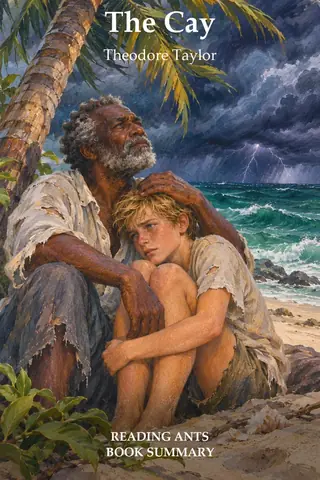
During World War II, a prejudiced eleven-year-old American boy is shipwrecked on a tiny Caribbean island, blind, with an old West Indian sailor who teaches him to survive and to see people differently.
Overview
The Cay is a 1969 novel by Theodore Taylor, which has been widely read in schools and has received awards such as the Lewis Carroll Shelf Award. It begins in 1942 on the island of Curaçao, where Phillip Enright, eleven, lives with his American parents, while German submarines attack ships nearby. When his mother decides to take him home to Virginia, the freighter they sail on is torpedoed. Phillip wakes up on a raft with an old Black sailor called Timothy and a cat, and soon finds that he has lost his sight. The book is a survival story and a story about learning to overcome prejudice. Taylor dedicates it to Dr. King’s dream, which, he says, can only come true if the very young know and understand.
Main Characters
- Phillip Enright: the eleven-year-old narrator, who has been taught by his mother to look down on Black people.
- Timothy: a very old West Indian sailor from St. Thomas, in the Virgin Islands, who speaks in a strong island dialect.
- Stew Cat: the ship cook’s cat, who survives on the raft.
- Phillip’s father: an oil refinery expert from Virginia, lent to a Dutch oil company on Curaçao.
- Phillip’s mother (Grace): who is homesick and nervous, wants to leave Curaçao, and looks down on Black people.
- Henrik van Boven: Phillip’s Dutch school friend.
Full Summary
War Comes to Curaçao
In February 1942, German submarines attack the big oil refinery on Aruba and blow up small tankers, and the war comes close to Phillip’s home. His father works at the refinery on Curaçao, and Phillip sneaks off with his friend Henrik to the old fort to look for submarines. His mother, Grace, dislikes the island and fears the war. Later in February, a British tanker is torpedoed right outside the harbor while Phillip and his father watch, and that night she says she will take Phillip home to Norfolk, Virginia. In early April they board a small Dutch freighter, the Hato, bound for Panama and then Miami. Phillip, who thinks his mother is a coward, tells her he hates her.
The Raft
On April 6, 1942, before the ship has reached Panama, the Hato is torpedoed at about three in the morning. The deck is on fire, the lifeboats fail, and Phillip is hit on the head by a timber. Hours later he wakes on a small raft with Timothy, a huge old sailor from the Hato’s crew, and the ship’s cat. Timothy rations the water and the biscuits. Phillip, who has been taught that Black people are different from him, feels disgust and fear. He finds Timothy’s looks, speech and smell strange, and he tells himself that his mother must be right that Black people are different.
Darkness
Phillip’s eyes were hurt by the blow and by looking at the bright sun, and one morning he wakes in total darkness. He is blind. Timothy tells him that it may be temporary, and he tells of a man he once knew who was blind for a few days. In his fear and anger Phillip hits Timothy, who tells him to go ahead if it will make him feel better. A plane passes overhead without seeing them. Timothy describes the sea and sky to Phillip, who begins to depend on him.
The Cay
At last they reach a tiny, low island, a cay, with only a few palm trees and no people. Timothy builds a hut of palm fronds, finds food on the reef and sets up a signal fire. He wants to lay out the word HELP with stones, and Phillip, who can still spell, draws the letters in the sand for him to follow. Later Phillip refuses to work and shouts a hateful insult at Timothy, who slaps him. Phillip is shaken, and changes. He asks to be called by his name and says he wants to be Timothy’s friend.
Learning to Live
Timothy teaches Phillip to find his way by a vine rope, to weave mats, to fish with hooks he makes from nails, and to climb a palm for coconuts. In the evenings Timothy talks about his childhood in Charlotte Amalie. When Phillip asks why his mother dislikes Black people, Timothy says that he too dislikes some white people but that it would be wrong to dislike all of them, and that beneath the skin everyone is the same. When Timothy later falls sick with malaria and wanders delirious into the sea, Phillip drags him out. Phillip, who cannot see Timothy’s face, realizes that the old man’s skin color no longer matters. He asks Timothy if he is still black, and Timothy laughs. Timothy seems to be training him to live without him, because he fears he may become ill again.
The Storm and the Rescue
In July a hurricane strikes. Timothy ties them to a palm and shields Phillip with his body. In the morning Timothy is dead. Phillip buries him and lives alone on the cay for several weeks with the cat, fishing and tending the fire. He learns that sea grape makes thick black smoke, and on August 20, 1942, a plane sees his signal, and sailors from an American destroyer rescue him. His parents meet him in Panama, and his mother apologizes. After three operations in New York, he can see again, though he must wear glasses. He goes back to Curaçao, talks with Black islanders, and hopes one day to return to the cay and stand at Timothy’s grave.
Why It Matters
The Cay has been a widely read middle-school novel since 1969, and it is one of the best-known novels for young readers about racism and a friendship across race. It was written during the civil rights era and dedicated to Dr. King’s dream. For many readers it was an introduction to the idea that prejudice is learned and can be unlearned.
It has also been the subject of discussion. Some educators praise its message, while others point out that the story is told from the point of view of the white boy, and that Timothy is shown as a noble helper who gives up his life, a pattern that has drawn criticism. In 1974 a group called the Council on Interracial Books for Children publicly called the story racist when it was shown on television.
Key Takeaways
- Prejudice is learned. Phillip repeats what his mother taught him, and he can change.
- Character matters more than color. Timothy’s skill and kindness show who he is.
- Dependence can turn into friendship. Phillip begins by needing Timothy and ends by loving him.
- Survival requires skills and courage. Fishing, fire and shelter keep them alive.
- Real change takes experience. Phillip changes by living with someone, not by being lectured.
What We Can Learn
If you have been taught to think badly of a group of people, ask whether you have ever really met anyone from it. Phillip’s change comes from daily life with Timothy. Getting to know people is the best way to see past stereotypes.
The book also reminds us to be grateful for people who help us through hard times, and to learn their lessons while they are with us.
Finally, Phillip’s courage in learning to live without sight shows that people can do more than they think when they must.
Criticism and Counterpoints
Many modern readers and teachers have criticized The Cay. Timothy’s speech is written in a heavy phonetic dialect that can look like a caricature, and some of Phillip’s early descriptions of Black people are hurtful. Critics say that the story gives a noble Black character who exists mainly to teach a white boy, and then dies. Others find the plot unlikely, since a blind child survives alone for weeks. Some schools have stopped assigning the book, while others use it with discussion about these issues. It is best read with an adult.
Who Should Read It
This book suits readers from about ten to fourteen who like survival stories, and classes that want to discuss prejudice and how books about race have changed over time. Because of the insulting words, the war violence and a death, it should be read with some guidance, and alongside books by Black authors.
Want the whole book?
A summary is a taste, not the meal. Here is where to find the full book.
You reached the end 🎉
Nicely done. Mark this one as read, and we will suggest what to read next.
Read this next
Island of the Blue Dolphins
Scott O'Dell
After her people leave their island and she is left behind, a Native American girl named Karana survives alone for years, learning to hunt, build and make friends with animals.
🧸 Children's Books
Hatchet
Gary Paulsen
After a plane crash leaves him alone in the Canadian wilderness with only a hatchet, a thirteen-year-old boy must learn to survive, and grows from a frightened city kid into a patient, resourceful young man.
🧸 Children's Books
Call It Courage
Armstrong Sperry
A Polynesian boy who has been afraid of the sea since it took his mother sets out alone in a canoe to prove his courage.
🧸 Children's Books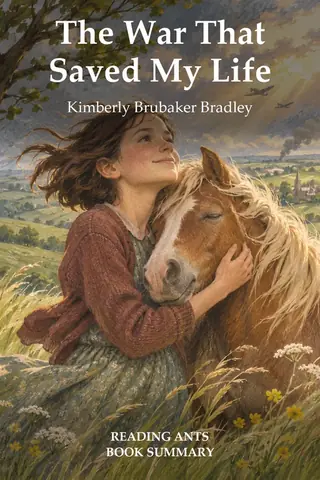
The War That Saved My Life
Kimberly Brubaker Bradley
A girl with a twisted foot, who has been kept shut in her mother's one-room flat, is evacuated from London in 1939, learns to ride a pony and to read, and finds out what being loved feels like.
🧸 Children's Books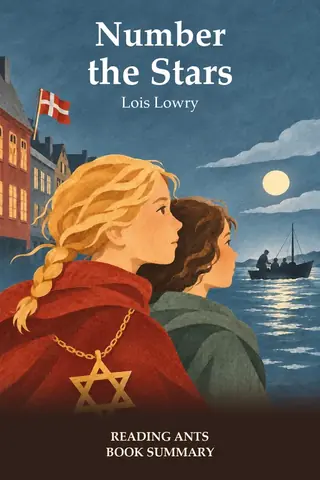
Number the Stars
Lois Lowry
In 1943, a ten-year-old Danish girl named Annemarie helps her Jewish best friend Ellen escape from Nazi-occupied Copenhagen by pretending that Ellen is her sister and by helping with a daring rescue.
🧸 Children's Books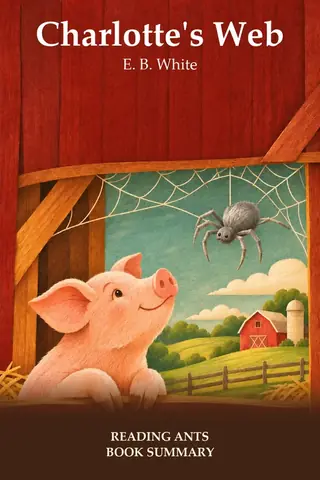
Charlotte's Web
E. B. White
A lonely pig named Wilbur learns he is going to be killed, and his clever friend Charlotte, a spider, comes up with an amazing plan to save his life.
🧸 Children's BooksWant something different?
Pick another topic and we will show you three books to start with.