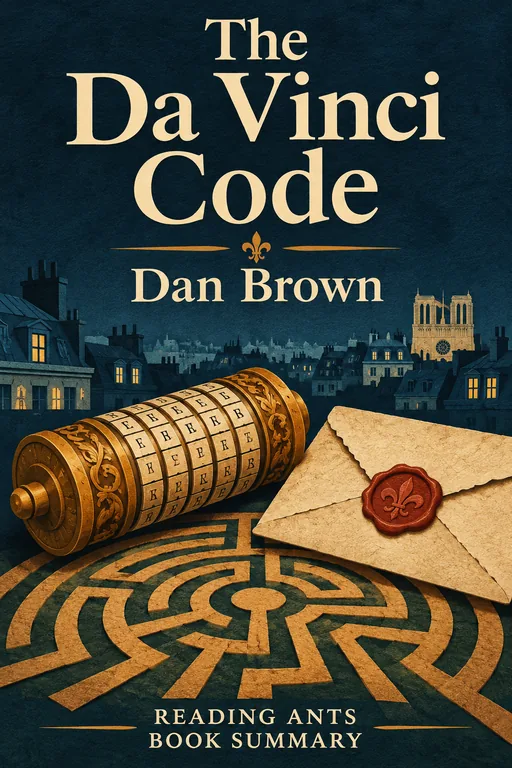
The Da Vinci Code
When a curator is murdered inside the Louvre Museum, a Harvard symbologist and a French cryptologist race across Paris and London, solving riddles hidden in famous artworks that point to a secret guarded for two thousand years.
Overview
The Da Vinci Code, by the American author Dan Brown, was published in 2003 and became one of the best-selling novels of all time, with more than eighty million copies sold. The story begins with the murder of the Louvre’s curator, Jacques Saunière, who leaves behind a series of cryptic clues. Robert Langdon, a Harvard professor of religious symbology visiting Paris, is summoned to the crime scene and becomes the prime suspect, until Saunière’s granddaughter, a police cryptologist named Sophie Neveu, helps him escape. Together they follow the clues, which lead to a secret society called the Priory of Sion and a sensational claim about the history of Christianity. The book is a fast-paced thriller with short chapters that end in cliffhangers.
Main Characters
- Robert Langdon: a Harvard professor and expert in symbols.
- Sophie Neveu: a French police cryptologist, the curator’s granddaughter.
- Jacques Saunière: the murdered curator of the Louvre.
- Sir Leigh Teabing: a wealthy British scholar of the Holy Grail.
- Silas: an albino monk and assassin.
- Bishop Aringarosa: the head of Opus Dei, a Catholic organization.
- Bezu Fache: the French police captain who hunts Langdon.
- The Teacher: the mysterious mastermind behind events.
Full Summary
The Louvre
The novel begins as Jacques Saunière, the curator of the Louvre Museum in Paris, is shot by a hooded albino monk named Silas, who has been told to find a secret called the keystone. Dying, Saunière uses his last moments to arrange his body in the pose of Leonardo da Vinci’s Vitruvian Man and to leave a message in a secret code for his granddaughter, Sophie.
Robert Langdon is called to the Louvre by the police, led by the intimidating Captain Fache. Sophie, a police cryptologist, secretly warns Langdon that he is the main suspect, and they flee together. Saunière’s last message includes a scrambled sequence of numbers, a two-line anagram and a final line telling Sophie to find Langdon. Sophie recognizes the numbers as a famous mathematical sequence, and Langdon realizes that the letters are an anagram naming Leonardo da Vinci and his painting the Mona Lisa. Following the clue to the painting, they find a hidden message on the back of another Leonardo work, which leads them to a key engraved with the symbol of the Priory of Sion.
The Secret
Langdon explains that the Priory of Sion is a secret society that, according to a legend, has guarded a great secret about Christianity for centuries: that the Holy Grail is not a cup, but a person, Mary Magdalene, who carried the child of Jesus, and that the Church has hidden this truth. Sophie, who was raised by her grandfather and has hidden pain, is drawn into a mystery about her own family.
They find a bank vault in Paris holding a box, a cryptex, a small cylinder with a combination lock which, if forced open, will destroy the scroll inside. The police pursue them as they escape.
Teabing
Langdon and Sophie take refuge at the château of Sir Leigh Teabing, Langdon’s friend, a wealthy scholar of the Grail. Teabing explains his theory, using Leonardo da Vinci’s painting The Last Supper as evidence: the figure next to Jesus is Mary Magdalene, not John. They realize that the cryptex’s code is the key to the Grail’s location.
Silas, controlled by a mysterious figure known only as the Teacher, continues to hunt for the cryptex. Bishop Aringarosa, who has been manipulated, believes he is working to protect the Church.
London
The trio travels to London and the Temple Church, and then to Westminster Abbey, following clues connected to Isaac Newton’s tomb. At Westminster Abbey, Teabing is revealed to be the Teacher: he has been manipulating everyone, including Silas and the Bishop, to obtain the Grail’s secrets, which he believes will expose the Church. Langdon, who has secretly solved the code, outwits him, and Teabing is arrested.
Rosslyn
Langdon and Sophie follow the cryptex’s final clue to Rosslyn Chapel in Scotland. In the chapel, they meet Sophie’s grandmother, Marie, and her long-lost brother, and learn that Sophie is a descendant of Jesus and Mary Magdalene. The Priory has guarded her family’s secret for centuries, and the family has been living in hiding.
Langdon realizes that the true Grail, Mary Magdalene’s remains, lies beneath the Louvre’s glass pyramid, in a small chamber under the inverted pyramid. In the final scene, in Paris, he kneels before the spot, aware that he is in the presence of something sacred, as the novel closes.
Why It Matters
The Da Vinci Code was one of the best-selling novels of the twenty-first century, selling over eighty million copies in many languages and spending years on bestseller lists. It was adapted into a 2006 film starring Tom Hanks, and brought record crowds to the Louvre, to Rosslyn Chapel and to other places mentioned in the book.
The novel provoked fierce debate, with the Catholic Church and many scholars criticizing its claims, and it sparked widespread interest in Christian history, art and symbols. It also launched a wave of imitators and showed how successful a historical conspiracy thriller could be.
Key Takeaways
- Symbols carry hidden meanings. Art and architecture contain layers of messages.
- History is often disputed. Different groups tell different stories about the past.
- Secrets can be powerful. The idea of hidden truths drives the plot.
- Teamwork solves puzzles. Langdon’s knowledge and Sophie’s skills complement each other.
- Obsession can be dangerous. Several characters are consumed by their beliefs.
What We Can Learn
The book can spark curiosity about art, history and symbols, encouraging readers to look more closely at paintings and buildings. It shows how much meaning can be hidden in everyday images.
It also reminds us to be careful with information. The novel opens with a page stating that its descriptions of artworks and documents are accurate, but many historians dispute that. Checking claims against reliable sources is an important skill.
Finally, the story shows how people can be manipulated through their beliefs, as Silas and the Bishop are.
Criticism and Counterpoints
Historians and art experts have identified many errors. The claim that the Priory of Sion is an ancient secret society was based on a hoax created in the twentieth century. Scholars also dispute the interpretation of The Last Supper and the history of the early Church, and the book’s version of Opus Dei is widely seen as inaccurate. The Catholic Church condemned the novel, and some countries banned the film.
Critics have also panned the writing as stiff and repetitive, with cardboard characters and endless explanations. A lawsuit claimed that Brown copied material from an earlier book, but he won. Many readers nevertheless enjoy it as an entertaining adventure, as long as it’s understood as fiction.
Who Should Read It
This novel suits teens and adults who enjoy fast-paced thrillers. It is best read as entertainment, not history. Readers interested in the real history of Leonardo da Vinci or the Holy Grail can follow up with historical works.
Want the whole book?
A summary is a taste, not the meal. Here is where to find the full book.
You reached the end 🎉
Nicely done. Mark this one as read, and we will suggest what to read next.
Read this next
The Name of the Rose
Umberto Eco
A Franciscan friar investigates deaths in a medieval abbey, where the struggle to control books and laughter proves more dangerous than any supernatural curse.
🌍 World Literature
The Girl with the Dragon Tattoo
Stieg Larsson
A disgraced journalist and a brilliant, damaged young hacker team up to solve a decades-old disappearance, and uncover a family's dark secrets.
🌍 World LiteratureThe Murders in the Rue Morgue
Edgar Allan Poe
In Paris, a brilliant amateur detective, C. Auguste Dupin, solves the baffling murder of a mother and daughter in a locked room by thinking carefully about what the evidence really shows, and reaches a startling conclusion.
🔍 Mystery & Thriller
A Study in Scarlet
Arthur Conan Doyle
Dr. John Watson meets the eccentric consulting detective Sherlock Holmes and shares his rooms at 221B Baker Street, and together they investigate a mysterious murder in an empty London house, in the first Sherlock Holmes story.
🔍 Mystery & Thriller
The Hound of the Baskervilles
Arthur Conan Doyle
Sherlock Holmes and Dr. Watson investigate a family curse involving a monstrous spectral dog on the dark, foggy moors of Devon, and discover that the legend is being used to cover a very human crime.
🔍 Mystery & Thriller
The Adventures of Sherlock Holmes
Arthur Conan Doyle
A collection of twelve short stories in which the brilliant London detective Sherlock Holmes uses observation and logic to solve puzzling cases, narrated by his friend and companion, Dr. John Watson.
🔍 Mystery & ThrillerWant something different?
Pick another topic and we will show you three books to start with.