 Reading Ants
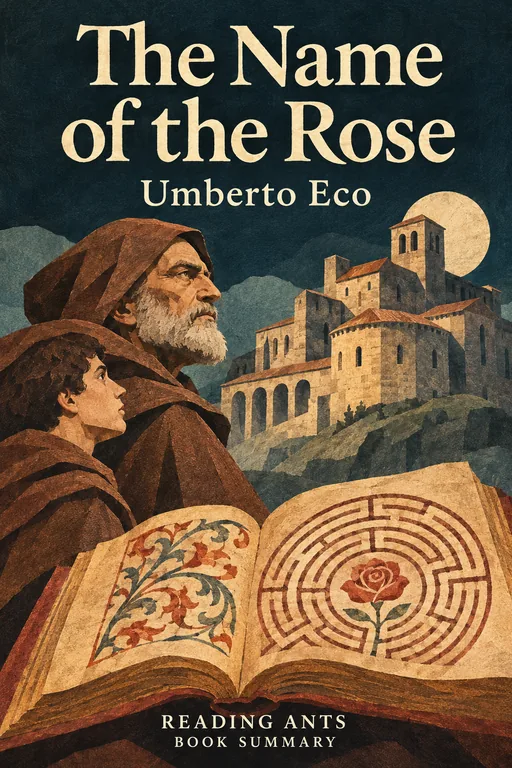
The Name of the Rose
Original title: Il nome della rosa
A Franciscan friar investigates deaths in a medieval abbey, where the struggle to control books and laughter proves more dangerous than any supernatural curse.
Overview
Set in 1327, The Name of the Rose combines a murder mystery with debates about faith, knowledge and political power. The elderly Adso of Melk recalls arriving as a young novice at an Italian Benedictine abbey with his teacher, William of Baskerville. William has come for a sensitive meeting between church factions, but the abbot asks him to investigate a monk’s strange death. More deaths follow, and clues lead toward the abbey’s guarded library. Umberto Eco uses the investigation to explore who may interpret truth, why institutions suppress ideas and whether reason can master a disorderly world. The novel is intellectually demanding and deliberately filled with medieval theology, languages and signs.
Main Characters
- William of Baskerville: a Franciscan friar who uses observation, logic and intellectual humility.
- Adso of Melk: William’s young novice and the story’s older narrator.
- Jorge of Burgos: a blind, elderly monk who fears the moral power of laughter.
- Abbo: the abbot, concerned with the monastery’s authority and secrets.
- Bernard Gui: an inquisitor whose certainty turns accusation into judgment.
- Salvatore: a strange-speaking monk with a troubled religious past.
- Remigio: the cellarer, whose past makes him vulnerable to the Inquisition.
- Malachi: the librarian, one of the few monks permitted inside the library.
Full Summary
Arrival and a Death
William and Adso reach the wealthy abbey as church leaders prepare to debate whether Christ and the apostles owned property. William immediately impresses the monks by reasoning from small signs. Abbo privately tells him that Adelmo, a young illuminator, has been found dead below a tower. The abbey fears scandal and possible evil.
William studies the buildings and questions monks. Adelmo’s death appears connected to secret relationships, shame and access to forbidden books. The magnificent library occupies a maze above the scriptorium, but outsiders may not enter. Its secrecy makes knowledge a form of power. William and Adso begin mapping the maze indirectly while trying to interpret coded clues.
A Pattern of Deaths
Venantius, a translator of Greek, is found dead, and Berengar, an assistant librarian, disappears. Venantius’s fingertips are dark, as if stained by some unknown substance. William notices that several monks were interested in a lost work associated with comedy. The old monk Alinardo insists that the deaths echo the seven trumpets of the biblical Apocalypse, encouraging fear that prophecy is unfolding.
William is wary of such fantasies, but he treats the idea as the possible plan of one human mind, and it later helps him find the missing Berengar. He and Adso secretly enter the library. Mirrors, misleading inscriptions and drug-like vapors confuse them, but they learn that rooms are arranged according to a coded geography. The library is not merely a storehouse; it controls which parts of the world may speak.
Adso’s Sin and Compassion
Adso encounters a hungry village girl who enters the abbey in exchange for food. Their sexual meeting overwhelms and troubles him. He later tries to understand whether his feelings were love, temptation or compassion shaped by unequal circumstances. He never learns her name, a fact that remains painful in his old age.
Meanwhile, William and Adso find Berengar drowned in the abbey’s baths. His fingers and tongue are darkened, like Venantius’s fingertips, which suggests that both men handled and swallowed something poisonous. A visiting delegation arrives, including Bernard Gui, an experienced inquisitor. Bernard approaches uncertainty very differently from William: he seeks confessions that will confirm categories he already accepts. When Salvatore and the girl are caught together, with a black cat and attempted magic, and Remigio is accused because of his past and the murders, Bernard builds a case of heresy and witchcraft around them.
The Inquisition
The political meeting begins, but arguments about religious poverty are inseparable from power. If the church accepts that Christ owned nothing, its wealth and authority may be challenged. The murders and Bernard’s investigation disrupt any hope of open discussion.
Under pressure, Remigio confesses to crimes and beliefs far beyond the immediate evidence. Bernard treats confession as proof and prepares to take the accused away. William cannot save them. His reason works best when people permit evidence to matter; an institution committed to a conclusion can turn procedure into violence. Adso is especially horrified that the unnamed girl may be punished while the powerful protect themselves.
The Forbidden Book
More monks die. Not every death comes directly from the poisoned pages: the librarian Malachi kills the herbalist Severinus with an armillary sphere and later dies of the poison himself, while the abbot, Abbo, is trapped by Jorge in an airless secret passage beneath the library. William eventually identifies the hidden center of the mystery: a rare surviving book attributed to Aristotle, dealing with comedy. Jorge believes laughter is dangerous because it weakens fear, including fear that supports religious authority. He has coated the book’s pages with poison. Readers wet their fingers to turn the leaves and unknowingly kill themselves.
The apocalyptic pattern was never a master plan. It began with Alinardo’s remarks and William’s own willingness to believe them. Jorge, hearing of the idea, took it as a sign of divine will and used it when he warned Malachi about the book’s danger. This matters to William: investigators can be right about a culprit while wrong about the perfect pattern they imagine. Human beings hunger for order, but reality may combine intention, accident and imitation.
Fire in the Labyrinth
William and Adso confront Jorge in the library’s secret room. Jorge consumes poisoned pages to prevent anyone from reading them, then flees through the maze. In the struggle, Jorge tears the lamp from Adso’s hand and flings it onto a heap of books, starting a fire. The library’s design, secrecy and abundance of dry manuscripts allow the flames to spread. Attempts to save it fail, and the fire consumes the library and much of the abbey.
William is devastated. His reasoning found the truth too late and did not prevent destruction. Years afterward, Adso returns to the ruins and gathers fragments of burned manuscripts, assembling a broken personal library. As an old man, he tells a story whose final meaning remains uncertain. The vanished book, unnamed girl and ruined abbey leave him with words and memories rather than a single secure answer.
Why It Matters
The Name of the Rose showed that a demanding novel about medieval theology and signs could also become a popular mystery. Eco turns detective fiction into an inquiry about interpretation itself. William resembles a rational investigator, yet his final lesson is that good reasoning requires humility: evidence matters, but reality does not promise a perfect pattern.
The library gives the novel lasting force. Books can preserve voices across centuries, while systems for organizing them can also hide or exclude. The conflict over laughter asks whether authority depends on fear and whether comedy can loosen claims of absolute certainty. At the same time, the Inquisition demonstrates that interpretation is never merely academic when institutions have power to punish. Readers return to the novel for its atmosphere and puzzle, but also because censorship, misinformation and confident accusation remain recognizable dangers.
Key Takeaways
- Knowledge and power are connected. The abbey’s leaders protect books partly by deciding who may read them.
- Reason needs humility. William follows evidence well, but admits that his imagined pattern was neater than events themselves.
- Certainty can become cruelty. Bernard Gui forces ambiguous lives into categories that justify punishment.
- Laughter can challenge authority. Jorge fears comedy because people who can laugh at an idea may cease to fear it.
- Preservation without access is incomplete. A library that hides knowledge may save objects while preventing understanding.
What We Can Learn
The mystery encourages a useful habit: separate observations from the story built around them. A pattern can guide investigation, but it should change when evidence fails to fit. We can also notice who controls access to information and whose interests that control serves.
William’s limits are as instructive as his successes. Intelligence cannot guarantee a good outcome, and admitting uncertainty is not weakness. In public arguments, we should be especially wary when authorities treat accusation as proof or demand confessions that repeat an expected story. Finally, the ruined library reminds us to preserve knowledge in forms that people can actually use. Guarding ideas through secrecy may leave them vulnerable to a single disaster or gatekeeper.
Criticism and Counterpoints
The novel’s long theological debates, untranslated phrases and dense historical references can interrupt the mystery and exclude readers without background knowledge. Female experience is especially restricted: the central young woman is never named and is understood mainly through Adso’s memory and male institutions.
Eco deliberately makes the story difficult, but difficulty can still limit emotional depth. Its historical setting blends careful research with invention, so it should not be read as a straightforward account of every medieval belief or practice. Some readers may also find that the ingenious structure keeps suffering at an intellectual distance.
Who Should Read It
This is for adults and older teens who enjoy layered mysteries, medieval history, philosophy and books about books. Readers wanting a fast detective story may find it slow. Its sexual episode, killings, persecution and torture-related material make it unsuitable for younger children.
Want the whole book?
A summary is a taste, not the meal. Here is where to find the full book.
You reached the end 🎉
Nicely done. Mark this one as read, and we will suggest what to read next.
Read this next

The Brothers Karamazov
Fyodor Dostoevsky
When a vulgar, greedy landowner is murdered, his three very different sons, a passionate soldier, a rational intellectual and a gentle novice monk, are drawn into a mystery that is also a debate about faith, doubt, guilt and freedom.
🌍 World Literature
The Divine Comedy
Dante Alighieri
Lost in a dark wood in the middle of his life, the poet Dante journeys through Hell, Purgatory and Heaven, guided first by the poet Virgil and then by his beloved Beatrice, on a quest to understand sin, redemption and divine love.
🎭 Epics, Drama & Poetry
The Hound of the Baskervilles
Arthur Conan Doyle
Sherlock Holmes and Dr. Watson investigate a family curse involving a monstrous spectral dog on the dark, foggy moors of Devon, and discover that the legend is being used to cover a very human crime.
🔍 Mystery & Thriller
The Little Prince
Antoine de Saint-Exupery
A pilot stranded in the desert meets a small boy from a tiny planet, who teaches him that the most important things in life, like love and friendship, can only be seen with the heart.
🌍 World Literature
Things Fall Apart
Chinua Achebe
Okonkwo, a proud and fearsome leader in an Igbo village in Nigeria, struggles against his own fears and against the arrival of British missionaries and colonial rulers, who change his world forever.
🌍 World Literature
One Hundred Years of Solitude
Gabriel Garcia Marquez
Seven generations of the Buendía family live, love, fight and repeat the same mistakes in the magical Colombian town of Macondo, from its founding to its final destruction.
🌍 World LiteratureWant something different?
Pick another topic and we will show you three books to start with.