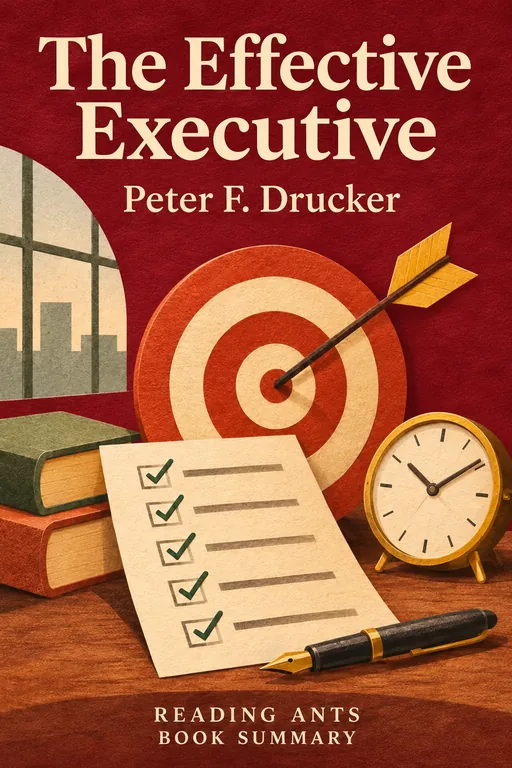
A classic management book that argues that effectiveness is a habit that can be learned, and that sets out five practices that help people to get the right things done.
Overview
The Effective Executive is a book by the Austrian-American management thinker Peter F. Drucker, first published in 1967. Drucker, who is often called the father of modern management, wrote it for “executives,” a word he uses for any knowledge worker who is expected to make decisions that affect results. He argues that effectiveness is not a gift, but a set of practices that can be learned by anyone. The book is short and practical, and has been in print for more than half a century.
Full Summary
1. Effectiveness can be learned
The idea: Drucker begins by saying that being effective means getting the right things done. It is not the same as being clever or hard-working. He says that intelligence and knowledge only set limits on what a person can achieve, and that effectiveness is what turns them into results. It is a set of habits, and these habits can be learned.
From the book: He argues that effectiveness is a discipline made up of a few practices, and not a matter of personality or talent.
In real life: A student who does not seem the smartest in class, but who plans their work and meets deadlines, often does better than a clever student who is disorganized.
2. Know where your time goes
The idea: Time is the limiting resource. The first step to effectiveness is to find out how you actually spend your time, by keeping a record, and then to remove the activities that do not produce results.
From the book: Drucker recommends tracking your time over a period, and then cutting out tasks that are not productive, delegating some and doing the most important ones in large blocks.
In real life: Keep a log of your day for one week. You may find that you spend hours on messages, or on tasks that someone else could do.
3. Focus on contribution
The idea: Effective people ask, “What can I contribute?” They look beyond the tasks of their job to the results that they can achieve for the organization or for other people. This gives their work meaning and direction.
From the book: He says that an organization needs contribution in three areas: direct results, building and reaffirming values, and developing people for the future. Asking the question turns attention outward, away from the job description and toward what the organization needs.
In real life: In a group project, ask what the team needs most from you, and then aim to deliver exactly that.
4. Build on strengths
The idea: Drucker says that one should make use of strengths, in oneself and in others, and not dwell on weaknesses. An organization is effective when it makes people’s strengths productive, and their weaknesses irrelevant.
From the book: He advises managers to choose people for what they can do, and not to be put off by what they cannot do.
In real life: If a friend is great at drawing but poor at speaking, ask them to make the posters, and let someone else give the talk.
5. First things first
The idea: Effective people concentrate. They decide what is most important, and do it one thing at a time, and they have the discipline to say no to other demands. Drucker says that we should decide what to give up, as much as what to do.
From the book: He says that concentration is the core of effectiveness: do first things first, and one thing at a time. He adds that deciding what not to do is harder than setting priorities.
In real life: Pick the most important task of the day and do it first, before checking messages or doing small jobs.
6. Make effective decisions
The idea: Decisions are the core of the executive’s work. Drucker says that a good decision is not made by a vote among people who agree, but by starting from different opinions and testing them against the facts. A good decision is based on real disagreement. Drucker also separates generic problems from exceptional ones, asks for clear boundary conditions, and says that a decision must include the action that will carry it out, and feedback to check it.
From the book: He argues that one should aim to find what is right before asking what is acceptable, and that opposing views are a tool for thinking and not a nuisance.
In real life: Before making a big choice, such as which school to attend, write down the problem clearly, and ask people with different views for their opinions.
Why It Matters
The Effective Executive is a classic of management writing, and it has been read by generations of managers and leaders. Many of the ideas, such as tracking one’s time and focusing on contribution, have become standard advice. Drucker’s focus on knowledge workers, a term that he coined in 1959, was ahead of its time, as the number of such workers has grown greatly. The book is also admired for being short, clear and free of jargon. Many later books on productivity, such as those on focus and on making the best use of one’s time, owe a great deal to it, and managers at all levels still go back to it for its calm and sensible approach to getting results.
Key Takeaways
- Effectiveness is a habit. It can be learned.
- Time is precious. Know where it goes.
- Contribute. Ask how you can serve the goals of the organization.
- Use strengths. Do not dwell on weaknesses.
- Prioritize. Focus on the most important things, and do them one at a time.
- Decide with care. Define the problem first, and welcome disagreement.
What We Can Learn
You do not need to be a manager to use Drucker’s advice. A student, a parent or a volunteer can all benefit from tracking time, setting priorities and thinking about their contribution. These habits can reduce stress, and help us to feel that our days have been well spent.
It also teaches us to be realistic about our own strengths and weaknesses, and to build teams that make use of different gifts. Finally, it shows that making good decisions requires time and discussion, and not only quick judgment.
Criticism and Counterpoints
Some readers find the book dated, since it was written in the 1960s and its examples come from large organizations and a world of male managers. The language of “executives” may seem narrow, though the ideas apply more widely. Others say that the advice is common sense, or that it is too focused on results and not enough on creativity or well-being, though Drucker’s central point is that effectiveness means getting the right things done. A few feel that the book does not give enough practical guidance on how to put its ideas into action.
Who Should Read It
This book is for managers, students and anyone who wants to be more effective. It is short and easy to read. Readers who want a fresh, modern approach to productivity may find it plain, but its ideas are the foundation of much that came after.
Want the whole book?
A summary is a taste, not the meal. Here is where to find the full book.
You reached the end 🎉
Nicely done. Mark this one as read, and we will suggest what to read next.
Read this next
Deep Work
Cal Newport
Cal Newport argues that the ability to focus without distraction on hard tasks, which he calls deep work, is becoming rare and valuable, and shows how to train it and protect it in a distracted world.
🌱 Self-Improvement
The 7 Habits of Highly Effective People
Stephen R. Covey
Lasting success in life and work comes not from quick tricks or a charming personality but from good character, built through seven habits that move us from depending on others, to standing on our own, to working well with others.
🌱 Self-Improvement
Good to Great
Jim Collins
Collins argues that sustained corporate improvement comes from disciplined leaders, carefully chosen people, a focused economic concept and cumulative execution rather than dramatic transformation programs.
💼 Business
The One Minute Manager
Kenneth Blanchard and Spencer Johnson
A short story about a young man searching for a good boss teaches three quick habits, clear goals, immediate praise and immediate, fair correction, that can make people more productive and happier.
💼 Business
The 5 Love Languages
Gary Chapman
Gary Chapman proposes that people give and receive love in five main ways, words of affirmation, quality time, gifts, acts of service and physical touch, and that relationships improve when partners learn each other's primary language.
🌱 Self-Improvement
The Lean Startup
Eric Ries
Startups succeed not by following a detailed plan but by quickly testing their ideas with real customers, learning from the results and changing direction when needed.
💼 BusinessWant something different?
Pick another topic and we will show you three books to start with.