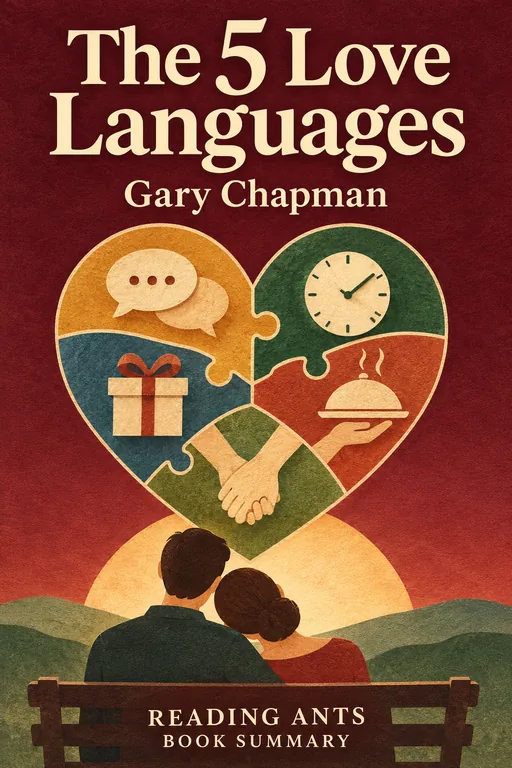
The 5 Love Languages
Gary Chapman proposes that people give and receive love in five main ways, words of affirmation, quality time, gifts, acts of service and physical touch, and that relationships improve when partners learn each other's primary language.
Overview
The 5 Love Languages (later editions carry the subtitle The Secret to Love That Lasts) was written by Gary Chapman, an American pastor and marriage counselor, and first published in 1992. Chapman based the book on many years of counseling couples, in which he noticed that people often felt unloved even when their partners were sincerely trying to show love. His explanation was that people have different “languages” for expressing and receiving love, and that misunderstandings arise when partners speak different ones. The book became a long-running bestseller, with revised editions and versions for children, teens, singles and workplaces, and sold tens of millions of copies.
Full Summary
1. The love tank and the in-love experience
The idea: Chapman begins by observing that everyone has an emotional love tank that needs to be filled. When it is full, people feel secure and content, and when empty, they feel hurt and distant. He discusses the early stage of romantic love, “being in love,” which he says is temporary. After that, he suggests that real, lasting love is a choice, which requires effort and attention, and that learning to meet a partner’s emotional needs keeps the tank full.
In real life: A couple who stop noticing each other after the excitement fades may need to deliberately build habits of care.
2. Words of affirmation
The idea: The first love language is words of affirmation: compliments, encouragement, kind words and expressions of appreciation. For some people, hearing “I love you,” “Thank you” or “You did a great job” means more than anything. Chapman cautions that harsh or critical words can be especially painful to those whose main language is affirmation, and suggests that tone of voice matters.
In real life: A short note saying “I’m proud of you” can brighten someone’s day.
3. Quality time
The idea: The second is quality time: giving someone your undivided attention, such as talking without distractions, taking a walk together or doing an activity side by side. It is not about being in the same room while looking at a phone, but about being present. Chapman says that for people with this language, distractions or postponed dates can feel like rejection. Quality conversation, in which each person shares thoughts and feelings, is a key form.
In real life: Putting phones away at dinner shows a partner that they matter.
4. Receiving gifts
The idea: The third language is receiving gifts. For people with this language, a thoughtful gift is a visible symbol of love. It’s not about price but about the thought behind it. Chapman suggests that, for such people, forgetting a birthday or anniversary is especially hurtful. He recommends that those who do not naturally speak this language learn to give small, meaningful gifts, which can be as simple as a flower or a favorite snack.
In real life: Bringing home a small item because it reminded you of your partner shows that you thought of them.
5. Acts of service and physical touch
The idea: The fourth is acts of service: doing helpful things such as cooking a meal, washing dishes or running errands, as a way of showing love. For those with this language, laziness or broken commitments feel like a lack of love. The fifth is physical touch: hugs, holding hands, a pat on the back and other forms of closeness. Chapman stresses that touch can communicate love, comfort and security, and that its absence can be painful.
In real life: A partner who is exhausted may feel loved when the other takes over a chore without being asked.
6. Discovering and speaking the language
The idea: The last chapters explain how to discover your own primary language and your partner’s, by looking at what you complain about, what you request most often and how you tend to express love. Chapman encourages people to learn to speak the other’s language, even if it feels unnatural, as an act of love. He also extends the idea to children, parents and friends, and says that speaking the right language can renew a relationship over time.
In real life: Asking “What makes you feel most loved?” can open a useful conversation with a friend or partner.
Why It Matters
The 5 Love Languages is one of the best-selling relationship books ever. It has given millions of couples, families and friends a simple vocabulary for talking about how they feel loved, and the term “love language” has entered everyday speech. It has also been used in church groups, marriage counseling and schools, and has spawned quizzes, apps and workbooks.
Its popularity reflects how many people feel unseen in relationships and appreciate a straightforward explanation.
Because the idea is so easy to remember, couples often use the five names as shorthand during arguments or at moments of reconciliation, which may be one of its greatest practical benefits.
Key Takeaways
- People feel loved differently. Not everyone responds to the same gestures.
- Learn your partner’s language. Pay attention to what they value.
- Love is a choice. Keep investing after the first excitement fades.
- Small acts count. Notes, time, gifts, help and touch all matter.
- Ask and listen. Conversation helps you understand each other’s needs.
What We Can Learn
The book teaches that good intentions are not enough; the way we express care needs to fit the person receiving it. Asking what makes someone feel appreciated can prevent misunderstanding.
It also encourages us to put in effort even when it feels unnatural. Doing something thoughtful in the other person’s language, instead of our own, is a sign of respect.
Finally, it can help in many relationships, not only romantic ones. Friends, parents, children and coworkers also have preferences about how they feel valued.
Criticism and Counterpoints
Researchers have found little scientific support for the idea that people have a single primary love language or that matching languages leads to happier relationships. Research on couples has suggested that people tend to value all five forms of expression and that the theory’s predictions did not hold, and the categories are based on Chapman’s counseling experience rather than controlled research.
Critics also note that the book is written from a Christian, mostly heterosexual and marriage-focused perspective, and that its suggestions may not work for everyone, especially in cases of abuse, where it could encourage someone to keep trying to please a harmful partner. Others say the idea is simplistic. Still, many find the framework a helpful starting point for conversation.
Who Should Read It
This book suits teenagers and adults, and couples reading together. It is short and easy to follow. Readers should treat the five categories as a conversation tool and not a scientific classification.
Want the whole book?
A summary is a taste, not the meal. Here is where to find the full book.
You reached the end 🎉
Nicely done. Mark this one as read, and we will suggest what to read next.
Read this next
How to Win Friends and Influence People
Dale Carnegie
People are driven by emotion and the desire to feel important, so the way to get along with them, and win them to your point of view, is to stop criticizing, show genuine interest and appreciation, and see things from their side.
🌱 Self-Improvement
How to Talk So Kids Will Listen and Listen So Kids Will Talk
Adele Faber and Elaine Mazlish
Parents can get better cooperation and closer relationships by acknowledging children's feelings, describing problems instead of blaming, and using simple, respectful communication skills.
🎓 Parenting & Education
Emotional Intelligence
Daniel Goleman
Daniel Goleman argues that the ability to understand and manage emotions, our own and others', matters as much as IQ for success, relationships and well-being, and that it can be learned.
🌱 Self-Improvement
Never Split the Difference
Chris Voss
Former FBI hostage negotiator Chris Voss teaches that great negotiation comes not from logic and compromise but from listening, empathy and asking the right questions, so that the other side feels understood and wants to cooperate.
🌱 Self-Improvement
Atomic Habits
James Clear
Big changes in life come not from huge leaps but from tiny habits repeated every day, and you can build good habits (and break bad ones) by designing your life so the right choices are obvious, attractive, easy and satisfying.
🌱 Self-Improvement
The 7 Habits of Highly Effective People
Stephen R. Covey
Lasting success in life and work comes not from quick tricks or a charming personality but from good character, built through seven habits that move us from depending on others, to standing on our own, to working well with others.
🌱 Self-ImprovementWant something different?
Pick another topic and we will show you three books to start with.