 Reading Ants
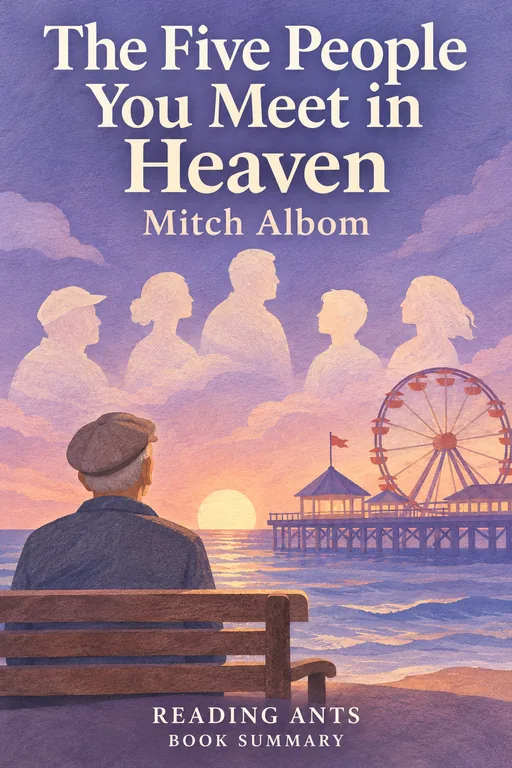
The Five People You Meet in Heaven
Mitch Albom's short novel follows Eddie, an elderly amusement-park maintenance man who dies saving a child, and meets five people in the afterlife who explain how his life connected to theirs, and why it mattered.
Overview
The Five People You Meet in Heaven was published in 2003 by Mitch Albom, an American sportswriter and author, who had earlier written Tuesdays with Morrie. It is a work of inspirational fiction, a fable about the meaning of life and death. The character of Eddie was inspired by Albom’s uncle. The book is short, and set partly in a seaside amusement park called Ruby Pier. It became a huge bestseller, and was adapted for television.
Main Characters
- Eddie: an elderly maintenance worker at Ruby Pier who feels that his life has been small.
- The Blue Man: the first person Eddie meets in heaven, a man whose death is linked to Eddie’s childhood.
- The Captain: Eddie’s commanding officer in the war.
- Ruby: the woman after whom the pier is named.
- Marguerite: Eddie’s late wife, whom he loved deeply.
- Tala: a young Filipino girl whom Eddie did not know.
- Eddie’s father: a hard, angry man who shaped Eddie’s life.
Full Summary
Eddie’s last day
The story opens on Eddie’s eighty-third birthday, which is also his last. He is a maintenance worker at Ruby Pier, the seaside amusement park where he has worked for decades, and he feels that his life has been small and unfulfilled. He is haunted by memories of a hard, angry father, his war service and an injury to his leg that left him with a lifelong limp. On that day, a ride called Freddy’s Free Fall breaks down, and a falling cart threatens a little girl named Annie. Eddie rushes to save her, and he dies, feeling a small hand in his, not knowing whether he succeeded.
The Blue Man
In the afterlife, Eddie meets the first person, a blue-skinned man known as the Blue Man, who had been a sideshow performer. The Blue Man explains that he died of a heart attack when his car swerved to avoid Eddie, who as a small boy ran into the street after a ball. The Blue Man tells Eddie that he will meet five people in all, each of whom either changed his life or had their own life changed by him. The lesson is that there are no random events and that all lives are connected, as parts of a larger story.
The Captain
The second person is Eddie’s commanding officer in the war. They had been prisoners together in a forced labor camp in the Philippines, and their group burned the camp as they escaped. As Eddie ran, he glimpsed a shadow moving in one of the burning huts, and the Captain shot him in the leg to stop him from running back into the fire. The Captain explains that this saved Eddie’s life, though it left him with a lifelong limp. The Captain later died by stepping on a land mine that would otherwise have killed his men. His lesson is about sacrifice: Eddie, who had long resented the injury, begins to see it in a new light.
Ruby
The third person is Ruby, the woman after whom the pier was named. Her husband, Emile, built it as a tribute to her. Eddie finds himself outside a diner, where he sees his father through the window, and Ruby appears beside him. She shows him the true cause of his father’s death, which is different from what Eddie had always believed. Eddie’s father was a harsh man, and Eddie had resented him for most of his life. Ruby teaches that holding on to anger hurts the one who holds it, and she tells Eddie that he needs to forgive his father.
Marguerite
The fourth person is Eddie’s late wife, Marguerite, whom he loved deeply. They had met at Ruby Pier and married after he returned from the war, and she had died long before him, leaving him lonely for years. The pier where Eddie spent his working life was also where their story began. In heaven, the two remember their wedding and scenes from their life together. She teaches him that love is never lost in death: it moves on and takes a different form.
Tala and the meaning of his life
The fifth person is a young Filipino girl, Tala, whom he did not know, who had died in the war, when he was a soldier. During the escape, his group burned the camp, and she was in a hut that he had set on fire, though he did not know it. Eddie breaks down when he learns this. Tala gives him a stone and asks him to wash her, as the other children in a riverbed are washing one another, and as he does, her scars and wounds fade away. Eddie asks whether he saved the little girl at the pier, and Tala tells him that he pushed her out of the way. In this way, she explains, he had been making up for her death every day, and he learns that his life mattered. In the end, his heaven is the band shell at the pier where he first met Marguerite.
Why It Matters
The Five People You Meet in Heaven was a major international bestseller, selling millions of copies, and stayed on the lists for a long time. It spoke to readers’ wish for meaning, and for reassurance that their lives and sacrifices matter, particularly the lives of ordinary working people. It was adapted for a television film in 2004, and a sequel, The Next Person You Meet in Heaven, appeared in 2018. The book is often given to people who are grieving, and used in discussions of death and legacy. Its simple style and moving message have made it popular across different ages.
Key Takeaways
- All lives are connected. Our actions affect others in unseen ways.
- Sacrifice matters. Giving something up for others can be a gift.
- Forgiveness frees us. Anger hurts the one who holds it.
- Love continues beyond loss. Memory keeps it alive.
- Every life has meaning. Ordinary work and care matter.
What We Can Learn
You can use the story to think about the people who have shaped your life, and how you might have affected others without knowing it. Take time to thank someone, and to forgive someone, if you can. Reflect on what you consider a “small” life, and how kindness and work have value. Talk with an older relative about their life. At the same time, enjoy the story as a story, in which the afterlife is a way of exploring ideas, not a doctrine. If you are grieving, speak to someone you trust, and know that it is a gentle, though sad, book.
Criticism and Counterpoints
Some critics find the book sentimental, and the plot, with its neat connections and lessons, too contrived, and the characters thin. Others say that the picture of an afterlife in which every suffering is explained oversimplifies grief and the question of why bad things happen. Religious readers may find its vague spirituality unsatisfying, or at odds with their beliefs. Some reviewers note that the writing style, with short sentences, is simple. Still, many readers find the story consoling.
Who Should Read It
This book is for readers who like short, emotional fables about life and death, including older children and teenagers. It can be read in an afternoon. Those who prefer realistic or complex fiction may find it too sweet, and those who are recently bereaved may find it either comforting or painful.
Want the whole book?
A summary is a taste, not the meal. Here is where to find the full book.
You reached the end 🎉
Nicely done. Mark this one as read, and we will suggest what to read next.
Read this next
Tuesdays with Morrie
Mitch Albom
Sportswriter Mitch Albom visits his old college professor, Morrie Schwartz, every Tuesday as Morrie dies of ALS, and records the wisdom about life, love and death that Morrie shares in his last months.
🌱 Self-Improvement
The Alchemist
Paulo Coelho
A young Spanish shepherd follows a recurring dream across the desert to the Egyptian pyramids in search of treasure, and learns that the journey toward one's dream is itself the greatest treasure.
🌍 World Literature
The Monk Who Sold His Ferrari
Robin Sharma
In this fable, a successful lawyer who suffers a heart attack sells his possessions and travels to India and the Himalayas, where he learns from sages a set of simple principles for a fulfilled life, which he later passes on to a friend.
🌱 Self-Improvement
The Little Prince
Antoine de Saint-Exupery
A pilot stranded in the desert meets a small boy from a tiny planet, who teaches him that the most important things in life, like love and friendship, can only be seen with the heart.
🌍 World Literature
Man's Search for Meaning
Viktor E. Frankl
A psychiatrist who survived the Nazi concentration camps explains that even in the worst suffering, people can choose their attitude, and that finding a reason to live is what gives us the strength to endure.
👤 Real Lives
The Kite Runner
Khaled Hosseini
A wealthy boy in Kabul betrays his loyal best friend on the day of a kite tournament, and decades later, after fleeing to America, he returns to a Taliban-ruled Afghanistan to try to make things right.
✨ Modern FictionWant something different?
Pick another topic and we will show you three books to start with.