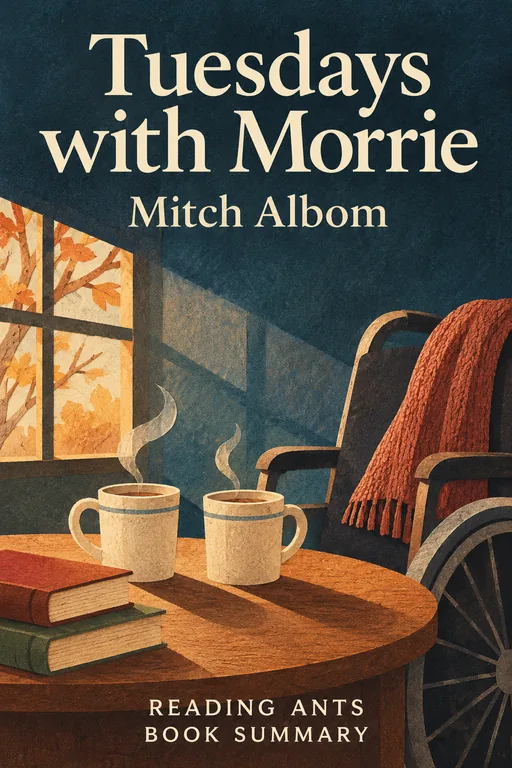
Tuesdays with Morrie
Sportswriter Mitch Albom visits his old college professor, Morrie Schwartz, every Tuesday as Morrie dies of ALS, and records the wisdom about life, love and death that Morrie shares in his last months.
Overview
Tuesdays with Morrie: An Old Man, a Young Man, and Life’s Greatest Lesson is a memoir by Mitch Albom, a sports journalist and radio host in Detroit, published in 1997. Sixteen years after graduating from Brandeis University, Albom sees his former sociology professor, Morrie Schwartz, on a television program, in which Morrie speaks about living with amyotrophic lateral sclerosis, or ALS, also known as Lou Gehrig’s disease, a progressive illness that affects the muscles. Albom, who had lost touch with Morrie and become overworked and disconnected, goes to see him. They begin meeting every Tuesday, in what Morrie calls “our final thesis.” The book became a worldwide bestseller.
Full Summary
1. The curriculum and a reunion
The idea: The book opens with a description of the “last class” of Morrie’s life, which met on Tuesdays in his study, with only one student, and had no grades. Albom recalls his college days, when Morrie was his favorite teacher, and how he promised to stay in touch but did not. Now Albom is a successful but harried columnist, working relentlessly and not allowing himself to feel much. When he sees Morrie on television, he feels guilty, and decides to visit, flying from Detroit to Massachusetts.
In real life: Many people lose touch with the teachers and friends who mattered to them, and reconnecting can be meaningful.
2. Learning to die so you can live
The idea: Morrie, whose body is gradually failing, is calm and cheerful. He tells Albom that when you learn how to die, you learn how to live. Each week, he loses more of his abilities: first he needs a cane, then a wheelchair, then help to eat and finally breathing equipment. Even so, he talks openly about death and says that he wants to use his time to teach. He also holds a “living funeral,” where friends and family speak while he can hear them.
In real life: Telling people how much they mean to you while they can hear it is a powerful act.
3. The lessons: love, regrets, family and money
The idea: Each Tuesday has a theme, such as the world, feeling sorry for yourself, regrets, death, family, emotions, aging, money, love, marriage, forgiveness and the perfect day. Morrie says that the most important thing in life is to learn how to give love and let it come in. He says that family provides support and a sense of belonging, that we should not worry about growing old, and that money and possessions do not give lasting fulfillment. He also says that we should forgive ourselves and others before it is too late.
In real life: Choosing to spend time with family and friends is often more meaningful than chasing another promotion.
4. Culture and “building your own”
The idea: Morrie criticizes aspects of modern culture, which he says encourages people to chase money and fame, and that it can numb us to real connection. He encourages people to create their own culture, a set of values and relationships that fits them, instead of simply accepting what is offered. He tells Albom to ask himself whether he is a person who gives to others, whether he is at peace and whether he is engaged in meaningful work.
In real life: Deciding which values guide your daily choices, such as kindness and honesty, is a way to build your own culture.
5. Physical decline and emotional openness
The idea: As Morrie gets weaker, Albom helps him with small things, like feeding and wiping his face, and Morrie lets himself be dependent, saying that he allows himself to cry and be cared for. Albom, who begins to open up, mends relationships, such as one with his brother, and starts to rethink his own priorities. Morrie says that the pain of loss is part of love, and that he does not want to be ashamed of crying.
In real life: Accepting help can be hard, but it can deepen connection.
6. The final goodbye and the funeral
The idea: The last Tuesdays are difficult, as Morrie struggles to breathe. Albom visits for the last time and says goodbye, with an exchange of love. Morrie dies on a Saturday in November 1995. At the funeral, Albom thinks about what Morrie taught him: that love is how we stay alive even after death, and that the relationships we build continue to support us. Albom ends with the sense that their relationship still lives on, as the “last class” never really ends.
In real life: Memories of someone we loved can continue to guide us after they are gone.
Why It Matters
Tuesdays with Morrie became one of the best-selling memoirs of all time, with millions of copies sold and translations in dozens of languages. It was adapted into an Emmy-winning television movie in 1999, starring Jack Lemmon and Hank Azaria, and into a stage play. The book is widely read in schools and hospices.
Its simple, direct style made conversations about death and meaning accessible, and Morrie’s nationally broadcast interview with Ted Koppel, which helped lead to the book, introduced him to many Americans.
Albom gave much of the money earned to cover Morrie’s medical bills, and later to charity, which has added to the book’s reputation as an act of gratitude as well as a work of literature.
Key Takeaways
- Love is what matters. Giving and receiving love is life’s central task.
- Face death honestly. Accepting it can help you live more fully.
- Don’t chase empty goals. Money and status do not bring lasting happiness.
- Make time for people. Relationships need attention.
- Forgive. Letting go of grudges brings peace.
What We Can Learn
The book invites us to reflect on our priorities. If we knew we had only a few months, what would we change? Asking this now, while we have time, can help us to align our days with what matters.
It also encourages us to reach out. Calling an old friend, thanking a teacher or repairing a broken relationship can bring comfort to both sides.
Finally, it reminds us that dignity in illness is possible. Morrie’s willingness to be open about his needs and fears is a model for facing hard times with honesty and humor.
Criticism and Counterpoints
Some critics find the book sentimental and its advice simple, and say that it presents a very idealized picture of dying, in which the dying person is wise and peaceful, which may not match the experience of many families. Others note that Morrie had loving support and good medical care, which not all patients have.
Some readers say that the book’s wisdom is familiar and that its style, with short sentences and a pared-down tone, is too simple. A few reviewers also argued that Albom’s role as the narrator is more prominent than needed. Many readers, however, have found it comforting and moving.
Who Should Read It
This book suits readers from about age ten up to adults. It is short and easy to read, but it deals with a dying person and can bring up deep emotions. It is a good book for sharing between generations.
Want the whole book?
A summary is a taste, not the meal. Here is where to find the full book.
You reached the end 🎉
Nicely done. Mark this one as read, and we will suggest what to read next.
Read this next
The Last Lecture
Randy Pausch
Dying of pancreatic cancer, computer science professor Randy Pausch shares life lessons about achieving your dreams, helping others and enjoying every moment, in a book based on his famous farewell lecture.
🌱 Self-Improvement
When Breath Becomes Air
Paul Kalanithi
Paul Kalanithi, a young neurosurgeon, writes about facing terminal lung cancer at thirty-six and asks what makes a life meaningful when time is short.
👤 Real Lives
Being Mortal
Atul Gawande
Surgeon and writer Atul Gawande argues that modern medicine is good at fighting death but poor at helping people live well as they age and approach the end, and that doctors and families should focus on what matters most to the person.
👤 Real Lives
Man's Search for Meaning
Viktor E. Frankl
A psychiatrist who survived the Nazi concentration camps explains that even in the worst suffering, people can choose their attitude, and that finding a reason to live is what gives us the strength to endure.
👤 Real Lives
The Five People You Meet in Heaven
Mitch Albom
Mitch Albom's short novel follows Eddie, an elderly amusement-park maintenance man who dies saving a child, and meets five people in the afterlife who explain how his life connected to theirs, and why it mattered.
✨ Modern Fiction
Atomic Habits
James Clear
Big changes in life come not from huge leaps but from tiny habits repeated every day, and you can build good habits (and break bad ones) by designing your life so the right choices are obvious, attractive, easy and satisfying.
🌱 Self-ImprovementWant something different?
Pick another topic and we will show you three books to start with.