 Reading Ants
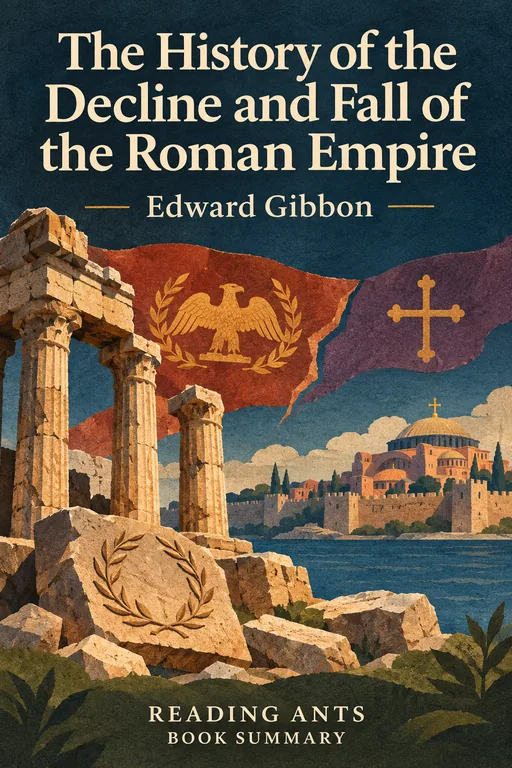
The History of the Decline and Fall of the Roman Empire
Edward Gibbon traces over a thousand years of Roman and Byzantine history, from the height of the empire in the second century to the fall of Constantinople in 1453, and offers a famous, elegant and controversial explanation of why Rome declined.
Overview
The History of the Decline and Fall of the Roman Empire was written by the English historian Edward Gibbon and published in six volumes between 1776 and 1788. Gibbon says that the idea came to him as he sat among the ruins of ancient Rome during a visit to the city. The work begins with the empire at its peak, and follows its slow weakening, the division between East and West, the barbarian invasions and the long story of the Eastern Roman, or Byzantine, state. It is admired as a masterpiece of English prose, and its irony, wit and wide learning have kept it alive.
Full Summary
1. The empire at its height
The idea: Gibbon opens with a picture of the Roman Empire in the second century, when it stretched across Europe, North Africa and the Middle East. He says that for several generations it was ruled by capable emperors who kept peace, built roads and cities and governed with moderation. In his view, this was the period in which the human race was most happy and prosperous. But he shows that the seeds of trouble were already there, in the army’s power over the throne.
In real life: A school or a club can look strong from the outside, while the habits that will cause trouble are already forming.
2. Crisis, soldiers and emperors
The idea: After the Antonine emperors, the empire passed through a period of civil wars, weak emperors and frequent murders, in which the army, and particularly the elite guards in Rome, made and unmade rulers. Gibbon describes how the throne was sold to the highest bidder at one stage. He argues that when the army controls the state, order collapses. Later emperors such as Diocletian tried to restore stability by dividing the work of government.
In real life: When the people who are supposed to guard the rules start to decide who gets to be in charge, trust in the system fades.
3. Constantine, Christianity and a new capital
The idea: In the fourth century, Constantine became emperor and, after a famous victory, gave favor to the Christian religion, which had been persecuted. He founded a new capital at Byzantium, which was renamed Constantinople. Gibbon describes the growth of the church and the arguments over doctrine. He also suggests, controversially, that the spread of Christianity made the empire more concerned with the next world, and less with defense, a claim that drew angry responses from some readers.
In real life: A new idea can change what a community values, and not everyone will agree about whether this is good.
4. The barbarian invasions
The idea: In the fourth and fifth centuries, groups the Romans called barbarians, such as Goths, Vandals and Huns, pressed on the borders and entered the empire. The Goths, who had been allowed to settle, rebelled and defeated a Roman army in 378, and later their leader Alaric sacked Rome in 410. In 476, the last emperor of the West was removed. Gibbon explains these events in terms of both the pressure from outside and the weakness within.
In real life: A wall can be strong on paper, but if the guards are tired or divided, it may not hold.
5. The Eastern Empire
The idea: While the West collapsed, the eastern half, centered on Constantinople, lasted for another thousand years. Gibbon tells about Justinian, whose armies recovered some of the lost lands and whose lawyers organized Roman law, and about the later struggles with Persians, Arabs and others. He is less sympathetic toward the Byzantines, whom he sees as often stagnant and wrapped up in religious disputes.
In real life: A group that survives for a very long time may do so by changing, but it may also lose some of its energy.
6. The rise of Islam and the end
The idea: Gibbon describes the rise of the Arab empire under the new faith of Islam, whose armies took much of the Eastern Empire’s land in the seventh century, as well as the Crusades, the Mongols and the rise of the Ottoman Turks. His history ends with the fall of Constantinople in 1453, when the Ottomans captured the city and ended the Roman state. He reflects on the ruins of Rome, and on the fate of great powers.
In real life: Even the oldest institutions can come to an end, and that makes it important to understand how change occurs.
Why It Matters
Gibbon’s work is among the most influential history books in the English language. It set a new standard for the use of evidence and for the narrative sweep of history, and its prose style has been admired and imitated. It also shaped the way people have thought about the fall of Rome and the idea that civilizations can decline, which has been invoked in discussions of modern empires. The theory of causes that Gibbon presents, with a mix of military, political, moral and religious factors, remains a model for debate. Winston Churchill was among the later readers who admired it. Historians today disagree with many details, but few deny its importance as a literary and intellectual achievement.
Key Takeaways
- Empires decline from within and without. Military pressure and internal weakness work together.
- Power in the wrong hands is dangerous. When armies make emperors, stability disappears.
- Ideas change societies. Religion and values can alter priorities.
- Decline can be slow. The fall of Rome took centuries, not days.
- History is also literature. A great historian shapes events into a story that people want to read.
What We Can Learn
Gibbon’s book encourages us to think about what makes institutions last, such as fair rules, loyal service and a sense of common purpose. It warns us to be alert when those who hold power are not accountable. At the same time, it shows that the story of decline is not simple, and that different people have given different explanations. When you hear that a country or a company is declining, ask for evidence, and ask what is changing. Reading history critically teaches both humility and judgment.
Criticism and Counterpoints
Modern historians dispute many of Gibbon’s claims. They say that the term “fall” hides a long and complex transformation in the West, with continuities in law, language and religion, and that the East did not simply decline. His view of Christianity, as a cause of weakness, is considered unfair by many, and his attitude toward Byzantium reflects the prejudices of his time. Some of his sources are out of date, and new archaeological discoveries have changed the picture. Even so, scholars respect his scholarship and ideas, and the book remains a classic.
Who Should Read It
This book is for readers who love history and fine writing, and who have the time for a very long work. Many people read selected chapters or an abridged edition. Beginners in Roman history may want to start with a modern overview, and then enjoy Gibbon’s style and wit as a classic.
Want the whole book?
A summary is a taste, not the meal. Here is where to find the full book.
You reached the end 🎉
Nicely done. Mark this one as read, and we will suggest what to read next.
Read this next
SPQR: A History of Ancient Rome
Mary Beard
Classicist Mary Beard tells the story of Rome from its legendary beginnings to the third century CE, and shows how Romans themselves argued about their origins and how we know what we think we know about them.
🏛️ History
The Histories
Herodotus
Herodotus, often called the father of history, tells how the Greeks and the Persians came into conflict and fought the great wars of the early fifth century BCE, with long, colorful detours into the lands, customs and legends of the known world.
🏛️ History
History of the Peloponnesian War
Thucydides
Thucydides, an Athenian general turned historian, records the long war between Athens and Sparta in the fifth century BCE and uses it to study power, fear, politics and how human nature behaves in crisis.
🏛️ History
The Lessons of History
Will and Ariel Durant
After spending decades writing a huge history of civilization, Will and Ariel Durant distill what they learned into a short book of reflections on geography, human nature, morals, religion, economics, government, war and progress.
🏛️ History
Collapse: How Societies Choose to Fail or Succeed
Jared Diamond
Jared Diamond studies societies that collapsed and societies that survived, and argues that environmental damage, climate change, enemies, trade and the way a society responds to problems decide whether it fails or succeeds.
🏛️ History
Sapiens: A Brief History of Humankind
Yuval Noah Harari
Humans came to rule the planet not because we are the strongest animals but because we can believe in shared stories (gods, nations, money, companies) that let millions of strangers cooperate.
🏛️ HistoryWant something different?
Pick another topic and we will show you three books to start with.