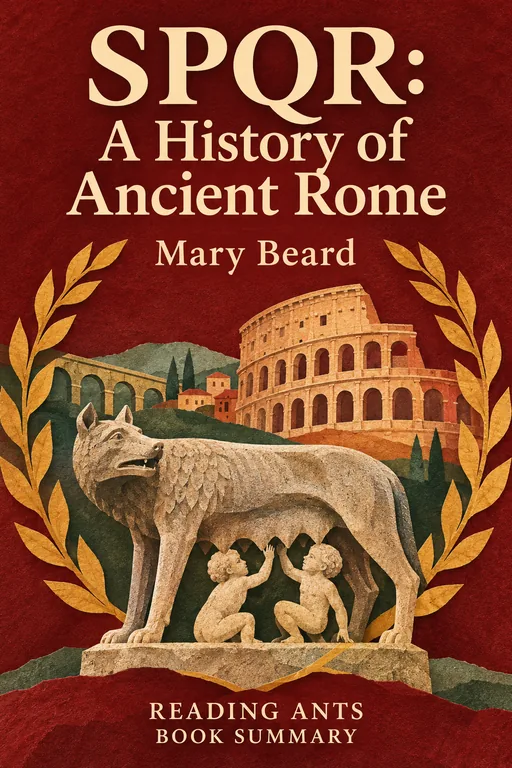
SPQR: A History of Ancient Rome
Classicist Mary Beard tells the story of Rome from its legendary beginnings to the third century CE, and shows how Romans themselves argued about their origins and how we know what we think we know about them.
Overview
SPQR: A History of Ancient Rome was published in 2015 by the classicist Mary Beard. The title is the abbreviation of a Latin phrase meaning “the Senate and People of Rome.” Beard covers about a thousand years, from the earliest times to the year 212 CE, when an emperor granted citizenship to nearly all free people in the empire. Rather than just listing great men and battles, she asks how we can know about the past, how stories were made, and what life was like for people at all levels of society, including women and others at the margins.
Full Summary
1. A city of legends
The idea: Beard starts with a famous event in the year 63 BCE, when the politician and orator Cicero uncovered a plot to overthrow the government (the Catiline conspiracy). The case lets her show how historians must work from limited sources and competing accounts. She then goes back to the beginning and looks at the myths about Rome’s origins, such as the story of the twins Romulus and Remus, raised by a wolf in the legend, and the tale of the Sabine women. She explains that the stories about early Rome were shaped by later writers with their own concerns, so our picture of the earliest period is patchy and inconsistent.
In real life: Every country, school and family has stories about its origins, and it is worth asking how much is memory and how much is legend.
2. Kings, a republic and a revolution
The idea: According to Roman tradition, the city was ruled by seven kings, the last of whom was driven out, and a republic was founded. Beard explains that we cannot be sure how much of this is true, since the earliest records are poor. She describes how the republic developed, with elected officials, a Senate and assemblies, and with a long conflict between rich families and the poorer citizens over rights and power.
In real life: Struggles over who gets a say, and who pays the costs, appear in many communities.
3. Conquest and its costs
The idea: From a small city in Italy, Rome expanded by war and alliance, first through the peninsula and then across the Mediterranean, defeating powers such as Carthage. Beard argues that this expansion was largely unplanned: the Romans sought glory and plunder, but there was no grand scheme for world domination. She also stresses that Rome was unusually good at absorbing defeated enemies. The success brought wealth and ambitious generals, and it changed Roman society and politics.
In real life: Rapid growth can bring benefits but also put strains on how people live and share power.
4. The crisis of the late Republic
The idea: In the later republic, from the Gracchus brothers in the second century BCE onward, the republic was shaken by violent politics, with the struggles of generals such as Sulla, Pompey and Julius Caesar, and civil wars. Beard follows how the old system broke down, and she suggests that Pompey has a strong claim to be thought of as the first Roman emperor. Caesar was assassinated in 44 BCE, but that did not restore the old order.
In real life: When people stop following the unwritten rules, a system that depended on trust can quickly break down.
5. Augustus and the empire
The idea: Caesar’s heir, Octavian, who became known as Augustus, defeated his rivals and built a new system in which he held huge power while claiming to have restored the republic. Beard warns against treating his own propaganda as the truth about the man. She also challenges the old habit, from ancient writers such as Tacitus and Suetonius onward, of sorting emperors into heroes and villains, and she suggests that for many people in the provinces the personality of the emperor made little difference.
In real life: A leader who keeps the old titles but changes the way power works can be harder to challenge.
6. Everyday life, slaves and women
The idea: Throughout the book, Beard looks beyond the elite, using evidence such as inscriptions and objects found by archaeologists, including a child’s coffin found under the Forum and a relief from a poultry shop. She contrasts the luxury of the wealthy with the squalor faced by the urban poor, and she reminds us that most people in the empire were peasants living close to subsistence. She also gives space to women, slaves and other people whose voices are rarely recorded.
In real life: A school history that mentions only the headmasters would miss most of what happened.
7. Who counts as a Roman
The idea: The story ends in 212 CE, when the emperor Caracalla extended Roman citizenship to nearly all free inhabitants of the empire. Beard presents this as the completion of a long “citizenship project” and a tradition of Rome absorbing outsiders, which she sees as one of the keys to its success. She also points out that the project was undercut by slavery, and she cautions readers against applying Roman approaches to citizenship directly to the modern world.
In real life: Communities that welcome newcomers often become larger and more adaptable.
Why It Matters
SPQR was a New York Times bestseller and a finalist for the National Book Critics Circle Award, and it helped to bring a fresh, critical view of Roman history to general readers. Reviewers praised its lively, witty writing and its balance, and its way of showing that history is an argument based on evidence, not a fixed set of facts. Beard’s attention to people at the margins and to the limits of our sources sets it apart from histories that simply list rulers, offices and battles. The book also tells us about our own world, since many political ideas, such as citizenship, republic and empire, come from Rome.
Key Takeaways
- Origins are stories. Rome’s early history is mixed with legend.
- Empires are not always planned. Rome’s expansion was driven by opportunity and glory, not a master plan.
- Success had a price. Conquest brought wealth, ambitious generals and, in time, civil war.
- Power can wear a mask. Augustus ruled as a monarch while keeping republican forms.
- Include everyone. To understand Rome, we must include ordinary people and outsiders.
What We Can Learn
When you read about the past, ask how we know, and whose point of view is missing. Notice how political language can hide the real distribution of power. Think of how communities grow, and what makes them either more open or more closed. Compare Roman questions, such as who counts as a citizen, with debates today. And enjoy the fact that people two thousand years ago were as curious, witty and complicated as we are. It is a good reminder that history is made by people.
Criticism and Counterpoints
Reviewers were mostly very positive, but some raised objections. The historian Richard Talbert felt that the book is slow to reach Rome’s rise as a power, that it has few maps and illustrations, and that it pays less attention to big-picture topics such as imperial strategy than to the private lives of individuals. He also questioned stopping in 212 CE, before the crises of the third century. Edith Hall in Prospect found the opening confusing, thought the chronology could disorient newcomers, and felt that too much space goes to Cicero. Beard’s supporters answer that her approach is a strength, as it makes the book an introduction to historical thinking.
Who Should Read It
This book is for readers who want a lively, modern introduction to ancient Rome, and for students beginning the subject. It is long but readable, with humor and clear explanations. Those who want a detailed account of battles or of the later empire may need other books as well.
Want the whole book?
A summary is a taste, not the meal. Here is where to find the full book.
You reached the end 🎉
Nicely done. Mark this one as read, and we will suggest what to read next.
Read this next
The History of the Decline and Fall of the Roman Empire
Edward Gibbon
Edward Gibbon traces over a thousand years of Roman and Byzantine history, from the height of the empire in the second century to the fall of Constantinople in 1453, and offers a famous, elegant and controversial explanation of why Rome declined.
🏛️ HistoryThe Histories
Herodotus
Herodotus, often called the father of history, tells how the Greeks and the Persians came into conflict and fought the great wars of the early fifth century BCE, with long, colorful detours into the lands, customs and legends of the known world.
🏛️ HistoryHistory of the Peloponnesian War
Thucydides
Thucydides, an Athenian general turned historian, records the long war between Athens and Sparta in the fifth century BCE and uses it to study power, fear, politics and how human nature behaves in crisis.
🏛️ History
Meditations
Marcus Aurelius
The private notebook of a Roman emperor, reminding himself daily to accept what he cannot control, to act with justice and kindness, and to remember that life is short.
🕊️ Philosophy & Religion
The Odyssey
Homer
After the Trojan War, the clever hero Odysseus struggles for ten years against monsters, gods and temptations to return home to his faithful wife and son, then must win back his house from the men trying to steal it.
🎭 Epics, Drama & Poetry
Sapiens: A Brief History of Humankind
Yuval Noah Harari
Humans came to rule the planet not because we are the strongest animals but because we can believe in shared stories (gods, nations, money, companies) that let millions of strangers cooperate.
🏛️ HistoryWant something different?
Pick another topic and we will show you three books to start with.