 Reading Ants
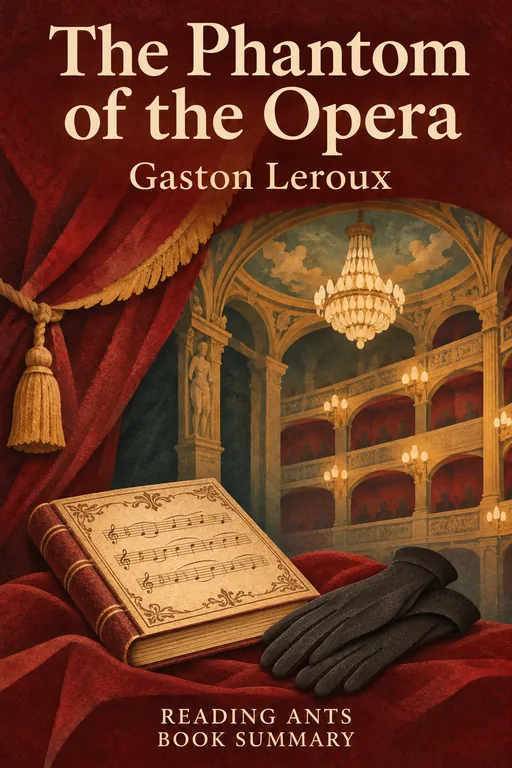
The Phantom of the Opera
Original title: Le Fantôme de l'Opéra
A mysterious, disfigured genius haunts the Paris Opera House and tries to win the love of a young singer, while her childhood sweetheart fights to save her.
Overview
The Phantom of the Opera is a novel by the French writer Gaston Leroux, published in 1910. It is set in Paris, in the great Opera House, at the end of the nineteenth century. It is a mixture of mystery, gothic horror and love story, told in the style of a journalist’s investigation. The story is better known today from stage and film versions, but the original book is different in many details. Its question is a poignant one: can a person who has been rejected for his appearance still be capable of love, and what does he do when he is refused?
Main Characters
- Erik, the Phantom: a brilliant, disfigured musician and architect who lives beneath the opera house.
- Christine Daae: a young Swedish singer with a beautiful voice.
- Raoul, Vicomte de Chagny: a young nobleman who has loved Christine since childhood.
- The Persian (the Daroga): a mysterious man who knows Erik’s past.
- Count Philippe de Chagny: Raoul’s older brother.
- Carlotta: the opera’s leading soprano, who is jealous of Christine.
- The managers: the men who run the opera house, who are at first skeptical of the ghost.
Full Summary
The Opera Ghost
The book begins with the narrator saying that he has investigated the case and found that the Opera Ghost is real. The old managers of the opera are leaving, and they warn the new ones about the ghost, who demands a salary and the use of Box Five. The new managers think it is a joke, until strange things start to happen.
On the very night the old managers leave, a stagehand is found hanged. Later, in the middle of a performance, the voice of the leading soprano suddenly cracks into a croak, and a great chandelier crashes into the audience. The new managers realize that the ghost is not a joke.
Christine’s Angel
Christine Daae is a young singer, who has been taught since the death of her father to expect a visit from the “Angel of Music.” In fact, a hidden voice has been tutoring her, and her voice has improved in remarkable ways. When the prima donna Carlotta cannot perform, Christine takes her place, and she is a triumph.
At the performance, Raoul, a young nobleman, sees her and recognizes the girl he knew as a boy. He falls in love with her again, but Christine pretends at first not to know him, because the voice she calls her Angel is jealous.
Erik’s Lair
On the night of the chandelier, Christine is taken by the Phantom, who is the voice that taught her, to his home deep below the opera house, beside an underground lake. There, she tears away his mask and sees his face, which is horribly disfigured, and she is terrified. He tells her that he loves her and will never let her leave. She is both frightened and sorry for him.
After about two weeks he lets her go, on the condition that she promises to come back, and she continues to sing under his guidance. Raoul, meanwhile, grows jealous, and he is afraid for her.
The Chase
Raoul and Christine plan to escape together, but the Phantom hears of the plan. He kidnaps Christine during a performance and takes her back to his lair. Raoul, with the help of the Persian, goes into the cellars to rescue her.
The Persian, who has known Erik for years, explains that he is a genius and a master of tricks, who built many of the opera’s secret passages. The two men fall into one of the Phantom’s traps, a torture chamber made of mirrors that creates the illusion of a forest and slowly drives them toward despair.
The Choice
Erik offers Christine a terrible choice: marry him, or he will blow up the opera house, and all the people in it. Christine turns the scorpion, the control Erik had said would mean yes. It floods the cellar where the gunpowder is stored and saves the opera house, but the water also rises in the torture chamber where Raoul and the Persian are trapped, and they are in danger of drowning. Christine, to save them, promises to be Erik’s living wife.
Erik, whose own mother would never let him kiss her, kisses Christine on the forehead, and she does not pull away. He weeps, overwhelmed by the first tenderness he has ever known. He releases them all, gives Christine a plain gold ring as a wedding present, and lets the couple go, asking only that she return one day, when he is dead, to bury him in secret with the ring. As they leave, Christine kisses his forehead too.
Erik’s Death
Not long afterward, a weak and ill Erik visits the Persian and tells him that he is dying of love, asking him to announce his death in the newspaper when it comes. Raoul and Christine have left Paris and gone to live a quiet life far away. Three weeks later, the paper prints a short notice that Erik is dead. The narrator closes his investigation by saying that a skeleton was later found in the cellars, wearing a plain gold ring, which proves that the ghost was a real man. The narrator is sure that the ring is the one that Christine slipped on his finger when she came back, as she had promised, to bury him.
Why It Matters
Leroux’s novel became the basis for many stage and screen adaptations, including the 1925 silent film with Lon Chaney, and the hugely successful musical by Andrew Lloyd Webber, which opened in 1986. Many people know the story from these versions, so the book is a surprise to readers who discover how different it is. The Phantom is one of the great sympathetic monsters in fiction, in the line of Frankenstein’s creature and Quasimodo. The Paris Opera House, the Palais Garnier, is a real place, and its legends continue to attract visitors.
Key Takeaways
- Appearance can hide worth. Erik is feared for his face, though he has remarkable gifts.
- Rejection can turn to cruelty. His pain makes him dangerous.
- Kindness can change a person. A moment of tears and tenderness undoes his plans.
- Love needs freedom. Forcing someone to love us does not work.
- Fear thrives on rumor. The opera staff’s superstition feeds the legend.
What We Can Learn
The book invites us to look beyond first impressions. Erik is a frightening figure, but he is also lonely, and he has been treated cruelly. It reminds us that people who seem threatening may be hurt, and that a little compassion can change things.
It also shows the danger of controlling someone else, even in the name of love. Real love must respect the other person’s choices. Finally, the story shows how legends grow from fear and rumor, and it encourages us to ask for evidence before we believe frightening stories.
Criticism and Counterpoints
Some readers find Leroux’s style old-fashioned and uneven, with a clumsy mix of newspaper-style reporting and melodrama. The plot has many coincidences, and the female characters, especially Christine, are less developed than in the stage version. Others point out that the book’s treatment of disability and the villain’s looks reflect the attitudes of its time. Still, the story remains lively and fun, and the strongest criticism is usually that the final chapters, with their long explanations by the Persian, slow down the pace after the thrilling middle of the book.
Who Should Read It
This book is for teenagers and adults who enjoy gothic stories and old-fashioned mystery, and for fans of the musical who are curious about the original. It is a quick, atmospheric read. Readers who expect the musical will find that the story, the characters and the ending differ in many ways.
Want the whole book?
A summary is a taste, not the meal. Here is where to find the full book.
You reached the end 🎉
Nicely done. Mark this one as read, and we will suggest what to read next.
Read this next

Dracula
Bram Stoker
An ancient vampire count from Transylvania moves to England to spread his curse, and a small band of brave friends, led by a wise Dutch professor, must hunt him down before he destroys them all.
📜 Classics
The Hunchback of Notre-Dame
Victor Hugo
In fifteenth-century Paris, the deformed bell-ringer Quasimodo, the cold archdeacon Frollo and the dashing captain Phoebus are all drawn into a deadly web of desire around the beautiful Gypsy dancer Esmeralda.
🌍 World Literature
Frankenstein
Mary Shelley
A young scientist creates a living being from dead body parts, then abandons it in horror, and his rejected creation, longing for love, turns to revenge.
🚀 Sci-Fi & Fantasy
Rebecca
Daphne du Maurier
A shy young woman marries a wealthy widower and moves to his great estate, Manderley, where she is haunted by the memory of his first wife, Rebecca, and slowly learns the truth about her death.
📜 Classics
The Count of Monte Cristo
Alexandre Dumas
A young sailor, betrayed by jealous rivals and thrown into a dungeon for fourteen years, escapes with the help of a fellow prisoner, finds a vast treasure and returns as a mysterious, powerful count to take elaborate revenge on those who ruined him.
🌍 World Literature
The Little Prince
Antoine de Saint-Exupery
A pilot stranded in the desert meets a small boy from a tiny planet, who teaches him that the most important things in life, like love and friendship, can only be seen with the heart.
🌍 World LiteratureWant something different?
Pick another topic and we will show you three books to start with.