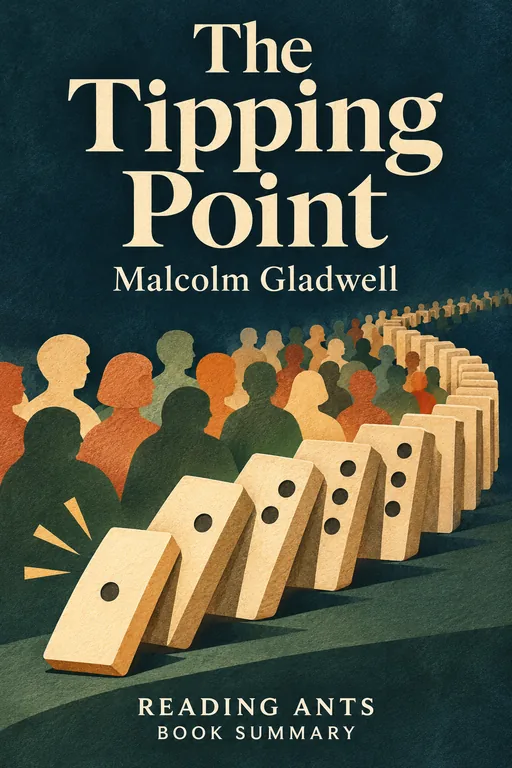
The Tipping Point
Ideas, products and behaviors spread like epidemics, and Malcolm Gladwell shows that small changes in a few key people, messages and circumstances can suddenly tip a trend into a major wave.
Overview
The Tipping Point: How Little Things Can Make a Big Difference was Malcolm Gladwell’s first book, published in 2000. Gladwell, a writer at The New Yorker, borrowed the idea of an epidemic from medicine. He observes that changes sometimes happen suddenly, after a long period of little change, when a tipping point is reached. He explores why crime dropped in New York City, why a brand of shoes suddenly became fashionable and why some children’s programs teach better than others. He identifies three rules that explain how such epidemics begin: the Law of the Few, the Stickiness Factor and the Power of Context.
Full Summary
1. Three rules of epidemics
The idea: Gladwell opens with the example of Hush Puppies, a brand of suede shoes that was nearly dead in the mid-1990s until a few trendsetters in downtown New York began wearing them, after which sales soared. He uses this to introduce the three rules: epidemics need the right people, a message that sticks and an environment that supports change. He also explains that epidemics spread nonlinearly: a small increase in cause can lead to a huge effect at the tipping point.
In real life: A song can sit unnoticed for months and then spread rapidly once a few influential people share it.
2. The Law of the Few: connectors, mavens and salesmen
The idea: A small number of people do most of the work in spreading ideas. Connectors know many people across different groups, as Paul Revere did when he rode to warn the colonists, while William Dawes, who rode a different route, did not provoke the same response. Mavens are information specialists who collect knowledge and share it generously, such as a person who always knows the best deals. Salesmen are charismatic persuaders who can convince others, even when they are reluctant.
In real life: A friend who always recommends restaurants or books, and whom everyone trusts, acts as a maven.
3. The Stickiness Factor
The idea: A message must be memorable enough to change behavior. Gladwell looks at children’s television shows Sesame Street and Blue’s Clues, which used research to learn what held children’s attention and adjusted their format accordingly. Small details, such as repetition or how a message is framed, can make a big difference. He gives the example of a tetanus-shot campaign at Yale, where adding a map of the campus health center to a persuasive booklet dramatically raised the number of students who got vaccinated.
In real life: A clear, specific instruction is much more likely to be followed than a vague one.
4. The Power of Context
The idea: People are heavily influenced by their surroundings, even in ways they do not notice. Gladwell uses the “broken windows” theory to explain how cleaning graffiti and fixing small signs of disorder in the New York subway and streets may have helped reduce crime, though this explanation is disputed. He also cites psychological experiments, such as the Stanford prison experiment, whose methods have since been heavily criticized, to argue that situations can change behavior. Small changes in the environment can shift behavior at a tipping point.
In real life: A clean, well-kept park invites people to respect it, while one covered with litter invites more litter.
5. The Rule of 150
The idea: Another form of context is group size. Gladwell reports that people can maintain real social relationships with only about 150 others (an approximate hypothesis, not a hard limit), a number he links to the anthropologist Robin Dunbar’s work and to the practice of the company W. L. Gore, which kept its factory units small so that people would know each other. In groups beyond this size, trust and peer pressure weaken. Dividing large groups into smaller ones can help ideas spread and cooperation grow.
In real life: In a small club, members know each other and tend to follow the group’s norms more closely than in a huge organization.
6. Case studies and conclusion
The idea: The book applies the framework to cases such as a rise in teenage smoking, a fashion trend, a syphilis epidemic in Baltimore and a wave of suicides in Micronesia. In each, small factors, such as the behavior of a core group or a change in the environment, helped tip the situation. The final chapter urges readers to see change as possible: with the right levers, even a small group can start a major shift in society.
In real life: A community that wants to improve, say, vaccination rates can focus on a few well-connected people and a clear message.
Why It Matters
The Tipping Point was a huge bestseller and helped make “tipping point” a common phrase in business and politics. It influenced marketing, public health campaigns and the study of social networks. Companies and organizations worked to find “influencers” and design messages and environments accordingly.
The book also brought academic findings from sociology and psychology into everyday conversation, and it launched Gladwell’s career as one of the most widely read nonfiction authors. It is still taught in business and communication courses, where students are asked to apply its three rules to a product, a campaign or a school problem of their own choosing, and to test whether the framework really explains what happens.
Key Takeaways
- Small causes, big effects. Trends can change suddenly.
- A few people matter. Connectors, mavens and salesmen spread ideas.
- Make it stick. Memorable messages change behavior.
- Context shapes action. The environment influences people.
- Group size matters. Smaller groups build stronger bonds and stronger shared habits.
- Anyone can apply it. Teachers, parents and organizers can look for leverage points.
What We Can Learn
The book teaches us to think about change in terms of leverage points. If we want to improve a school, a team or a neighborhood, it may help to find where a small change could have a large effect.
It also reminds us that how we present a message matters. Clear, memorable, actionable communication can make a big difference, whether in public health or in daily life.
Finally, it encourages optimism: Gladwell suggests that major change does not always require huge resources, and that people who understand how ideas spread can help good ideas take hold.
Criticism and Counterpoints
Researchers have challenged several of the book’s claims. Studies of social networks have found that ordinary people, not only special “influencers,” can spread ideas, and that big cascades often depend more on how susceptible a population is than on who starts them. The “broken windows” explanation of the drop in crime in New York is disputed, since crime fell in many cities for different reasons.
Critics also say that Gladwell’s stories are selected to fit his theory and that his “rules” are hard to test or apply in advance. Some of the examples simplify complex events. As with his other books, it is best read as a thought-provoking introduction, not a final scientific account.
Who Should Read It
This book suits teenagers and adults who enjoy stories about social behavior and marketing. It is easy to read, with lively examples. Readers who want rigorous evidence should also read the critiques of its claims.
Want the whole book?
A summary is a taste, not the meal. Here is where to find the full book.
You reached the end 🎉
Nicely done. Mark this one as read, and we will suggest what to read next.
Read this next

Outliers
Malcolm Gladwell
Malcolm Gladwell argues that extraordinary success comes not only from talent and effort but from hidden advantages of timing, place, culture and opportunity, so we should look at the whole story behind every "self-made" success.
🧩 Mind & Psychology
Blink
Malcolm Gladwell
Malcolm Gladwell explores how quick, unconscious judgments, made in the blink of an eye, can be remarkably accurate, but can also be misled by prejudice and pressure, and how we can learn to trust and improve our instincts.
🧩 Mind & Psychology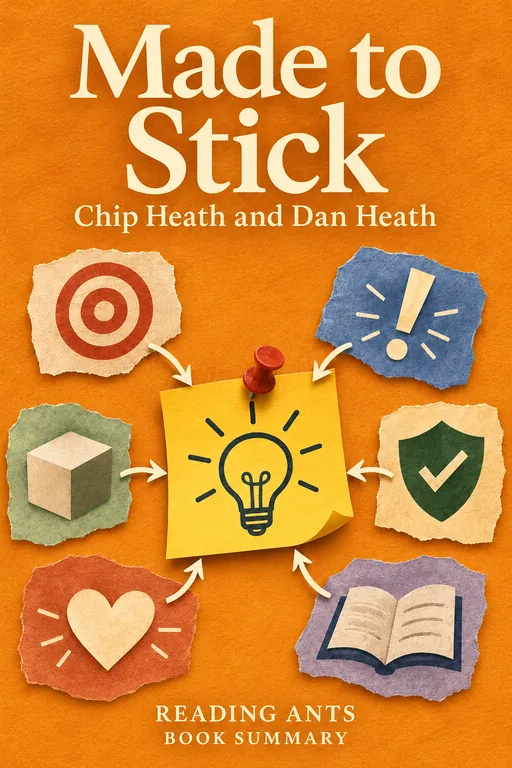
Made to Stick
Chip Heath and Dan Heath
Chip and Dan Heath identify six qualities, summed up as Simple, Unexpected, Concrete, Credible, Emotional and Stories, that make ideas understandable, memorable and able to change behavior.
🧩 Mind & Psychology
Influence: The Psychology of Persuasion
Robert B. Cialdini
Psychologist Robert Cialdini identifies six universal principles of persuasion, which explain why people say yes and show how to use them ethically and how to defend against those who misuse them.
🌱 Self-Improvement
Thinking, Fast and Slow
Daniel Kahneman
Our minds run on two systems, a fast, intuitive one and a slow, careful one, and understanding how the fast system fools us can help us make better decisions about money, risk, work and happiness.
🧩 Mind & Psychology
Predictably Irrational
Dan Ariely
Behavioral economist Dan Ariely uses entertaining experiments to show that people's decisions are shaped by predictable mental quirks, such as relativity, the lure of "free" and social norms, rather than by cool, rational calculation.
🧩 Mind & PsychologyWant something different?
Pick another topic and we will show you three books to start with.