 Reading Ants
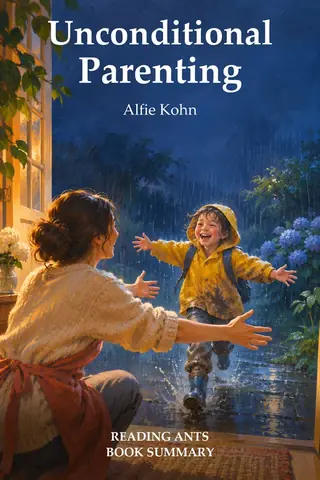
Unconditional Parenting
A writer on education and parenting argues that conditional love, rewards, praise and punishment teach children to please adults, and that parents should love unconditionally and work with children instead of doing things to them.
Overview
Unconditional Parenting: Moving from Rewards and Punishments to Love and Reason was published by Atria Books in 2005. Its author, Alfie Kohn, is an independent writer known for his criticism of rewards, grades and competition. He starts from a question that most parenting guides skip: not how to get children to do what they are told, but what children need and how parents can give it. The book argues that much of parenting is conditional, offering approval when a child meets expectations and withdrawing it otherwise, and that this can undermine the child’s sense of being loved. It has ten chapters and mixes research, argument and stories from family life.
Full Summary
1. Love that has to be earned
The idea: Kohn describes conditional parenting, in which love and attention seem to depend on behavior or achievement. He says that parents often do this with good intentions, using praise and rewards to encourage and punishments to discourage. Children, he argues, can come to feel that they are loved only when they perform, and that their worth is always on trial. He proposes the opposite: a child should know that acceptance does not depend on pleasing anyone, and that a parent’s love is a gift, not a wage.
In real life: A child who gets a big hug after a good report card begins to wonder what happens after a bad one.
2. Time-outs and withdrawn attention
The idea: Kohn also looks at methods that use closeness as a tool, such as sending a child away or holding back affection after misbehavior. He counts time-outs among these, and argues that they can leave a child feeling unsafe even when a parent does not mean them that way. A Publishers Weekly review notes that he suggests a restorative time away, as a last resort, instead of a punitive time-out. The aim is that a child who is struggling gets support, not isolation.
In real life: A parent whose child is melting down stays close, offers comfort and helps name the feeling, instead of sending the child to a corner.
3. Why punishment and pressure fall short
The idea: Kohn argues that punishment gets in the way of moral growth. It leads children to ask what will happen to them, instead of how their actions affect other people. He also questions heavy control and pressure to succeed, saying that obedience is not the same as healthy development and that pushing a child hard can backfire. In his view, the goal is a child who makes good decisions, and children learn to decide by making decisions, not by following directions.
In real life: A teenager who is punished for lying may learn to hide mistakes more carefully, not to be more honest.
4. The problem with praise and rewards
The idea: Kohn extends the argument to rewards and praise. In his essay on the subject, which points readers to this book, he says that praise can be a way of controlling children, can make them depend on adults’ approval, and can reduce their interest in the activity itself. One summary of the book describes a study in which rewarding very young children for helping made them less likely to help later without a reward. As alternatives, he suggests saying nothing when behavior is simply good, describing what you saw, or asking the child to describe her own experience.
In real life: A parent who sees a drawing says, “You used a lot of red,” and asks what the child likes about it.
5. Principles in place of techniques
The idea: The book does not give scripts for particular situations. It offers thirteen principles instead, which include reflecting on your own behavior, reconsidering your requests, treating children with respect and not rushing. One reviewer sums up the spirit as putting the relationship ahead of the behavior. Kohn suggests asking yourself whether you would feel loved if someone treated you the way you are treating your child, and shaping the environment instead of controlling the child.
In real life: A parent who is about to say no stops and asks whether the request is necessary, then changes it.
6. Choices and the child’s point of view
The idea: The last chapters turn to showing love without strings, giving children real choices, and seeing situations from the child’s side. Kohn argues that children need chances to make decisions, and that parents should assume the best possible reading of what a child does. He encourages parents to move from doing things to children to working with them, treating difficult behavior as a problem to solve together.
In real life: Parents of a reluctant student ask for the child’s own ideas about homework, and try one.
Why It Matters
Unconditional Parenting is a prominent argument against using rewards, praise and punishment as the basis of child-rearing. It draws on research about motivation, and it is often described as an early contribution to what later became known as gentle parenting. Publishers Weekly called Kohn controversial but popular, and said the book would challenge parents who want to be in charge. Even readers who disagree with parts come away asking what their discipline teaches a child about love. Kohn is a writer and critic of education, not a clinician, and the book’s strength is the clarity of its questions: who benefits when a child complies, and what does the child take away about being loved? Its central contrast, working with children instead of doing to them, remains a useful test.
Key Takeaways
- Love should not be earned. Children need to know they are loved whatever they do.
- Question rewards and praise. Incentives and “good job” can make children chase approval.
- Punishment teaches the wrong lesson. It focuses a child on what happens to him, not on caring about others.
- Work with, not do to. Involve children in solving problems and making decisions.
- Take the child’s view. Ask how a situation looks to your child before reacting.
What We Can Learn
Choose one habit to test for a week, such as replacing “good job” with a description or a question. Say what you see, such as “You kept going even though it was hard,” or ask, “What do you like best about it?” Notice how your child responds.
Also look at your requests. Before you say no or give an order, ask yourself whether it is truly necessary, and whether there is a way to include your child. Tell your children, in words and in hugs, that your love does not depend on how they behave.
Criticism and Counterpoints
Critics argue that Kohn’s rejection of time-outs, consequences, rewards and praise goes too far. A Shortform overview notes that some experts hold that natural consequences can build a child’s own motivation, and it contrasts Kohn with the parenting author Janet Lansbury, who treats firm boundaries as a form of love. A blogger on LessWrong who checked three of the studies the book cites found that they supported its claims weakly, and called the book one author’s opinion more than settled science. The same review says Kohn gives principles but few concrete scripts, which some readers find frustrating. A group of behavior analysts has also published a journal article arguing that Kohn misrepresents behavior analysis.
It can also feel idealistic for families under heavy pressure, and it may add guilt for parents who use ordinary rewards and praise.
Who Should Read It
This book is for parents, teachers and anyone who works with children and wants to examine their use of rewards and punishment. It is well argued and thoughtful, though more of a case than a manual. Readers who want step-by-step scripts for daily problems may prefer a more practical guide, and those who rely on structured reward charts may find it challenging.
Want the whole book?
A summary is a taste, not the meal. Here is where to find the full book.
You reached the end 🎉
Nicely done. Mark this one as read, and we will suggest what to read next.
Read this next

The Gift of Failure
Jessica Lahey
A middle school teacher and mother argues that fear of failure, in parents and children alike, has led us to rescue, reward and hover, and she shows how stepping back with clear expectations builds motivation, competence and independence.
🎓 Parenting & Education
How to Raise an Adult
Julie Lythcott-Haims
A former dean at Stanford University argues that modern parents who do too much for their children, from homework to college applications, are leaving them anxious and unprepared, and she urges them to step back and let young people learn to stand on their own.
🎓 Parenting & Education
Drive: The Surprising Truth About What Motivates Us
Daniel H. Pink
Daniel Pink argues that, for creative and complex work, carrots and sticks such as bonuses are less effective than the inner drive provided by autonomy, mastery and purpose, and that businesses and schools should be redesigned around them.
🧩 Mind & Psychology
The Whole-Brain Child
Daniel J. Siegel and Tina Payne Bryson
Understanding how a child's brain develops helps parents respond to tantrums, fears and conflicts in ways that connect, calm and teach, so that different parts of the brain work together.
🎓 Parenting & Education
Positive Discipline
Jane Nelsen
Jane Nelsen argues that children behave better when they are treated with both kindness and firmness, and she offers practical tools, such as family meetings and logical consequences, to teach them responsibility without punishment or pampering.
🎓 Parenting & Education
How to Talk So Kids Will Listen and Listen So Kids Will Talk
Adele Faber and Elaine Mazlish
Parents can get better cooperation and closer relationships by acknowledging children's feelings, describing problems instead of blaming, and using simple, respectful communication skills.
🎓 Parenting & EducationWant something different?
Pick another topic and we will show you three books to start with.