 Reading Ants
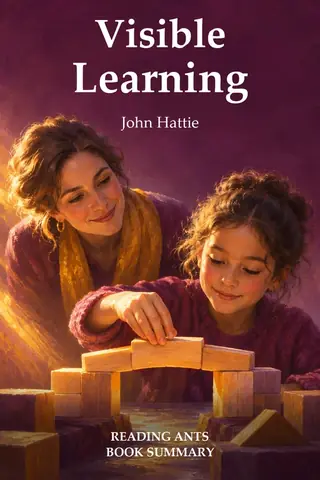
John Hattie gathers hundreds of research reviews on what helps school students learn, compares them on a single scale, and concludes that what teachers do, and how well they see learning through their students' eyes, matters most.
Overview
Visible Learning: A Synthesis of Over 800 Meta-Analyses Relating to Achievement was published in 2008 by John Hattie, an education researcher from New Zealand. A meta-analysis combines the results of many studies on one question, and Hattie’s book is a synthesis of such syntheses, covering a very large number of studies and millions of students. He compares influences on achievement using a measure called an effect size, and ranks them, from the student’s own expectations to the home, the school, the curriculum, the teacher and the way teaching is done. The book is dense and full of numbers, but its message is simple: teachers should know the impact of what they do.
Full Summary
1. A way to compare what works
The idea: Hattie’s central tool is the effect size, a standardized estimate of the size of a difference or relationship. Some estimates come from comparisons of groups, while others summarize associations. Using one scale lets him compare very different things, such as feedback, class size and homework, which would otherwise be hard to compare. He treats an effect size of 0.40 as a hinge point, because that is the average he found across everything he studied. Influences above it are read as better than typical, and those below as weaker. Later he said that the hinge point was meant to start conversations, not to make decisions by itself.
In real life: If every student in a school gets extra tutoring and the scores rise a little, it is hard to know if tutoring worked well. An effect size asks how that gain compares with other things the school could have done.
2. Almost everything works, so ask what works best
The idea: One of Hattie’s most important points is that almost every intervention in schools seems to help at least a little, because students learn and mature anyway. So the useful question is not whether something works but whether it works better than the alternatives. A school with limited time and money should put effort where the evidence shows the largest returns, and drop or rethink the rest.
In real life: A family that pays for a pricey app because it “helps” should still ask whether a free habit, such as asking a teacher for feedback on every essay, helps more.
3. Six areas of influence, and the teacher is key
The idea: The book groups influences into six areas: the student, the home, the school, the curricula, the teacher and the teaching approaches that teachers use. Student factors include prior knowledge, motivation and beliefs about learning. At home, high expectations and a good knowledge of how school works matter. For the school, the classroom climate and the influence of classmates count. Hattie concludes that the most important in-school influence is the teacher, and that what teachers do matters. In developed countries, he says, much of the variation in achievement lies between teachers within schools, not between schools.
In real life: Two classes in the same building may learn very different amounts in a year, because of how each teacher explains, questions and responds.
4. What students expect of themselves
The idea: Students are often good at predicting how well they will do, and those predictions can become limits. Hattie’s table lists students’ self-reported grades, meaning their own estimates of how well they will do, at 1.44, the highest value in that edition. The figure shows how closely those estimates go together with achievement. It does not tell teachers how much improvement to expect from trying to raise students’ expectations. He also found that ability grouping did little for achievement and may harm fairness.
In real life: A student who believes “I always get C’s” may quietly stop trying. A teacher who sets a challenging goal and shows how to reach it can change that belief.
5. Clear aims, challenge and practice
The idea: Among teaching approaches, Hattie stresses clear learning intentions and success criteria, so that students know what they are trying to learn and what good work looks like. Teacher clarity, with an effect size of about 0.75, is among the high-ranking influences. Tasks should be challenging, not easy, and students should have chances for deliberate practice and for learning strategies such as asking themselves questions, planning and checking their own work. The balance between surface knowledge and deep understanding also matters, and students need both.
In real life: A class told “by Friday you will be able to explain why the Roman Republic fell, and here is what a good answer includes” has a clear target. A class told to “work on Rome” does not.
6. Feedback, in the right form
The idea: Feedback is among the most powerful influences, with an effect size of about 0.73. Hattie says that quality matters more than quantity. Useful feedback concerns the task, the process and the student’s own self-regulation, and answers questions such as where am I going, how am I going and where to next. Praise aimed at the person, such as “you’re so clever,” is rarely useful, and rewards and punishment are among the weakest forms. Feedback also needs a base of instruction to build on.
Reported example: The summaries note that feedback from students to teachers is especially valuable, because it shows what students do and do not understand.
In real life: “Your second paragraph doesn’t yet explain why the evidence matters, so add a sentence linking them” helps far more than “good job.”
7. Teachers as evaluators of their own impact
The idea: The title refers to making teaching and learning visible: teachers see learning through the eyes of students. Hattie argues that teachers should treat their own teaching like an experiment, collecting evidence of the effect they have and changing course if the evidence shows a method is not working. Formative evaluation, which means checking progress during learning so that teaching can adjust, has an effect size of about 0.90. Expert teachers meet colleagues to review evidence of student progress and relationships with students (effect size about 0.72) matter too. He asks that teachers be caring, engaged and directive.
In real life: A teacher who gives a five-minute quiz at the end of a lesson and changes tomorrow’s lesson based on the answers is acting on this idea.
8. Things that matter less than people think
The idea: Hattie found that some popular reforms have small effects on achievement on their own. These include smaller classes, extra money without a change in teaching, homework in the earlier school years, and matching teaching to students’ supposed learning styles. Holding a student back to repeat a year was found to have a negative effect. He does not say these things never matter, only that teaching practices change more than structure does. He also notes that the book measures achievement only, not wellbeing or attitudes.
In real life: A school that halves its class sizes but keeps the same lessons may see little gain, while one that trains teachers to give better feedback may see more.
Why It Matters
Visible Learning became one of the most discussed education books of its time. A British education newspaper called it teaching’s holy grail, according to Wikipedia. It gave teachers, school leaders and policymakers a way to talk about evidence, and it pushed attention from structures such as class size toward practices such as feedback and clarity. Hattie went on to publish versions for teachers, and an updated sequel in 2023 which draws on many more studies. The idea that educators should know their impact, and judge their methods by what happens to learning, has influenced many schools and training programs.
Key Takeaways
- Compare what works. Effect sizes put very different influences on one scale, so schools can ask which choices help most.
- Almost everything helps a bit. The useful question is what helps most, so effort should go where the return is largest.
- Teachers make the difference. Clear aims, challenge, practice and good relationships are the strongest in-school levers.
- Feedback is powerful when well aimed. It should be about the task, the process and self-regulation, not about praising the person.
- Know your impact. Teachers should gather evidence about their own results and be ready to change their approach.
What We Can Learn
If you are a student, ask your teacher what success looks like before you start work, and ask for feedback that tells you the next step. Try to predict your grades, then compare them with the result, and raise your target a little each time. If you are a teacher, share the aim of each lesson, check understanding often and ask students what helped or confused them. If you are a parent, ask your child “what did your teacher say about how to improve?” rather than only “what grade did you get?” Be careful with any single number, though. Use the evidence to start a discussion about what suits your own class or child, and test it by watching what happens.
Criticism and Counterpoints
The book has been criticized on technical grounds. Robert Slavin argued that Hattie accepts the results of the underlying meta-analyses without enough scrutiny, even though they include studies of very different quality. Critics also say that combining studies of different ages, lengths and designs can hide important differences, and that the 0.40 hinge point is an average, not a proven threshold. Hattie himself admitted that a second statistic in the book, the common language effect size, was calculated wrongly, and said that the main effect sizes were not affected. Other scholars, including Schulmeister and Loviscach, and later Bergeron, raised further concerns about the selection of studies and the use of effect sizes. Defenders reply that readers misuse the rankings, and that Hattie does not recommend chasing the highest numbers. The book also measures achievement, not wellbeing.
Who Should Read It
This book is for teachers, school leaders, education students and parents who like evidence. It is a demanding book with many tables, so many readers start with a short summary or his follow-up book for teachers. Treat the rankings as a guide for discussion, not as a final verdict, and read it together with the critics. It may be too technical for readers who want a light introduction.
Want the whole book?
A summary is a taste, not the meal. Here is where to find the full book.
You reached the end 🎉
Nicely done. Mark this one as read, and we will suggest what to read next.
Read this next
Why Don't Students Like School?
Daniel T. Willingham
Cognitive scientist Daniel Willingham uses research on how the mind works to explain why thinking is hard, why knowledge matters and how teachers and students can make learning more effective and enjoyable.
🎓 Parenting & Education
Teach Like a Champion
Doug Lemov
Doug Lemov, a former teacher who studied unusually successful classrooms, describes 49 small, learnable moves that help teachers set high expectations, plan well, keep every student thinking and run an orderly, warm classroom.
🎓 Parenting & Education
Make It Stick
Peter C. Brown, Henry L. Roediger III and Mark A. McDaniel
A writer and two cognitive scientists explain, with research and stories, that effective learning is often effortful, and that retrieval practice, spacing, interleaving and other "desirable difficulties" help knowledge to stick, while popular habits such as rereading do not.
🌱 Self-Improvement
Mindset: The New Psychology of Success
Carol S. Dweck
Psychologist Carol Dweck shows that people who believe abilities can grow, a growth mindset, learn, cope with failure and achieve more than people who believe their talents are fixed.
🌱 Self-Improvement
How Children Succeed
Paul Tough
Journalist Paul Tough argues that qualities like perseverance, curiosity and self-control matter more for children's success than test scores alone, and that these qualities can be nurtured, especially for children who face hardship.
🎓 Parenting & Education
How to Talk So Kids Will Listen and Listen So Kids Will Talk
Adele Faber and Elaine Mazlish
Parents can get better cooperation and closer relationships by acknowledging children's feelings, describing problems instead of blaming, and using simple, respectful communication skills.
🎓 Parenting & EducationWant something different?
Pick another topic and we will show you three books to start with.