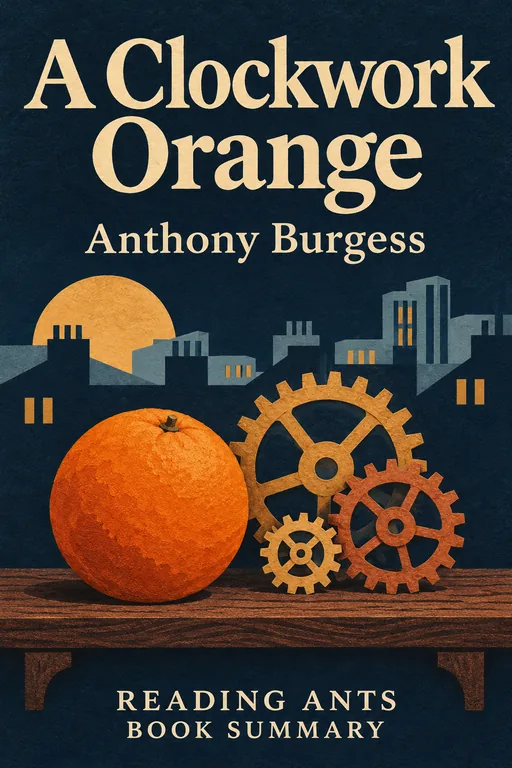
A Clockwork Orange
Alex, a teenage gang leader in a near-future England, loves violence and music, is caught and subjected to a government treatment that removes his ability to choose evil, raising the question of whether goodness forced upon a person is goodness at all.
Overview
A Clockwork Orange is a short dystopian novel by Anthony Burgess, published in 1962. It is narrated by Alex, a fifteen-year-old who speaks in “Nadsat,” an invented teenage slang made of English, Russian and rhyming words. Alex leads a gang that commits robbery, beatings and rape at night, and also loves classical music, especially Beethoven. After his arrest, he is subjected to an experimental therapy meant to cure his violence. The book is both a thrilling story and a serious debate about free will, state power and morality. It became widely known after Stanley Kubrick’s 1971 film.
Main Characters
- Alex: the narrator and leader of a gang, intelligent, charming and violent.
- Pete, Georgie and Dim: his “droogs,” or friends, in the gang.
- P. R. Deltoid: Alex’s social worker.
- Mr. Alexander: a writer whose wife was attacked by Alex’s gang.
- The prison chaplain: who questions the morality of the treatment.
- The Minister of the Interior: the politician who promotes the new technique.
- Dr. Brodsky and Dr. Branom: the scientists who administer the therapy.
Full Summary
Night in the City
The story begins in a milk bar, where Alex and his droogs drink milk laced with drugs to prepare for a night of “ultra-violence.” They beat an old man, rob a shop, fight a rival gang and break into a house, where they beat a writer, Mr. Alexander, and rape his wife. Alex narrates it all with a mixture of glee and style, and speaks to the reader as “your humble narrator.” He also takes pleasure in listening to music, and in the strength of Beethoven’s Ninth Symphony.
Burgess uses the slang to keep the reader at a distance from the worst acts: the words are strange enough that violence is described in a half-comic, half-poetic way. Alex addresses the reader as a friend, which draws us into complicity and makes us uncomfortable with how much we enjoy his voice.
Betrayal and Arrest
The gang begins to break up. Georgie wants a bigger role and Dim is rowdy, and the others resent Alex’s rule. During a burglary at the home of a rich woman who keeps cats, Alex hits her, and she dies. His friends, who are tired of him, leave him to be caught by the police. At the police station, he is beaten, and then sentenced to fourteen years in prison.
Prison
In prison, Alex pretends to be devout, studies the Bible, and reads for the violent parts. He is chosen for a new government experiment, the Ludovico technique, which promises to cure criminals in two weeks. The state is eager to free up space in prisons, and the Minister of the Interior is keen to show quick results. Alex agrees, thinking that it will free him.
The chaplain, who is a thoughtful man, tells Alex that goodness is something chosen, and that a man who cannot choose ceases to be a man. Alex, however, cares only about getting out, and is puzzled by such talk.
The Treatment
Alex is strapped to a chair, and forced to watch violent films while being given a drug that makes him extremely sick. The treatment conditions him to feel nausea at the thought of violence, and also at the sound of Beethoven, whose music was played in one of the films. The chaplain objects that this is not true goodness, because Alex no longer has a choice. Alex is declared cured and released in a public demonstration, in which he is shown to be unable to defend himself or to hit back.
Released
Returning home, Alex finds that his parents have rented his room, and that the world is hostile. He is beaten by those he wronged: the old man he once attacked, and then his former gang-mate Dim and his old rival Billyboy, who are now policemen. He collapses at the door of Mr. Alexander, the writer whose home his gang once invaded; Alexander does not recognize him at first, and he and his friends plan to use him as a political weapon against the government. When Alex gives himself away, they lock him in a room and play classical music, which now makes him violently ill, driving him to jump from a window.
A Choice
Alex survives the fall, and the government, embarrassed by the scandal, reverses the treatment. Alex finds that his violent desires have returned. In the final chapter, which was omitted from the original American edition and from Kubrick’s film, Alex, now eighteen, begins to grow bored with violence, thinks about starting a family and sees that his old gang life is childish. He realizes that growing up means choosing to put it behind him, which restores his moral agency.
Why It Matters
A Clockwork Orange is among the best-known dystopian novels, widely discussed for its questions about free will and the role of the state. The title refers to a person who looks organic but is mechanical, which Burgess uses to symbolize a person deprived of the choice to be good. Kubrick’s film of 1971 brought it great notoriety, and it was withdrawn from British screens for years.
The novel’s invented slang, the Nadsat, is one of the most famous literary inventions of the century, and it influenced later writers and musicians. It is still frequently taught and debated.
Key Takeaways
- Choice is essential to morality. Goodness imposed by force is not truly good.
- The state can be as dangerous as the criminal. The treatment is another kind of violence.
- People can grow up. Alex’s last chapter suggests change is possible.
- Art and violence can coexist. Alex loves beauty and cruelty.
- Language shapes experience. Nadsat both distances and attracts the reader.
What We Can Learn
The novel raises a profound question: would we prefer a society where people are made to behave well, or one where they choose, even if some choose badly? It encourages us to value freedom and responsibility.
It also shows how entertainment and politics can use fear. The government uses Alex as a tool for its image, and then discards him, which can teach us to be wary of leaders who offer quick solutions.
Finally, it suggests that moral growth comes from within. Alex’s final change does not come from therapy but from his own wish to grow up.
Criticism and Counterpoints
Many readers find the violence and sexual assault very disturbing, and some critics accused the book and film of glamorizing brutality. Burgess himself later said that he regretted the film’s fame, and that it was misunderstood. Others find the Nadsat slang hard to follow at first, though most pick it up quickly.
The book’s women are mostly victims or minor characters, and some readers think the final chapter, in which Alex simply outgrows violence, is weak and unconvincing. Some critics dispute its ideas about psychology and treatment. Even so, it is considered a powerful satire.
Who Should Read It
This book suits mature readers. It contains graphic violence and sexual assault, and should not be given to younger teenagers. Readers who can face this material will find a short but thought-provoking novel.
Want the whole book?
A summary is a taste, not the meal. Here is where to find the full book.
You reached the end 🎉
Nicely done. Mark this one as read, and we will suggest what to read next.
Read this next
Brave New World
Aldous Huxley
In a future world where people are made in factories, programmed for their roles and kept happy with drugs and entertainment, a man raised outside the system discovers that this perfect comfort comes at the cost of everything that makes us human.
📜 Classics
Lord of the Flies
William Golding
A group of British schoolboys stranded on a deserted island try to govern themselves, but fear and the desire for power slowly turn them into savages, revealing the darkness inside human nature.
📜 Classics
Fahrenheit 451
Ray Bradbury
In a future America where books are illegal and firemen start fires instead of putting them out, one fireman begins to read the books he is supposed to burn, and discovers what his society has lost.
🚀 Sci-Fi & Fantasy
The Handmaid's Tale
Margaret Atwood
In a near-future United States taken over by a religious dictatorship that strips women of their rights, a woman forced to bear children for a powerful couple secretly remembers her old life and searches for a way to survive.
✨ Modern Fiction
Pride and Prejudice
Jane Austen
Quick-witted Elizabeth Bennet and the proud, wealthy Mr. Darcy badly misjudge each other, and only by facing their own faults do they find their way to love.
📜 Classics
Nineteen Eighty-Four
George Orwell
In a future Britain ruled by an all-seeing Party, one man secretly rebels by keeping a diary and falling in love, and discovers just how completely a totalitarian state can crush the human mind.
📜 ClassicsWant something different?
Pick another topic and we will show you three books to start with.