 Reading Ants
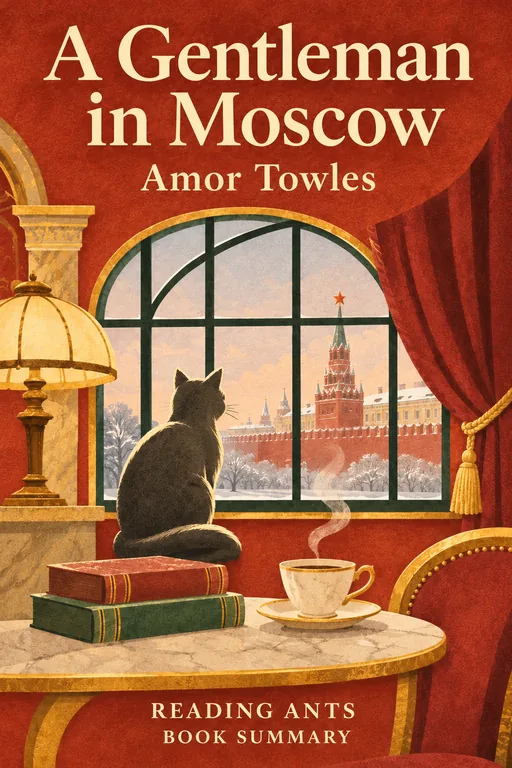
A Gentleman in Moscow
In 1922, a Russian aristocrat, Count Alexander Rostov, is sentenced by the Bolsheviks to house arrest in the Hotel Metropol in Moscow, where he lives for more than thirty years in a tiny attic room and finds meaning in friendship, work and love.
Overview
A Gentleman in Moscow is a novel by Amor Towles, published in 2016, and became an international bestseller. It is set in the grand Metropol Hotel, across the street from the Kremlin, from 1922 to 1954. The count, who is a charming, well-read man of the old aristocracy, is spared execution only because of a poem he once wrote, and must live out his life inside the hotel. Over time, he becomes a waiter, a friend to the staff and a surrogate father to a young girl. The novel is gentle and witty, and shows how an individual can retain dignity and joy while history changes around him.
Main Characters
- Count Alexander Ilyich Rostov: a polished, courteous aristocrat who adapts to his confinement.
- Nina Kulikova: a young girl in the hotel who befriends the Count.
- Sofia: a girl left in his care, who becomes his adopted daughter.
- Anna Urbanova: a famous actress who has an affair with the Count.
- Emile Zhukovsky: the hotel’s chef, a gruff, talented man.
- Andrey Duras: the maître d’ of the hotel restaurant.
- Osip Glebnikov: a former Red Army officer and the Count’s friend.
- The Bishop: a ruthless hotel manager.
Full Summary
The Sentence
In 1922, Count Rostov appears before a Bolshevik tribunal, which sentences him to house arrest rather than death, because of a poem, “Where Is It Now?” whose revolutionary spirit saves him from being shot. If he leaves the Metropol Hotel, he will be shot. The Count, who has lived in a luxurious suite, is moved to a small attic room. He thinks of this as a challenge, and resolves to make the best of it, keeping his manners and his curiosity.
Nina
The Count meets a nine-year-old girl, Nina, who lives in the hotel with her father, and who is adventurous. She shows him secret passages and tells him of her explorations, and carries a master key that opens every door. They become friends, and Nina, who eventually grows up, shares with him her beliefs in the new Soviet society. They part, and years later, as a grown woman, she returns and entrusts her young daughter, Sofia, to the Count while she goes to find her husband, who has been sent to a labor camp.
The Waiter
The Count takes a job as a waiter at the hotel’s restaurant, the Boyarsky, where he works with the chef, Emile, and the maître d’, Andrey. He learns to love the work, and is skilled at wine and food, and he finds satisfaction in doing it well. He enjoys talking to his colleagues, and comes to see that good manners, kindness and attention are valuable in any world.
On many evenings, he arranges meals for guests and helps the staff with problems. He proves a natural at the job, and his old training in etiquette turns out to be useful in a new way, as he teaches by example how to treat people with respect, whatever their rank.
Anna and the Years
The Count has a long romance with Anna Urbanova, a famous actress, who is staying in the hotel from time to time. Their relationship is warm, though clandestine, as she is a figure in the Soviet system. Over the years, the Count watches as the regime changes: friends vanish, new rules are made and the hotel itself is transformed. He remains cheerful, and quietly helps others, using his resources.
Sofia
Sofia, who is still a small child, comes to live with the Count, and he raises her in the hotel, with the help of his friends. He teaches her manners, languages and music, and she becomes a skilled pianist. As she grows, a Soviet official proposes to send her to a music tour in Paris. The Count, who is torn between his love for her and the wish for her freedom, plans her escape.
The Escape
With the help of Emile, Andrey and others, the Count arranges for Sofia to defect during a trip to Paris. In a daring scheme, he uses his wits, with help from his friend Osip and others, to deceive the authorities. On the day that she leaves, he leaves the hotel himself, taking a chance to be free, and the novel ends with him walking out of Moscow and, finally, being reunited with Anna. The ending is hopeful and bittersweet.
Sofia’s departure is arranged with care: the Count tells the staff, who each play a part, from the chef’s cooking to the maître d’s timing. The plan is as much a gift from the hotel family as it is the Count’s, and it shows how a community can come together to protect one of its own.
Why It Matters
A Gentleman in Moscow was a New York Times bestseller for over a year, and has been praised for its charm and humane optimism. It has been adapted into a television miniseries starring Ewan McGregor. It follows Towles’s first novel, Rules of Civility, and was followed by The Lincoln Highway.
The book is a favorite of book clubs because of its warm tone, and it offers a gentle view of the twentieth century in Russia, focusing on private life rather than politics.
Critics praised its wit and old-fashioned elegance, and many readers say it is the kind of book they return to for comfort. The novel works out the idea of a character who is confined and yet free with warmth and humor.
Key Takeaways
- Dignity can be kept in any circumstances. The Count remains himself.
- Small pleasures matter. Food, music and friendship give meaning.
- Adaptability is a strength. The Count turns confinement to advantage.
- Found family can be as strong as blood. The Count raises Sofia.
- Kindness has lasting effects. His generosity returns to him.
What We Can Learn
The novel suggests that how we respond to circumstances matters more than the circumstances themselves. The Count, in a small room, builds a rich life.
It also reminds us that daily rituals, such as a good meal or a careful greeting, can give structure and joy to life, even in hard times.
Finally, it encourages us to be generous, and to see that our relationships are the most valuable thing we have.
It also shows that being useful to others, whether by waiting tables or raising a child, can give life purpose even when our larger plans are taken away.
Criticism and Counterpoints
Some critics find the novel too charming and escapist, with a gentle portrait of the Soviet era that avoids the horror of the purges and the gulag. Others find the Count too perfect, and the plot too neat, with coincidences and a happy ending. The length and slow pace may be a problem for some readers.
A few note that the book’s female characters are less developed than the male ones. Some readers prefer a more critical treatment of Soviet history. Still, many love its warmth.
Who Should Read It
This book suits teenagers and adults. It is gentle and funny, with some serious moments. It is a good choice for readers who like historical fiction and elegant prose.
A slow, enjoyable read.
Want the whole book?
A summary is a taste, not the meal. Here is where to find the full book.
You reached the end 🎉
Nicely done. Mark this one as read, and we will suggest what to read next.
Read this next
The Master and Margarita
Mikhail Bulgakov
The Devil arrives in 1930s Moscow with a cat, a fanged assistant and a naked witch, and turns the city upside down, while a persecuted writer and his devoted lover try to save a novel about Pontius Pilate from oblivion.
🌍 World Literature
War and Peace
Leo Tolstoy
Five aristocratic Russian families are swept through the Napoleonic Wars, and through love, loss and searching, three of their young members discover what makes a life meaningful.
🌍 World Literature
Doctor Zhivago
Boris Pasternak
A Russian doctor and poet lives through the First World War, the revolution and the civil war, torn between his family, a lasting love and a country that has no place for him.
🌍 World Literature
Anna Karenina
Leo Tolstoy
In imperial Russia, a married aristocrat falls passionately in love with a dashing officer and loses her place in society, while a thoughtful landowner seeks a meaningful life through love, work and faith.
🌍 World Literature
The Kite Runner
Khaled Hosseini
A wealthy boy in Kabul betrays his loyal best friend on the day of a kite tournament, and decades later, after fleeing to America, he returns to a Taliban-ruled Afghanistan to try to make things right.
✨ Modern Fiction
The Bluest Eye
Toni Morrison
In 1940s Ohio, a poor Black girl named Pecola Breedlove, who believes that she is ugly, prays for blue eyes, and the community's failure to protect her leads to tragedy.
✨ Modern FictionWant something different?
Pick another topic and we will show you three books to start with.