 Reading Ants
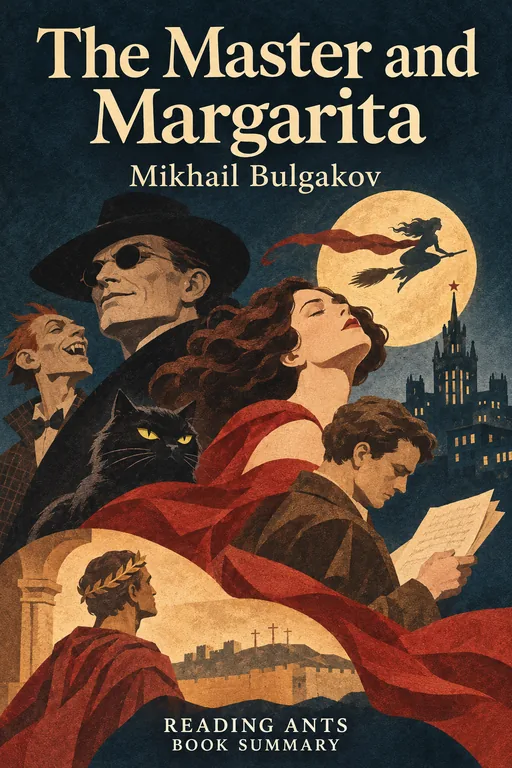
The Master and Margarita
Original title: Мастер и Маргарита
The Devil arrives in 1930s Moscow with a cat, a fanged assistant and a naked witch, and turns the city upside down, while a persecuted writer and his devoted lover try to save a novel about Pontius Pilate from oblivion.
Overview
The Master and Margarita was written by Mikhail Bulgakov between 1928 and 1940, but it was not published until 1966 and 1967, long after his death, because it was too dangerous to print in Stalin’s Soviet Union. It weaves together three stories: a satirical comedy about the devil Woland and his entourage causing chaos in Moscow; a love story between a writer known only as “the Master” and a woman named Margarita; and a historical narrative set in ancient Jerusalem, in which Pontius Pilate condemns Jesus, whom the novel calls Yeshua. Funny, frightening and moving at once, it is regarded as one of the greatest Russian novels of the twentieth century.
Main Characters
- Woland: the devil, who visits Moscow in disguise as a foreign professor.
- Behemoth: Woland’s huge, talking, gun-toting black cat.
- Koroviev (Fagot): a lanky, jesting assistant in a checkered suit.
- Azazello: a red-haired, fanged assassin.
- The Master: a writer who wrote a novel about Pontius Pilate and was driven to despair.
- Margarita: his devoted lover, who makes a pact with the devil.
- Ivan Bezdomny: a young poet who meets Woland and ends up in an asylum.
- Pontius Pilate: the Roman governor in the story within the story.
- Yeshua Ha-Notsri: the wandering philosopher, Jesus, in Pilate’s story.
Full Summary
The Professor at Patriarch’s Ponds
On a hot spring evening, two Soviet writers, Berlioz, the head of a literary association, and the young poet Ivan Bezdomny, are sitting in a Moscow park, discussing why Jesus never existed. A strange foreigner, Woland, joins them and calmly predicts that Berlioz will die that night, beheaded by a woman. A moment later, Berlioz slips on spilled sunflower oil and is run over by a tram, which is driven by a young woman, and his head is cut off.
Ivan chases the foreigner and his odd companions across the city, ending up in an insane asylum, where he tells everyone what happened and is called a lunatic.
Chaos in Moscow
Woland, with his entourage, takes up residence in the apartment of the dead Berlioz. They cause chaos wherever they go. At a variety theater, they give a “black magic” show in which the audience is showered with money, and women are given free clothes, which vanish when they leave the theater. The master of ceremonies has his head pulled off by the cat and then put back. Corrupt bureaucrats, greedy citizens and informers are exposed and punished in absurd and funny ways, vanishing, losing their jobs or being sent to Yalta.
Pilate
Throughout the book, chapters interrupt the story to tell the tale of Pontius Pilate, the Roman governor of Judea. Pilate meets Yeshua, a gentle, wandering philosopher who believes that all people are good, and who says that truth is not hard to find. Pilate realizes that Yeshua is innocent, and he is moved by him, but he is a coward, afraid of the emperor and of the crowd, and he lets him be executed. Pilate is haunted for centuries by this decision, and by his sleepless nights.
The Master
In the asylum, Ivan meets a man known only as the Master. He tells Ivan his story. He had been a historian who won a lottery, quit his job and wrote a novel about Pontius Pilate. He fell in love with a married woman, Margarita. But when he tried to publish his book, the critics attacked it viciously, calling it propaganda and religious nonsense. Terrified and ill, he burned the manuscript and checked himself into the asylum, abandoning Margarita.
Margarita and the Ball
Margarita, unhappy and desperate for her lover, is approached by Azazello with an offer from Woland. She rubs a magic ointment on her body, and she becomes a witch, flying naked over Moscow on a broom. She takes revenge on the critic who ruined the Master, and smashes his apartment. Then she is taken to Woland’s Spring Ball of the Full Moon, where she serves as hostess, greeting a parade of dead murderers, villains and sinners. She endures hours of the ordeal, with great courage and kindness.
As a reward, Woland offers to grant her a wish. Moved by pity, she first uses it to ask mercy for Frieda, a woman tormented by guilt; Woland then offers her a second wish, and she asks to have the Master back. He appears, and with the devil’s help, his burned manuscript is restored, since “manuscripts don’t burn.”
Resolution
Woland and his companions prepare to leave Moscow. Pilate, in the story within the story, is finally released from his eternal torment when the Master, who has finished writing the novel, calls out to him that he is free. The Master and Margarita, who have died, are granted not paradise but peace, a quiet house where he can write and she can be near him forever. Woland’s company flies away at midnight, revealing their true forms, as dark knights and a flying horse, over Moscow.
Why It Matters
The Master and Margarita is regarded as one of the greatest novels of the twentieth century. Bulgakov, a doctor turned writer who was repeatedly censored under Stalin, worked on it for twelve years, and burned an early version. It was finally published in a magazine in 1966 and 1967, in a censored form, and quickly became a sensation. Copies were passed around, and lines from the book entered everyday Russian speech.
The novel influenced many writers outside Russia, including Salman Rushdie. It is one of the great works about the courage of artists under tyranny, and its line that manuscripts don’t burn has become a symbol of resistance to censorship. It has been adapted for stage, film, opera and television many times.
Key Takeaways
- Cowardice is the worst sin. Pilate’s failure of courage haunts him for centuries.
- Art survives censorship. The Master’s novel is restored.
- Love is stronger than fear. Margarita risks everything for the Master.
- Hypocrisy and greed deserve to be exposed. Woland’s pranks reveal human weaknesses.
- Good and evil are intertwined. The devil is both a punisher and a source of justice.
What We Can Learn
The novel reminds us that standing by our convictions takes courage. Pilate knows what is right, but is afraid, and his regret lasts forever. Speaking up when something is wrong, even when it is risky, spares us a lifetime of guilt.
It also shows the power of loyalty. Margarita’s devotion to the Master, and her willingness to give up everything for him, shows the strength of love and persistence.
Finally, it encourages us to laugh at hypocrisy. Satire is a powerful way to point out foolishness and injustice when direct criticism is dangerous.
Criticism and Counterpoints
Some readers find the novel’s structure confusing, with three interwoven storylines, many characters and shifting tones, from slapstick to solemn. The sometimes loose episodes in Moscow can feel repetitive, and many references to the Soviet world of the 1930s need explaining for modern readers.
Critics have also debated the book’s religious ideas, since it presents Jesus and the devil in unconventional ways. Some readers find the Master himself, passive and defeated, an unsatisfying hero compared with Margarita. Despite this, most readers find it joyful, daring and unforgettable.
Who Should Read It
This novel suits mature readers who enjoy satire, fantasy and big ideas. A translation with notes, such as the one by Pevear and Volokhonsky, helps. Readers who enjoyed Faust or The Trial will find much to love.
Want the whole book?
A summary is a taste, not the meal. Here is where to find the full book.
You reached the end 🎉
Nicely done. Mark this one as read, and we will suggest what to read next.
Read this next
Faust
Johann Wolfgang von Goethe
A brilliant but restless scholar, frustrated that all his learning has not brought him true understanding or happiness, makes a bargain with the devil Mephistopheles, setting off a journey through love, tragedy and ambition that tests whether any human life can find lasting fulfillment.
🎭 Epics, Drama & Poetry
Dead Souls
Nikolai Gogol
A smooth-talking traveler roams the Russian provinces buying the names of dead serfs, and the landowners who sell them reveal how foolish and greedy people can be.
🌍 World Literature
The Trial
Franz Kafka
A respectable senior bank officer is arrested one morning for a crime nobody will name, and is dragged through a vast, senseless legal system that he can neither understand nor escape.
🌍 World Literature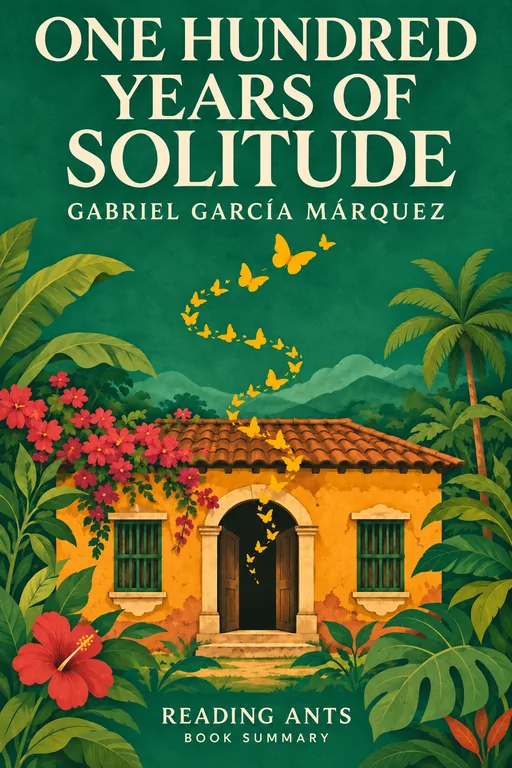
One Hundred Years of Solitude
Gabriel Garcia Marquez
Seven generations of the Buendía family live, love, fight and repeat the same mistakes in the magical Colombian town of Macondo, from its founding to its final destruction.
🌍 World Literature
The Little Prince
Antoine de Saint-Exupery
A pilot stranded in the desert meets a small boy from a tiny planet, who teaches him that the most important things in life, like love and friendship, can only be seen with the heart.
🌍 World Literature
Things Fall Apart
Chinua Achebe
Okonkwo, a proud and fearsome leader in an Igbo village in Nigeria, struggles against his own fears and against the arrival of British missionaries and colonial rulers, who change his world forever.
🌍 World LiteratureWant something different?
Pick another topic and we will show you three books to start with.