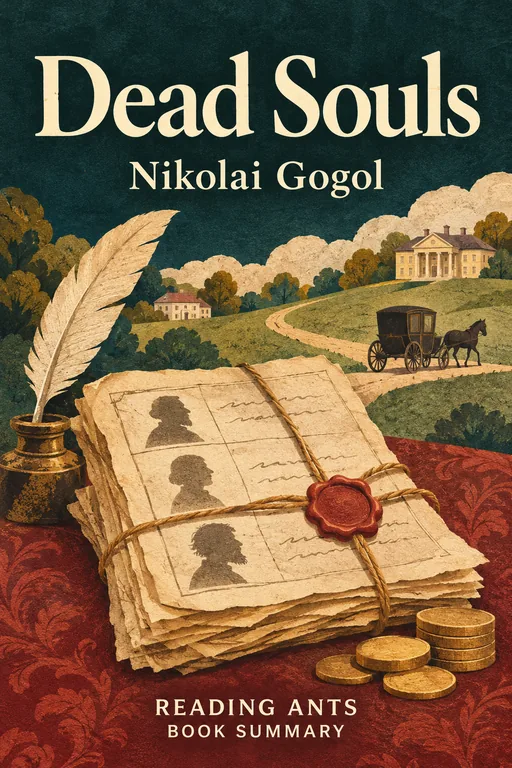
Dead Souls
Original title: Мёртвые души
A smooth-talking traveler roams the Russian provinces buying the names of dead serfs, and the landowners who sell them reveal how foolish and greedy people can be.
Overview
Dead Souls is a satirical novel by Nikolai Gogol, published in 1842. It is set in Russia under serfdom, when landowners owned peasants, called “souls,” who were counted in a census taken every few years. Between censuses, serfs who died were still counted as property and taxed. The hero, Chichikov, travels from estate to estate to buy those dead souls, with a scheme to profit from them. The book is a comic road story that is also a sharp portrait of Russian society. Gogol called it a “poem” and planned it as part of a larger work, but he never finished it, and he burned much of the second part before he died.
Main Characters
- Pavel Ivanovich Chichikov: a polite, well-mannered schemer who buys dead serfs.
- Manilov: a sweet-talking, dreamy landowner who does nothing.
- Korobochka: a cautious widow who haggles over every item.
- Nozdryov: a lying, boastful gambler who is always in trouble.
- Sobakevich: a blunt, bear-like landowner with a hard bargain.
- Plyushkin: a miser who lives in squalor among rotting hoards.
- Selifan and Petrushka: Chichikov’s coachman and servant.
Full Summary
A Stranger Arrives
A carriage rolls into a provincial town, and a man of middle age, neither handsome nor ugly, steps out. This is Chichikov, who rents a room and sets about making friends with the local officials. He is smooth, agreeable and always careful to say the right thing. He is invited to dinners, and he is a hit with the governor and the chief of police.
Chichikov has a secret plan. As the book later reveals, he is a former minor official, ambitious and dishonest, who is determined to rise in the world. He wants to buy the names of serfs who have died but who are still on the tax rolls. He can then claim that he owns them, pretend to settle them on cheap land in the south, and use them as collateral for a loan. Nobody in the town suspects what he is doing.
Manilov
His first visit is to Manilov, a pleasant, empty man who talks in flowery phrases and makes grand plans that he never carries out. He is delighted to be asked, and he gives Chichikov his dead souls for free, though he is puzzled by the request. The visit shows how Manilov lives in daydreams, and it hints at Chichikov’s skill with flattery.
Korobochka and Nozdryov
Chichikov then travels to the home of Korobochka, a widow who is anxious and mistrustful. She is afraid of being cheated, and she suspects that the dead souls might be worth more than he offers. After a long argument, she agrees to sell.
Chichikov next meets Nozdryov, a charming rogue who drinks, gambles and lies without stopping. Nozdryov tries to turn the deal into a bet, first with cards and then with a board game in which he cheats, and a fight breaks out. Chichikov escapes, but he knows that Nozdryov will talk.
Sobakevich and Plyushkin
At the estate of Sobakevich, a large, blunt man who lives in a house of heavy furniture, Chichikov finds a tough negotiator. Sobakevich praises each of his dead serfs as if they were still alive, and he drives a hard bargain, asking a high price for each one.
The strangest of all is Plyushkin, a landowner who is so mean that he lives in filth and rags, though he is rich. His estate is rotting, and he collects scraps and hoards everything. He is delighted to sell dead souls, as it saves him from paying taxes.
The Scheme Unravels
Chichikov returns to town with his list of dead souls and registers them. He plans to mortgage them to a government lending board. But rumors are flying. Nozdryov, at the governor’s ball, announces loudly that Chichikov is buying dead souls, and Korobochka comes to town to find out what the dead souls are worth. The townspeople speculate wildly: that he is a spy, a forger or even a disguised Napoleon. The prosecutor dies suddenly of a stroke, and some blame the commotion.
Chichikov is also accused of a plan to elope with the governor’s daughter. The town turns against him, and the governor’s footman turns him away at the door. Warned by Nozdryov of how far the rumors have spread, Chichikov decides to leave at once, and after some delays he drives out of town in his carriage.
The Troika
The part of the book that Gogol finished and published ends with Chichikov driving away in his carriage, pulled by three horses, a troika. Gogol compares the speeding carriage to Russia itself, rushing forward into an unknown future, and asks where it is headed. The question is left unanswered.
Why It Matters
Dead Souls is one of the great works of Russian literature, and it is often named alongside Eugene Onegin and War and Peace. Its portraits of landowners, each a comic type representing a different vice, are widely admired, and its picture of provincial life has influenced writers from Dostoevsky to Bulgakov.
The book is also an important critique of serfdom, which the Russian government abolished in 1861. By treating people as property, and even dead people as property, it exposed the moral emptiness of the system. It is often described as a comic novel with a serious side, since its jokes expose greed and self-deception.
Key Takeaways
- Greed and vanity reveal themselves. Each landowner shows his flaw.
- Appearances can deceive. Chichikov is charming, but he is a cheat.
- A system can treat people as objects. Serfdom counts souls like goods.
- Gossip spreads fast. The town invents wild stories about Chichikov.
- A nation’s future is uncertain. The final image asks where Russia is going.
What We Can Learn
The book invites us to look at people’s habits and weaknesses with humor. Each landowner has a flaw, such as laziness, suspicion or greed, and by laughing at them, we may learn to see our own. Being able to laugh at ourselves is a useful skill.
It also warns about how easily a system can reduce people to numbers. The idea of “dead souls” is funny, but it is also chilling, since real people are bought and sold. Whenever we hear people described only as statistics or as resources, we should ask what has been left out.
Finally, the story shows how a smooth manner can hide an unworthy aim. Chichikov wins people with courtesy, but his goal is selfish. Judging people by their actions, not their charm, is wise.
Criticism and Counterpoints
Some readers find the book unfinished and uneven, since the second part is fragmentary and Gogol’s attempt to portray a better Chichikov did not succeed. Others say that the satire is slow and repetitive, with long digressions, and that the characters, though vivid, are types and not full people. A few critics say that the book is hard to translate, since its humor depends on Russian speech and puns.
Still, it is regarded as a masterpiece.
Who Should Read It
This book is for teenagers and adults who enjoy satire and classic Russian literature. It is funny, but it requires some patience. It is a good choice for readers who like picaresque stories and comic portraits of society.
Want the whole book?
A summary is a taste, not the meal. Here is where to find the full book.
You reached the end 🎉
Nicely done. Mark this one as read, and we will suggest what to read next.
Read this next
Fathers and Sons
Ivan Turgenev
A young graduate and his strong-willed friend, who calls himself a nihilist, come home to the Russian countryside, where their ideas clash with those of the older generation.
🌍 World Literature
Anna Karenina
Leo Tolstoy
In imperial Russia, a married aristocrat falls passionately in love with a dashing officer and loses her place in society, while a thoughtful landowner seeks a meaningful life through love, work and faith.
🌍 World Literature
Candide
Voltaire
A trusting young man travels through a world of war, disaster, greed and cruelty, slowly learning that cheerful theories matter less than useful work and care for others.
🌍 World Literature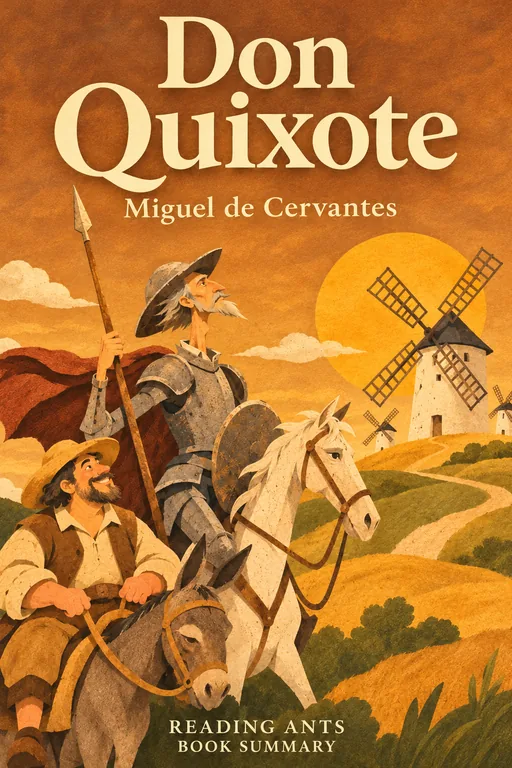
Don Quixote
Miguel de Cervantes
An aging Spanish gentleman reads so many tales of knights that he loses his mind, sets out to become a knight himself with a down-to-earth farmer as his squire, and turns every adventure into glorious, comic disaster.
🌍 World Literature
The Little Prince
Antoine de Saint-Exupery
A pilot stranded in the desert meets a small boy from a tiny planet, who teaches him that the most important things in life, like love and friendship, can only be seen with the heart.
🌍 World Literature
Things Fall Apart
Chinua Achebe
Okonkwo, a proud and fearsome leader in an Igbo village in Nigeria, struggles against his own fears and against the arrival of British missionaries and colonial rulers, who change his world forever.
🌍 World LiteratureWant something different?
Pick another topic and we will show you three books to start with.