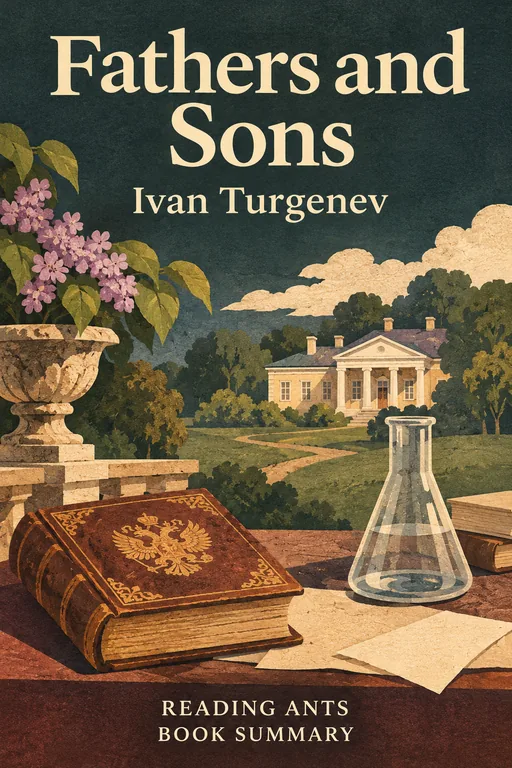
Fathers and Sons
Original title: Отцы и дети
A young graduate and his strong-willed friend, who calls himself a nihilist, come home to the Russian countryside, where their ideas clash with those of the older generation.
Overview
Fathers and Sons is a novel by Ivan Turgenev, published in 1862, set in Russia in 1859, just before the emancipation of the serfs. It is about the conflict between generations: the older landowners who believe in tradition, and the younger men who want to sweep away old ideas. The book helped to popularize the word “nihilist” in Russia, for someone who rejects accepted authority and principles without examination. It is also a love story, a family story and a story about the limits of any ideology. When it came out, it caused a storm, since both the older and younger generations felt that they had been portrayed unfairly.
Main Characters
- Arkady Kirsanov: a gentle, thoughtful young man who has just finished university.
- Yevgeny Bazarov: Arkady’s friend, a medical student and a confident nihilist.
- Nikolai Petrovich Kirsanov: Arkady’s kind, mild father, a landowner.
- Pavel Petrovich Kirsanov: Arkady’s elegant, proud uncle.
- Fenichka: a young woman who lives with Nikolai and has his child.
- Anna Odintsova: a rich, intelligent, cool widow.
- Katya: Odintsova’s gentle younger sister, whom Arkady comes to love and marries.
- Vasily and Arina Bazarov: Bazarov’s loving, old-fashioned parents.
Full Summary
Home Again
Arkady returns from university to his father’s estate, Marino, and he brings with him his friend Bazarov, a tall, rough man who studies natural science and rejects all authority. Nikolai, Arkady’s father, welcomes them warmly, though he is a bit afraid of his son’s friend. He is a gentle man, who plays the cello and worries about managing the estate, now that the serfs are about to be freed.
Pavel Petrovich, Nikolai’s older brother, is a proud, fastidious man who has lived in an English style, and who looks down on Bazarov’s rudeness. The two quarrel from the start. Bazarov says that he believes only in what he can test, and that he does not respect art, tradition or love. Pavel is shocked.
Fenichka
Nikolai lives with a young woman, Fenichka, who is a former housekeeper’s daughter, and with their small child. Arkady is at first surprised, but he accepts his father’s choice. Bazarov, who is dismissive of conventions, treats Fenichka with kindness, and he cares for her baby when it is ill. Pavel, however, is troubled by Fenichka, and he is secretly attracted to her.
Madame Odintsova
The two friends travel to a nearby town, where they meet Anna Odintsova, a young, wealthy widow who is intelligent and reserved. Both men are drawn to her, and she invites them to her estate. She and Bazarov have long conversations. He, who had always scorned love, falls deeply in love with her.
Odintsova is attracted to Bazarov, but she cannot give up her calm, ordered life. When he declares his love, she is startled and refuses him. He is humiliated and angry, and he leaves.
Bazarov’s Parents
Bazarov visits his parents’ small home, where his old father, a retired army doctor, and his mother, who is devout, adore him. They are overjoyed to see him, but he is awkward and cold, and he leaves after a few days. They are heartbroken, though they try not to show it.
Arkady, meanwhile, has found his way to Odintsova’s household, and he falls in love with her younger sister, Katya, who is gentle and sensible. His friendship with Bazarov is slowly changing, as he realizes that he is not a nihilist, and that he values family, love and nature.
The Duel
Back at Marino, Bazarov quarrels with Pavel again, and Pavel challenges him to a duel, after he sees Bazarov kiss Fenichka. They fight with pistols. Bazarov wounds Pavel in the leg, and treats him with a doctor’s care. Pavel, who is humbled, recovers, and he leaves for Europe after a time.
Arkady and Bazarov part, and Arkady chooses a quiet life with Katya.
Bazarov’s Death
Bazarov returns to his parents’ house, where he helps his father, and he cuts his finger while performing an autopsy on a man who has died of typhus. He becomes infected and falls gravely ill. Before he dies, he sends for Odintsova, who comes, and he tells her that he loves her. His last days include fever and delirium, his parents’ anguish and a priest’s visit at his mother’s wish, and he faces death without losing his composure.
Arkady marries Katya, and Nikolai marries Fenichka, so that the older generation settles down too. Bazarov’s parents remain, and they visit his grave often. The book ends with a passage about the grave, and the thought that nature and love will continue after all of us.
Why It Matters
Fathers and Sons is one of the great Russian novels of the nineteenth century, and a classic portrait of generational conflict. Bazarov is one of the most memorable figures in Russian fiction, a man whose ideas are admirable and also limited. The book was a landmark in the debate about the future of Russia, and it was read as a statement about the radical youth of the 1860s.
It is also a masterpiece of style, with clear, economical prose, and a gentle irony that holds both generations to account.
The word it gave to the language, “nihilist,” is still used today, though often in ways that differ from Turgenev’s meaning.
Key Takeaways
- Each generation questions the last. Arkady and Bazarov challenge their fathers.
- Ideology has limits. Bazarov’s views break down in the face of love and death.
- Tradition has value. The older characters show kindness and dignity.
- Love cannot be reasoned away. Bazarov falls for Odintsova despite his views.
- Family bonds endure. His parents love him until the end.
What We Can Learn
The book reminds us that strong beliefs can make us blind. Bazarov is clever and confident, but he cannot admit that he feels. When we hold a view tightly, we might ask what we are leaving out, and whether we are treating people well.
It also shows that young and old can learn from each other. Arkady’s father is not a fool, and Bazarov’s parents are wiser than he realizes. Listening across generations helps both sides.
Finally, the story shows that people are more than their opinions. A person who rejects love, art and family may still need them, and a person’s actions can matter more than their words.
Criticism and Counterpoints
Some readers find the plot slow, with long conversations and few events, and the philosophy of nihilism can seem dated. Others say that Bazarov’s death by a small accident feels like a convenient way to end his story, and that the female characters, though well drawn, are mainly seen through the men’s eyes. In its own time, the book was attacked by both conservatives and radicals, and many felt that Turgenev had not taken a side.
Still, it remains a favorite among readers of classic novels.
Who Should Read It
This book is for teenagers and adults who enjoy classic novels with ideas and strong characters. It is shorter and easier to read than many Russian classics. It is a good starting point for readers new to Russian literature.
Want the whole book?
A summary is a taste, not the meal. Here is where to find the full book.
You reached the end 🎉
Nicely done. Mark this one as read, and we will suggest what to read next.
Read this next
Anna Karenina
Leo Tolstoy
In imperial Russia, a married aristocrat falls passionately in love with a dashing officer and loses her place in society, while a thoughtful landowner seeks a meaningful life through love, work and faith.
🌍 World Literature
War and Peace
Leo Tolstoy
Five aristocratic Russian families are swept through the Napoleonic Wars, and through love, loss and searching, three of their young members discover what makes a life meaningful.
🌍 World Literature
Crime and Punishment
Fyodor Dostoevsky
A poor former student in St. Petersburg murders an old pawnbroker to prove he is an extraordinary man above ordinary morality, then is tormented by guilt until love and confession offer him a path to redemption.
🌍 World Literature
Eugene Onegin
Alexander Pushkin
A bored young aristocrat rejects a country girl's love, kills his friend in a duel, and years later realizes too late that he loves her.
🌍 World Literature
The Little Prince
Antoine de Saint-Exupery
A pilot stranded in the desert meets a small boy from a tiny planet, who teaches him that the most important things in life, like love and friendship, can only be seen with the heart.
🌍 World Literature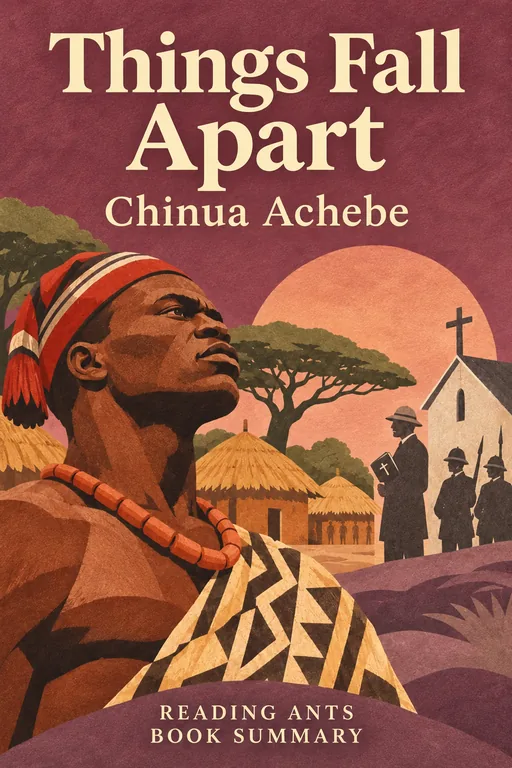
Things Fall Apart
Chinua Achebe
Okonkwo, a proud and fearsome leader in an Igbo village in Nigeria, struggles against his own fears and against the arrival of British missionaries and colonial rulers, who change his world forever.
🌍 World LiteratureWant something different?
Pick another topic and we will show you three books to start with.