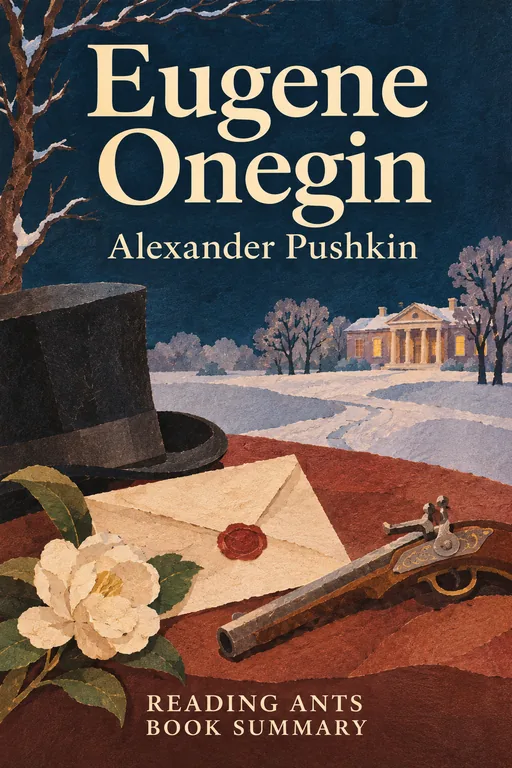
Eugene Onegin
Original title: Евгений Онегин
A bored young aristocrat rejects a country girl's love, kills his friend in a duel, and years later realizes too late that he loves her.
Overview
Eugene Onegin is a novel in verse by Alexander Pushkin, written between 1823 and 1831 and published in full in 1833. It tells a story of love, pride and missed chances among the Russian gentry in the 1820s, in a special fourteen-line stanza form that Pushkin invented. The narrator, a witty and friendly voice, often steps in to comment, joke or digress about fashion, food or poetry. It is considered the founding work of modern Russian literature, and it inspired a famous opera by Tchaikovsky. Its main characters are Onegin, a world-weary dandy, and Tatyana, a dreamy, sincere girl, who are drawn together and kept apart.
Main Characters
- Eugene Onegin: a clever, bored young man from Saint Petersburg society.
- Tatyana Larina: a shy, bookish country girl who falls in love with Onegin.
- Olga Larina: Tatyana’s cheerful, lively younger sister.
- Vladimir Lensky: a young, romantic poet who is engaged to Olga.
- Tatyana’s husband: an older prince and general, who is not named in the poem.
- The narrator: a poet who tells the story and often speaks directly to the reader.
Full Summary
The Dandy
Onegin is a young man who has lived a life of balls, theater and flirtation in Saint Petersburg. By his mid-twenties, he is tired of society, and nothing excites him. When his uncle dies and leaves him an estate in the country, he goes there, hoping for a change, but he is soon bored again.
In the country, Onegin befriends a neighbor, Vladimir Lensky, a young poet who has just come back from studying in Germany. Lensky is enthusiastic and idealistic, and he is in love with Olga Larina, a pretty, cheerful girl. The two men, who are very different, become close.
Tatyana’s Letter
Lensky takes Onegin to meet the Larina family. Olga’s sister, Tatyana, is quiet and dreamy and likes to read novels. When she meets Onegin, she falls in love with him at first sight. She cannot sleep, and in a long night she writes him a letter, telling him of her feelings. It is an unusual act for a young woman of her time.
Onegin receives the letter, and, to her disappointment, he does not respond with love. When they meet in the garden, he is kind but cold. He says that he is not made for marriage and that he would only make her unhappy. He advises her to learn to control her feelings. Tatyana is crushed.
The Name Day
Some time later, Tatyana’s name day is celebrated with a big party. She has a strange dream, a nightmare in which Onegin leads a crowd of monsters. At the party, Onegin is annoyed to find that many guests are there, and he is cross with Lensky for having brought him. To get back at his friend, he flirts with Olga and dances with her all evening.
Lensky is hurt and furious, and he challenges Onegin to a duel. His second, Zaretsky, who is strict about the rules of honor, delivers the challenge.
The Duel
Onegin knows that the quarrel is foolish, but he is too proud to back down. On a cold morning, the two friends meet with pistols. Onegin shoots first and kills Lensky. He is horrified by what he has done, and he leaves the district.
Olga soon forgets Lensky, and she marries a soldier. Tatyana, who is lonely, visits Onegin’s empty house and reads his books, and she begins to understand him. Her mother takes her to Moscow, where she is introduced to society.
Onegin Returns
Years later, Onegin has traveled widely, but he is still restless. Back in Saint Petersburg, he attends a ball, where he sees a beautiful, poised woman who is the wife of a prince. He realizes that it is Tatyana, who has become a self-assured lady of society. He falls in love with her.
He writes her letters, but she does not reply. He seeks her out, and he finally finds her alone at home, reading his letter and in tears.
The Last Scene
Tatyana tells Onegin that she still loves him, but that she is married, and that she will remain faithful to her husband. She reminds him that he once rejected her, and that she would have been happy then. Now it is too late. She leaves him standing alone. Her husband’s arrival is heard, and the poem ends there, without telling us what Onegin does next.
Why It Matters
Eugene Onegin is the most famous work of Russian poetry, and it set the pattern for the Russian realist novel, with its focus on a thoughtful, unhappy hero and a morally strong heroine. The characters, especially Tatyana, have become cultural symbols, and many Russian writers, from Dostoevsky to Tolstoy, took inspiration from the book. Tchaikovsky’s opera, first performed in 1879, brought the story to the world stage.
Its form is also admired, since Pushkin’s stanza is so flexible that he can use it for everything from description to jokes. Translators have found it very challenging, and there are many different English versions, from prose to rhyme.
Key Takeaways
- Pride can cost us love. Onegin rejects Tatyana and regrets it too late.
- Honesty is brave. Tatyana’s letter takes courage.
- Pointless quarrels can be deadly. The duel with Lensky is a tragic waste.
- People change. Tatyana grows from a girl into a poised woman.
- Duty has a price. Tatyana keeps her vow, though it costs her.
What We Can Learn
The poem warns against choosing pride over kindness. Onegin lets a small matter of honor grow into a duel and he lives with the result. In our lives, it is worth asking whether a quarrel is worth the damage that it might cause.
It also reminds us that timing matters. Onegin does not value Tatyana until she is out of reach. Paying attention to the people around us, and valuing them while we have the chance, is a lesson that needs no translation.
Finally, the story shows the strength that comes from character. Tatyana is hurt, but she does not become bitter, and when she has the chance to answer Onegin, she chooses her principles.
Criticism and Counterpoints
Some readers find the poem hard to enjoy in translation, since its charm lies in its rhymes, music and lightness, which are difficult to reproduce. Others say that the plot is thin, and that Onegin is cold and hard to like. A few feel that Tatyana’s refusal at the end is old-fashioned, or that the poem’s view of women is limited.
Still, it has a place as a founding work.
Who Should Read It
This book is for teenagers and adults who enjoy poetry, romance and classic stories. It is short, and the story is easy to follow, but a good translation matters. It is a good starting point for anyone curious about Russian literature or about the opera.
Want the whole book?
A summary is a taste, not the meal. Here is where to find the full book.
You reached the end 🎉
Nicely done. Mark this one as read, and we will suggest what to read next.
Read this next
Fathers and Sons
Ivan Turgenev
A young graduate and his strong-willed friend, who calls himself a nihilist, come home to the Russian countryside, where their ideas clash with those of the older generation.
🌍 World Literature
Anna Karenina
Leo Tolstoy
In imperial Russia, a married aristocrat falls passionately in love with a dashing officer and loses her place in society, while a thoughtful landowner seeks a meaningful life through love, work and faith.
🌍 World Literature
War and Peace
Leo Tolstoy
Five aristocratic Russian families are swept through the Napoleonic Wars, and through love, loss and searching, three of their young members discover what makes a life meaningful.
🌍 World Literature
Pride and Prejudice
Jane Austen
Quick-witted Elizabeth Bennet and the proud, wealthy Mr. Darcy badly misjudge each other, and only by facing their own faults do they find their way to love.
📜 Classics
The Idiot
Fyodor Dostoevsky
A gentle, honest prince who is thought to be simple-minded arrives in Petersburg, where his goodness is caught up in a deadly love triangle and he cannot save those he cares for.
🌍 World Literature
The Little Prince
Antoine de Saint-Exupery
A pilot stranded in the desert meets a small boy from a tiny planet, who teaches him that the most important things in life, like love and friendship, can only be seen with the heart.
🌍 World LiteratureWant something different?
Pick another topic and we will show you three books to start with.