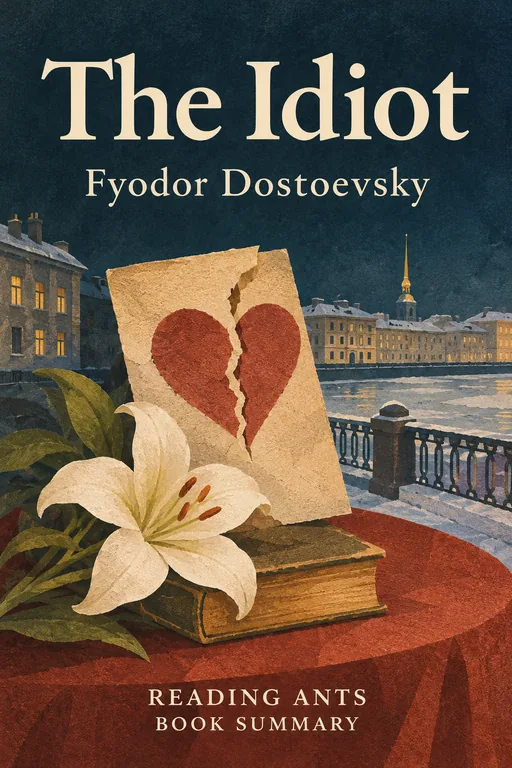
The Idiot
Original title: Идиот
A gentle, honest prince who is thought to be simple-minded arrives in Petersburg, where his goodness is caught up in a deadly love triangle and he cannot save those he cares for.
Overview
The Idiot is a novel by Fyodor Dostoevsky, published in installments in 1868 and 1869. Dostoevsky wanted to portray a truly good man, modeled on the Christian ideal and a relative of Don Quixote, and to see what would happen to him in a world of money, pride and passion. The hero, Prince Myshkin, has spent years in a Swiss sanatorium for epilepsy and returns to Russia, where his openness and kindness startle people. The book has many characters and stormy scenes, and it is both a social comedy and a tragedy. It is a long novel, rich in strong emotion, and it asks whether goodness can survive in a world like ours.
Main Characters
- Prince Lev Nikolayevich Myshkin: a kind, trusting young man, who has had epilepsy.
- Nastasya Filippovna: a beautiful, proud, tormented woman with a painful past.
- Parfyon Rogozhin: a passionate, wealthy merchant’s son, who loves Nastasya.
- Aglaya Epanchin: a lively, proud young woman, the youngest daughter of a general.
- General Epanchin and his wife Lizaveta: a well-off family who are distant relatives of the prince.
- Ganya Ivolgin: an ambitious clerk who wants to marry Nastasya for her money.
- Ippolit: a sick young man, who is dying of consumption.
Full Summary
The Prince Arrives
Prince Myshkin returns to Russia by train, and he meets Rogozhin, a dark, intense man who speaks about Nastasya Filippovna, a woman he has fallen in love with. In St. Petersburg, the prince visits the Epanchin family, who are relatives, and he charms them with his honesty. He seems to see through people, and he speaks about things that others avoid, such as pain and death. They find him odd, but they like him.
At the Epanchins’, the prince sees a photograph of Nastasya, who has been the ward and mistress of a rich man, Totsky. He is struck by her face, and he feels pity and attraction.
Nastasya’s Birthday
At Nastasya’s birthday party, a group of men gather. Totsky wants to marry her off to Ganya, with a dowry of seventy-five thousand roubles, so that he can be free of her. Nastasya, humiliated, is cynical and wild. Rogozhin arrives with a hundred thousand roubles, and offers it for her. The prince, whom Nastasya has asked for advice and who has told her not to marry Ganya, offers to marry her himself, saying that he sees her as an honest woman.
Nastasya is moved, but she decides that she cannot ruin such a good man by marrying him, and she goes off with Rogozhin. Before she leaves, she throws the money into a fire and says that Ganya may take it from the flames, if he is willing to do so, but he refuses.
The Prince and the Epanchins
The prince, who inherits a fortune, settles near the Epanchins, and he grows close to the family. Aglaya, the youngest daughter, who is clever and sharp, begins to take an interest in him. She teases him, but she also sees his goodness. He falls in love with her, though his feelings for Nastasya remain.
Meanwhile, Ippolit, a young man who is dying, tries to shock everyone with a long reading of his confession, in which he talks of his despair. He wants attention before he dies, and the prince treats him with compassion.
The Engagement
The prince becomes engaged to Aglaya, and the Epanchins prepare for a society event. But Nastasya, who has been writing to Aglaya, meets her in a stormy scene. Nastasya begs the prince to stay with her. He cannot abandon Nastasya, whom he pities, and he is torn. Aglaya, who is proud, leaves in anger.
Soon after, Nastasya agrees to marry the prince, and a wedding is planned. But on the day of the ceremony, she runs away at the church door with Rogozhin.
The Murder
The prince searches for her, and after a day of fruitless looking Rogozhin himself appears and secretly leads him to his house and a dark room, where Nastasya lies dead, killed by Rogozhin with a knife. The two men sit down by the body and spend the night together, talking in whispers, as the prince tries to calm the murderer.
When others arrive in the morning, they find Rogozhin raving and the prince, who has been overwhelmed, in a state of confusion. The prince has lost his reason, and he has returned to his old illness.
The End
Rogozhin is tried and sent to Siberia. The prince is taken back to the clinic in Switzerland, where he is no longer able to understand what has happened. The novel ends with the sorrow of those who loved him, and with the sense that a good man has been destroyed by a world that could not understand or protect him.
Why It Matters
The Idiot is considered one of Dostoevsky’s major works, and one of the great novels about goodness. Its picture of a “positively beautiful man” in a world of ego and passion has often been compared to the figures of Christ or Don Quixote, and it has been discussed by writers and thinkers for over a century. Its scenes of high emotion, in which characters declare their love or hatred in front of everyone, have become famous.
It is also remarkable for the way that it presents epilepsy, which Dostoevsky himself had, and for its descriptions of the moment before a seizure, when the prince feels a flash of harmony.
Key Takeaways
- Goodness is hard to live out. The prince is kind, but he cannot save anyone.
- Pity is not the same as love. The prince’s pity for Nastasya brings pain.
- Pride and shame can be destructive. Nastasya and Aglaya act out of wounded pride.
- Society mocks innocence. People call the prince an idiot.
- Passion without reason can turn violent. Rogozhin’s love ends in murder.
What We Can Learn
The book shows that sincerity and trust can touch people, even in cold company. The prince’s honesty makes people uncomfortable, but it also makes them speak truthfully. In our own lives, treating others with respect and openness can change the way they behave.
It also shows the limits of good intentions. The prince wants to help everyone, but he cannot choose between two women, and his indecision hurts them both. Being kind sometimes means being clear and honest about what we can and cannot do.
Finally, the story is a warning about how we treat people who have been hurt. Nastasya has been used and shamed, and she cannot believe that she deserves love. Offering patience and respect can matter more than we think.
Criticism and Counterpoints
Some readers find the book too long and chaotic, with scenes that go on for pages, and a plot that depends on melodramatic coincidences and outbursts. Others feel that the prince is not believable, since he is almost too good, and that his passivity makes him a frustrating hero. A few say that Nastasya and Aglaya, though vivid, are defined by their passions and by the men around them.
Still, the book’s emotional power and psychological depth are widely admired.
Who Should Read It
This book is for mature teenagers and adults who enjoy long, intense classics. It is slow to start, but it builds to a powerful end. It is a good choice for readers who like Dostoevsky, or who want to think about what goodness means.
Want the whole book?
A summary is a taste, not the meal. Here is where to find the full book.
You reached the end 🎉
Nicely done. Mark this one as read, and we will suggest what to read next.
Read this next
Crime and Punishment
Fyodor Dostoevsky
A poor former student in St. Petersburg murders an old pawnbroker to prove he is an extraordinary man above ordinary morality, then is tormented by guilt until love and confession offer him a path to redemption.
🌍 World Literature
The Brothers Karamazov
Fyodor Dostoevsky
When a vulgar, greedy landowner is murdered, his three very different sons, a passionate soldier, a rational intellectual and a gentle novice monk, are drawn into a mystery that is also a debate about faith, doubt, guilt and freedom.
🌍 World Literature
Notes from Underground
Fyodor Dostoevsky
A bitter, lonely former clerk who lives in a squalid underground existence writes an angry confession about his own spite, his contempt for the world and a humiliating episode from his past.
🌍 World Literature
Anna Karenina
Leo Tolstoy
In imperial Russia, a married aristocrat falls passionately in love with a dashing officer and loses her place in society, while a thoughtful landowner seeks a meaningful life through love, work and faith.
🌍 World Literature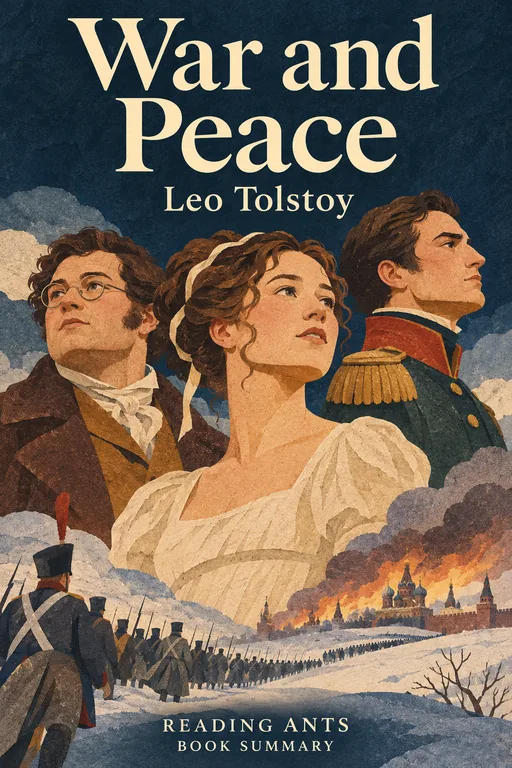
War and Peace
Leo Tolstoy
Five aristocratic Russian families are swept through the Napoleonic Wars, and through love, loss and searching, three of their young members discover what makes a life meaningful.
🌍 World Literature
The Little Prince
Antoine de Saint-Exupery
A pilot stranded in the desert meets a small boy from a tiny planet, who teaches him that the most important things in life, like love and friendship, can only be seen with the heart.
🌍 World LiteratureWant something different?
Pick another topic and we will show you three books to start with.