 Reading Ants
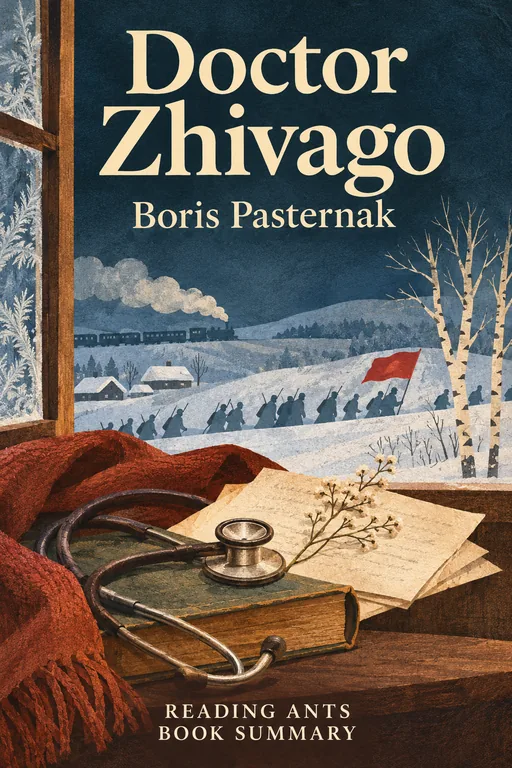
Doctor Zhivago
Original title: Доктор Живаго
A Russian doctor and poet lives through the First World War, the revolution and the civil war, torn between his family, a lasting love and a country that has no place for him.
Overview
Doctor Zhivago is a novel by Boris Pasternak, finished in 1956 and first published in Italy in 1957, after the Soviet authorities refused to print it. It follows the life of Yuri Zhivago from his boyhood, before the First World War, through the upheavals of 1917 and the civil war, until the 1920s. The story is told in many short episodes, with many coincidences, and it ends with a group of poems by Zhivago himself. Pasternak was awarded the Nobel Prize in Literature in 1958, but he was forced by the Soviet government to refuse it. The book is both a love story and a portrait of a society broken by history.
Main Characters
- Yuri Zhivago: a doctor and a poet, sensitive and independent.
- Lara (Larisa Guishar): a young woman whom Yuri loves, who has suffered much.
- Tonya Gromeko: Yuri’s wife, who is kind and steady.
- Pasha Antipov (Strelnikov): Lara’s husband, who becomes a revolutionary commander.
- Victor Komarovsky: a wealthy lawyer who exploits Lara.
- Misha Gordon and Nikolai Vedenyapin: a friend and an uncle who shape Yuri’s thinking.
Full Summary
A Boy and a City
Yuri Zhivago is a child when his mother dies, and he is taken in by the Gromeko family in Moscow, a family of educated people. He grows up in a world of music, books and conversation, and he studies medicine while writing poetry. He becomes close to the Gromeko family, and he later marries their daughter Tonya.
At the same time, a young girl named Lara Guishar, whose mother is a dressmaker, is drawn into the power of Komarovsky, a rich lawyer who takes advantage of her. She later marries Pasha Antipov, a student who loves her. Their marriage is damaged, but she remains attached to him.
War and Revolution
When the First World War begins, Yuri serves as a doctor at the front, and he meets Lara, who is working as a nurse. They are brought together briefly. Back in Moscow, he sees the effect of the revolution of 1917: shortages, fear and violence. He is at first hopeful about change, but he becomes disillusioned as the new government grows harsher.
Pasha, who was believed to be dead, returns as Strelnikov, a stern commander of the Red Army, who is known for his harshness.
The Journey East
Life in Moscow becomes impossible, with hunger and cold, and Yuri takes his family by train to the Urals, to an estate called Varykino, which belonged to Tonya’s family. The journey is long and difficult. They try to live as farmers, working the land and growing food. Yuri finds peace for a time, writing and thinking.
In the nearby town of Yuriatin, he discovers Lara again, who has been living there, and the two begin a love affair. Yuri is torn, as he loves Tonya, but cannot give up Lara.
The Partisans
Yuri is captured by a band of partisans fighting in the civil war and is forced to serve as their doctor for more than a year. He sees the brutality on both sides, and he is horrified. At last, he escapes and walks back to Yuriatin, through a snow-covered country.
He finds that Tonya has gone to Moscow and then abroad. Lara is still in the town, and he stays with her at Varykino for a few weeks of happiness, writing poems.
Separation
Komarovsky, who has become a government official, appears and persuades Lara to leave with him for the Far East, saying that Strelnikov will be arrested. He tells Yuri that this is the only way to save her. Lara, who is pregnant with Yuri’s child, agrees, to protect Yuri, and Yuri stays behind. Strelnikov, hunted by the new regime, comes to Varykino and talks with Yuri, and the next morning he takes his own life there.
Yuri is alone, and he decides to return to Moscow. There, he lives as a poor man with a woman named Marina, with whom he has two daughters, writing and doing odd jobs, while his health declines.
The End
In 1929, Yuri has a heart attack on a tram in Moscow, gets off, and collapses and dies in the street. Lara, who has come back to the city, attends his funeral. After his death, his half-brother, Yevgraf, and his friends collect his poems.
Lara disappears, probably arrested. A short epilogue set during the Second World War shows Yuri’s friends remembering him, and introduces Tanya, the daughter of Yuri and Lara, whom Yevgraf helps. The novel closes with Yuri’s poems, which include the poem “Hamlet” and a poem about a winter night.
Why It Matters
Doctor Zhivago is one of the most famous novels of the twentieth century, partly because of its history. The Soviet government tried to suppress it, and an Italian publisher had it smuggled out. Pasternak’s Nobel Prize was a political event, and he was forced to decline it. In 1988, the novel was finally published in the Soviet Union.
It is also notable as a celebration of private life and individuality, in a time when the state demanded collective sacrifice. Its lyrical style and its focus on love, nature and poetry give it a beauty that has made it a classic. It was adapted into a 1965 film that made the story widely known.
Key Takeaways
- History disrupts private lives. War and revolution break up families.
- Love and art survive hard times. Yuri writes poems in the middle of chaos.
- Ideology can be cruel. The revolution’s promise turns to violence.
- Individuals matter. Yuri refuses to give up his own thoughts.
- Chance shapes lives. Characters meet and part by coincidence.
What We Can Learn
The book reminds us that big events and personal lives are linked, and that when a society changes, ordinary people pay a price. When we read history, it helps to ask how it looked to the people living through it.
It also shows the value of keeping something that is yours. Yuri’s poems and his love give him an inner life that no state can control. We can protect our own interests, friendships and talents, which help us in hard times.
Finally, the story suggests that being true to yourself can be a form of courage, even when it brings loss.
Criticism and Counterpoints
Some readers find the plot rambling, with too many coincidences, and too many characters turning up by chance. Others say that Zhivago is passive, and that he is a weak hero who leaves his family and drifts through events, and that Lara is idealized. A few critics, especially in the Soviet Union, attacked it as hostile to the revolution. Others have said that the poems at the end are the best part, but that the prose is uneven.
Still, its beauty and its place in history have kept it widely read.
Who Should Read It
This book is for mature readers who like long, historical novels with a romantic and philosophical side. It contains war, death and a love affair. It is a good choice for anyone interested in the Russian Revolution or in the power of literature under censorship.
Want the whole book?
A summary is a taste, not the meal. Here is where to find the full book.
You reached the end 🎉
Nicely done. Mark this one as read, and we will suggest what to read next.
Read this next
War and Peace
Leo Tolstoy
Five aristocratic Russian families are swept through the Napoleonic Wars, and through love, loss and searching, three of their young members discover what makes a life meaningful.
🌍 World Literature
Anna Karenina
Leo Tolstoy
In imperial Russia, a married aristocrat falls passionately in love with a dashing officer and loses her place in society, while a thoughtful landowner seeks a meaningful life through love, work and faith.
🌍 World Literature
The Gulag Archipelago
Aleksandr Solzhenitsyn
Combining his own experience with the testimony of hundreds of other prisoners, Solzhenitsyn exposes the Soviet system of prison camps and arrests, showing how a regime built a vast machine of terror against its own people.
🏛️ History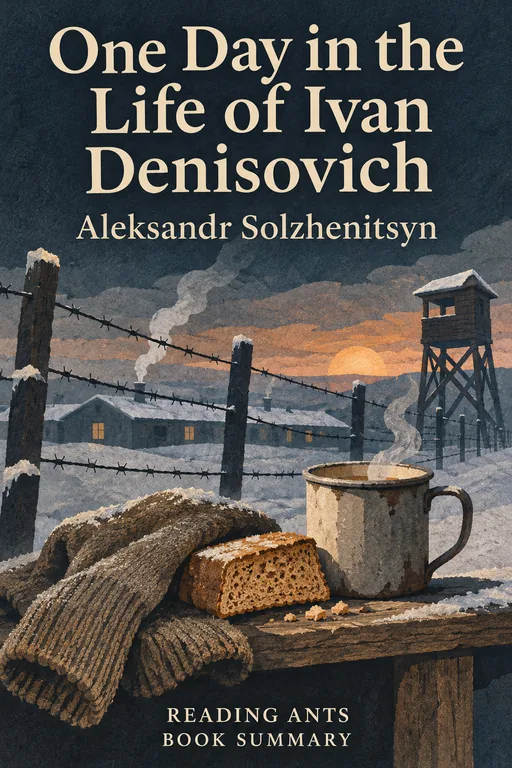
One Day in the Life of Ivan Denisovich
Aleksandr Solzhenitsyn
The novel follows a single ordinary day of a prisoner in a Soviet labor camp, showing how a man keeps his dignity through small acts of skill, shrewdness and kindness.
🌍 World Literature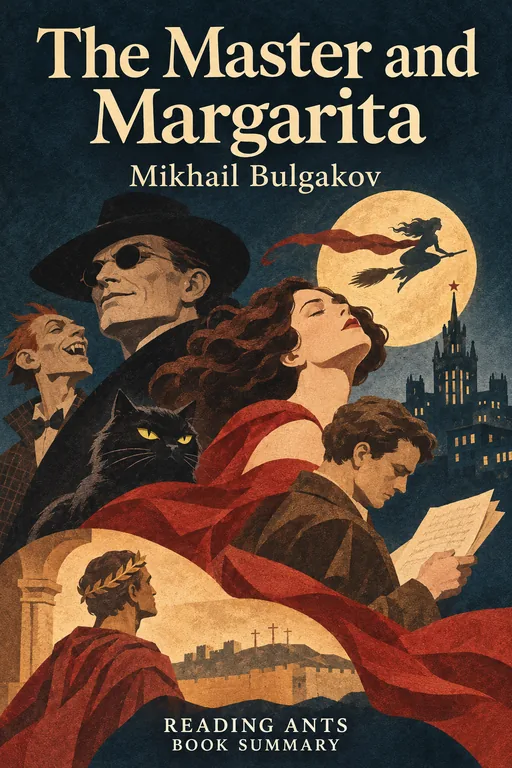
The Master and Margarita
Mikhail Bulgakov
The Devil arrives in 1930s Moscow with a cat, a fanged assistant and a naked witch, and turns the city upside down, while a persecuted writer and his devoted lover try to save a novel about Pontius Pilate from oblivion.
🌍 World Literature
The Little Prince
Antoine de Saint-Exupery
A pilot stranded in the desert meets a small boy from a tiny planet, who teaches him that the most important things in life, like love and friendship, can only be seen with the heart.
🌍 World LiteratureWant something different?
Pick another topic and we will show you three books to start with.