 Reading Ants
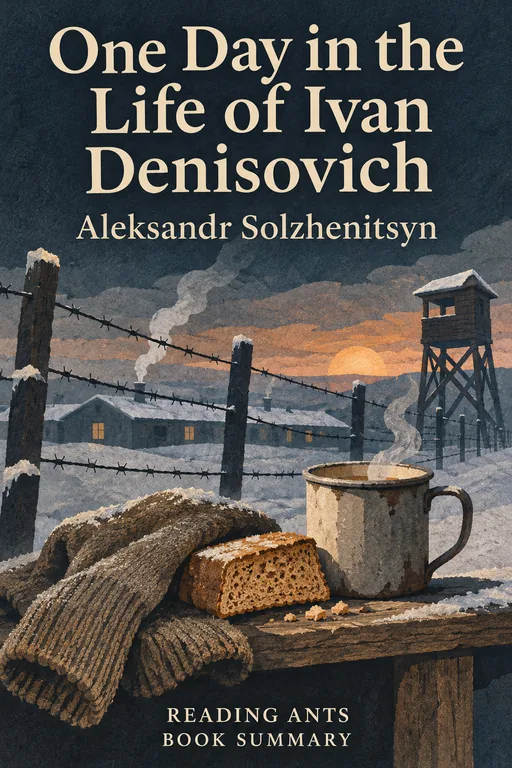
One Day in the Life of Ivan Denisovich
Original title: Один день Ивана Денисовича
The novel follows a single ordinary day of a prisoner in a Soviet labor camp, showing how a man keeps his dignity through small acts of skill, shrewdness and kindness.
Overview
One Day in the Life of Ivan Denisovich is a short novel by Aleksandr Solzhenitsyn, first published in the Soviet Union in 1962. It is set in a forced labor camp in Stalin’s time, in the early 1950s, in the freezing Russian winter. The story covers just one day, from the wake-up call before dawn to lights-out at night. Solzhenitsyn had spent years in such camps himself, and the book was one of the first honest accounts of that world to reach the public. The central question is simple and deep: what does it take to stay human when everything is done to break you?
Main Characters
- Ivan Denisovich Shukhov: a peasant and former soldier, a skilled bricklayer, practical and quietly decent.
- Tyurin: the tough, fair foreman of Gang 104, the work team.
- Tsezar (Caesar): an educated city man who receives food parcels and does lighter work.
- Alyoshka: a gentle Baptist who prays and never complains.
- Buynovsky: a former naval captain, still proud, who is not yet used to the camp.
- Fetyukov: a weak prisoner who begs and scavenges.
- Senka Klevshin: a quiet, half-deaf prisoner who has survived terrible things.
Full Summary
Before Dawn
The camp wakes to the sound of a hammer on a rail that serves as the camp’s bell. Shukhov feels unwell and stays in bed longer than he should. This is a risk, and a guard threatens him with three days in the cells. In the end he is made to scrub the floor of the guards’ room instead. Compared with the cells that other prisoners are sent to, it is a light punishment, and he accepts it without fuss.
We learn that he has been in camps for eight years. He was a soldier in the war, was captured by the Germans, escaped after a couple of days, and then was accused by his own side of treason, of having come back on secret orders from the Germans. The charge was absurd and false, but he signed a confession because refusing would have meant a quick death. Like most of the men around him, he is serving a long sentence for a crime he did not commit.
Breakfast and the Morning Count
The prisoners eat thin soup and a little bread in the mess hall, where food is the center of life. Shukhov has his own careful habits. He eats slowly, and when he gets his bread ration he saves part of it for later by hiding half in his jacket and half in his mattress. The men are counted several times, in the bitter cold, and any mistake in the count makes everyone wait longer.
Tsezar receives packages from home, and Shukhov sometimes earns a share by doing small favors for him. The camp runs on little trades like these.
The Building Site
The men march out to a building site, where Gang 104 is working on an unfinished power station on the frozen, treeless steppe. Their foreman, Tyurin, knows how to bargain with the officials, and he protects his men as well as he can. Without proper fuel and with the wind cutting across the open ground, the men first have to find ways to warm the place and prepare the materials.
Then Shukhov and his friends begin to lay bricks. Despite the cold and the injustice, Shukhov takes real pride in doing good work, and he loses himself in the wall. For a few hours he is simply a craftsman, and the work gives him something that the camp cannot take away.
Small Victories
At the end of the day, Shukhov keeps laying bricks until the mortar is used up, hides his precious trowel for the next day, and then hurries to catch up with the line going back to camp. Earlier he had picked up a scrap of steel that he could grind into a small knife for mending boots. At the camp gate he realizes it is still in his pocket, and he slips it into his mitten to get it past the search, a risky thing to do.
He also manages to get extra food. At midday he tricks the cook into giving the gang two spare bowls of mush, and in the evening he waits in line at the package room for Tsezar, who pays him with his own supper and bread. At the camp, he buys some tobacco from a Latvian prisoner.
Lights Out
At night Shukhov lies in his bunk and goes over his day. Nothing very bad has happened. He avoided the cells, he got extra food, he built a good wall, and he was not caught with the steel. In his own mind, it has been an almost happy day.
Alyoshka lies beside him reading the Gospels and urges him to pray. Shukhov says he believes in God but doubts that prayers can shorten a sentence. The book ends on a calm, almost cheerful note, with the narrator observing that Shukhov’s ten-year term lasts 3,653 days, the three extra days being the leap days. Alyoshka’s faith, and a cookie that Shukhov shares with him, show that the day is not only about survival.
Why It Matters
This novel broke a long silence. Published during a brief thaw after Stalin’s death, it was one of the first works in the Soviet Union to describe the labor camp system, and it made a huge impression at home and abroad. Solzhenitsyn went on to write much larger works on the same subject, and he later won the Nobel Prize in Literature. The book also showed that a short, plain, quiet story can say more about suffering than a long and loud one. Today it is read as a classic of twentieth-century literature and a record of what ordinary people endured under tyranny.
Key Takeaways
- Dignity survives in small things. Shukhov keeps himself human through his craft, his routines and his care for others.
- Work can give meaning. Laying bricks well gives him a sense of pride that the guards cannot take.
- Solidarity matters. The gang’s loyalty to one another helps them survive.
- Evil can be ordinary. The camp is run by routine and counting, not by dramatic cruelty alone.
- A plain style can carry great weight. The book’s calm tone makes the injustice more striking.
What We Can Learn
Shukhov shows that even when we cannot change our situation, we can still choose how to act within it. He does his work well, he helps those around him, and he does not give up his sense of self. In our own lives, when we are stuck in a job or a place we did not choose, we can look for small ways to keep our standards, take pride in our work and be kind to the people around us.
The book also teaches gratitude for simple things, like warm food, a dry place to sleep and a kind word. These seem small until they are taken away. Finally, it is a reminder to learn and remember history, so that injustices like these are not repeated or forgotten.
Criticism and Counterpoints
Some readers find the book’s detail slow, especially the long descriptions of food, work and camp routine, and the many Russian names and camp terms can be hard to follow. Others point out that Shukhov is a rather mild picture of camp life, and that Solzhenitsyn’s own later books, such as The Gulag Archipelago, show a much darker and wider reality. In the Soviet Union, the story was allowed in part because it suited a political moment, and it was soon restricted again.
Who Should Read It
This is a good book for teenagers and adults who want a short, powerful introduction to twentieth-century history and to Russian literature. It is easy to finish in a few evenings. Readers who want a fast-moving plot may find it quiet, and anyone who is sensitive to descriptions of hunger, cold and hardship should be prepared.
Want the whole book?
A summary is a taste, not the meal. Here is where to find the full book.
You reached the end 🎉
Nicely done. Mark this one as read, and we will suggest what to read next.
Read this next
The Gulag Archipelago
Aleksandr Solzhenitsyn
Combining his own experience with the testimony of hundreds of other prisoners, Solzhenitsyn exposes the Soviet system of prison camps and arrests, showing how a regime built a vast machine of terror against its own people.
🏛️ History
Nineteen Eighty-Four
George Orwell
In a future Britain ruled by an all-seeing Party, one man secretly rebels by keeping a diary and falling in love, and discovers just how completely a totalitarian state can crush the human mind.
📜 Classics
Night
Elie Wiesel
Elie Wiesel tells, in short and searing pages, how as a teenager he was taken from his hometown of Sighet to Auschwitz and Buchenwald, lost his family and watched his faith and childhood break apart.
👤 Real Lives
We
Yevgeny Zamyatin
In a glass city where everyone lives by a strict timetable and has a number instead of a name, a loyal engineer begins to feel love and doubt, and discovers what it costs to be free.
🌍 World Literature
The Little Prince
Antoine de Saint-Exupery
A pilot stranded in the desert meets a small boy from a tiny planet, who teaches him that the most important things in life, like love and friendship, can only be seen with the heart.
🌍 World Literature
Things Fall Apart
Chinua Achebe
Okonkwo, a proud and fearsome leader in an Igbo village in Nigeria, struggles against his own fears and against the arrival of British missionaries and colonial rulers, who change his world forever.
🌍 World LiteratureWant something different?
Pick another topic and we will show you three books to start with.