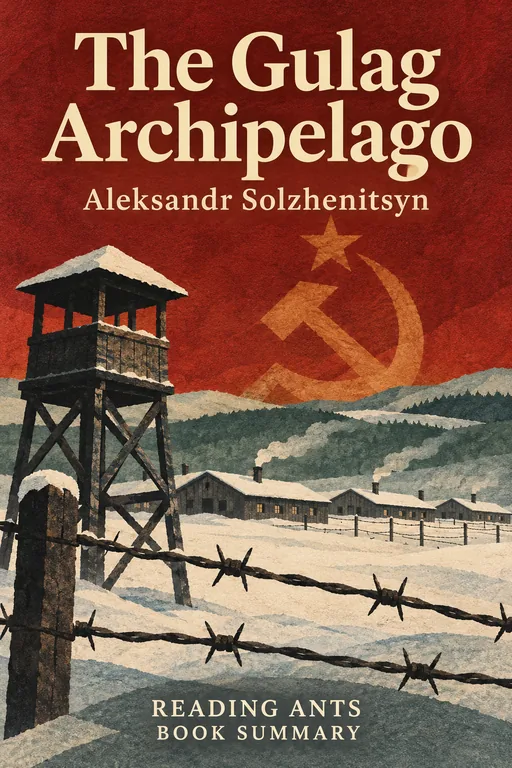
The Gulag Archipelago
Original title: Архипелаг ГУЛАГ
Combining his own experience with the testimony of hundreds of other prisoners, Solzhenitsyn exposes the Soviet system of prison camps and arrests, showing how a regime built a vast machine of terror against its own people.
Overview
The Gulag Archipelago was written by the Russian author Aleksandr Solzhenitsyn, who had himself been arrested in 1945 for criticizing Stalin in a private letter and spent years in prison and labor camps. The “Gulag” was the Soviet agency that ran the camps; Solzhenitsyn compared the scattered camps to a chain of islands, an “archipelago,” across the country. He wrote the work in secret in the 1960s, drawing on his memories and on letters and accounts from some two hundred and twenty-seven other prisoners. It was published in the West in 1973, in Russian, and caused an enormous stir. The book is part history, part memoir and part moral argument.
Full Summary
1. Arrest
The idea: Solzhenitsyn begins with the experience of being arrested, which he treats as the first shock in a long process. He describes how people were taken from their homes at night, often for tiny or imaginary offenses, and how fear spread through society. He shows that anyone could disappear, and that many never found out why. He explains that arrests came in waves, with mass arrests in the 1930s and again after the war, and that the secret police operated according to quotas and suspicion rather than evidence.
In real life: When people can be punished without a fair process, everyone begins to watch what they say, even to friends.
2. Interrogation and the system
The idea: In the next parts, he describes the methods used to get confessions, including sleep deprivation, threats and torture, and the sham trials that followed. He traces the history of the security services from the early Soviet years through Stalin’s rule, arguing that the terror did not begin with Stalin, but was part of the system from its earliest days under Lenin. He also discusses how many ordinary people took part, as informers, guards or officials, and how fear shaped behavior in every office and apartment block.
In real life: A confession obtained by pressure proves nothing, which is why modern legal systems limit how suspects may be questioned.
3. Transport and the camps
The idea: Prisoners were moved across the country in crowded railway cars and ships to remote camps in Siberia, the Arctic and elsewhere. Solzhenitsyn describes the camps’ daily life: hunger, cold, endless labor in mines and forests, and the hierarchy among prisoners, where some, such as trusted workers or common criminals, had power over others. He explains that the camps were also a source of cheap labor for the state’s building projects. Some prisoners lost their humanity while others kept it, and small acts of kindness mattered a great deal.
In real life: Forced labor treats people as tools, which is why modern human rights rules ban it.
4. The soul and the body
The idea: Solzhenitsyn reflects on what the camps did to people and on his own moral experience. He writes honestly about how he himself, as a young officer, once believed in the system and was not immune to arrogance and cruelty before his arrest. In the camps he came to see the line between good and evil as running through every human heart, rather than between groups. This reflection, and his change of outlook, gives the book its moral depth and distinguishes it from a simple list of crimes.
In real life: Admitting our own capacity for wrongdoing is a humbling step that helps us judge others less harshly and ourselves more honestly.
5. Resistance and escape
The idea: The book also tells of resistance. There are stories of escapes, most of them hopeless, and of uprisings and strikes in the camps in the 1950s after Stalin’s death, which showed that prisoners could organize themselves even in the harshest conditions. Solzhenitsyn argues that such acts, although often crushed, helped lead to the eventual release of many prisoners and to the winding down of the harshest camps. He also describes the quiet resistance of those who refused to inform on others or to give false testimony.
In real life: Even when change seems impossible, refusing to take part in wrongdoing can matter, and many small refusals can add up.
6. Exile and aftermath
The idea: After release, many prisoners were sent to permanent exile in remote regions, without freedom to return home. Solzhenitsyn describes his own time in exile in Kazakhstan, where he fell ill with cancer and was treated. He also discusses the partial reforms after Stalin’s death and how many former prisoners faced silence or suspicion from the rest of society. He ends by arguing that the truth about the camps must be remembered, and that failing to confront the past leaves a society vulnerable to repeating it.
In real life: Societies that do not talk honestly about past wrongs often struggle to heal, which is why many countries create memorials and truth commissions.
Why It Matters
The Gulag Archipelago is one of the most important books about Soviet history. It made the scale and nature of the camp system impossible to deny, both inside and outside the Soviet Union, and shaped Western views of Soviet communism. Solzhenitsyn had already received the Nobel Prize in Literature in 1970, and he was expelled from the USSR in 1974 after the book appeared in the West.
The book also remains a model of how personal testimony can document history, and it continues to be read as a powerful warning about the abuse of state power. In Russia, it was finally published openly in the late 1980s, as the Soviet system was weakening.
Key Takeaways
- State terror can be systematic. Arrests and camps formed a machine, not isolated incidents.
- Testimony preserves truth. Hundreds of voices told what happened to them.
- Evil is not only in others. Solzhenitsyn found the dividing line inside himself.
- Silence helps tyranny. Fear kept many from speaking out.
- Memory is a duty. Remembering the past helps prevent its repetition.
What We Can Learn
The book teaches how easily ordinary life can be broken by an unaccountable government. It encourages us to value laws that protect individuals, fair trials and the freedom to speak.
It also shows moral courage. Solzhenitsyn risked his life to write and smuggle out the manuscript, and prisoners shared their stories hoping the world would know. Their example reminds us that telling the truth can be an act of bravery.
Finally, the author’s honest self-examination invites us to look at our own choices. He suggests that good and evil are not simply “us” and “them” but exist in each person, which is a humbling but useful thought.
Criticism and Counterpoints
Some historians have criticized the book for relying on memories and secondhand accounts, and for overstating some figures, such as the number of victims, since archives opened after 1991 provided more precise data that sometimes differ from his estimates. Others have disagreed with his political and religious views, including his attitude toward the West and his nationalism, which became clear in later years.
The book is also very long and the style, mixing satire, history and philosophy, is hard for some readers. An abridged version exists. Despite these concerns, historians generally agree that it was essential in revealing the camp system and that its core picture is supported by later research.
Who Should Read It
This book suits mature readers who are interested in history, politics and moral questions. It describes brutality and is emotionally heavy. Readers new to the subject may wish to begin with the shorter novel One Day in the Life of Ivan Denisovich or with the abridged edition of this work.
Want the whole book?
A summary is a taste, not the meal. Here is where to find the full book.
You reached the end 🎉
Nicely done. Mark this one as read, and we will suggest what to read next.
Read this next
One Day in the Life of Ivan Denisovich
Aleksandr Solzhenitsyn
The novel follows a single ordinary day of a prisoner in a Soviet labor camp, showing how a man keeps his dignity through small acts of skill, shrewdness and kindness.
🌍 World Literature
Night
Elie Wiesel
Elie Wiesel tells, in short and searing pages, how as a teenager he was taken from his hometown of Sighet to Auschwitz and Buchenwald, lost his family and watched his faith and childhood break apart.
👤 Real Lives
Sapiens: A Brief History of Humankind
Yuval Noah Harari
Humans came to rule the planet not because we are the strongest animals but because we can believe in shared stories (gods, nations, money, companies) that let millions of strangers cooperate.
🏛️ History
Guns, Germs, and Steel
Jared Diamond
Some societies came to conquer others not because their people were smarter or better, but because geography gave them a head start in farming, animals, germs and technology.
🏛️ History
The Histories
Herodotus
Herodotus, often called the father of history, tells how the Greeks and the Persians came into conflict and fought the great wars of the early fifth century BCE, with long, colorful detours into the lands, customs and legends of the known world.
🏛️ History
History of the Peloponnesian War
Thucydides
Thucydides, an Athenian general turned historian, records the long war between Athens and Sparta in the fifth century BCE and uses it to study power, fear, politics and how human nature behaves in crisis.
🏛️ HistoryWant something different?
Pick another topic and we will show you three books to start with.