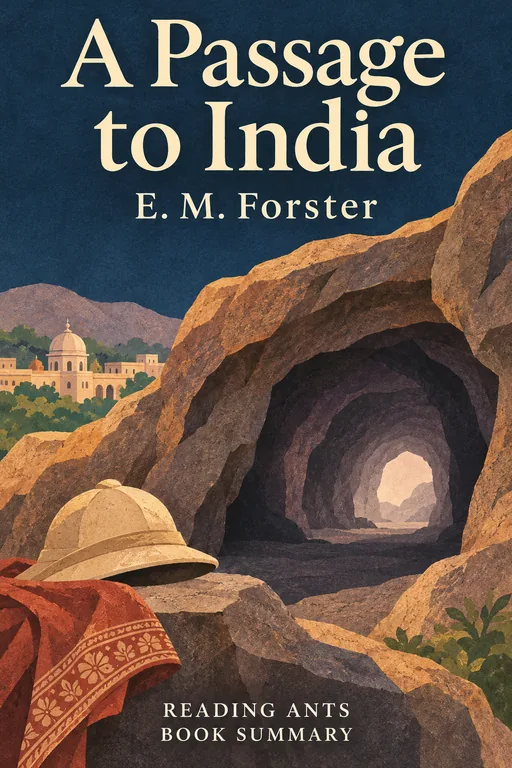
A Passage to India
In British-ruled India, a young Indian doctor is accused of assaulting an Englishwoman after an outing to the mysterious Marabar Caves, and the trial exposes how deep the gulf between the rulers and the ruled really is.
Overview
A Passage to India is a novel by E. M. Forster, published in 1924, after he had visited India twice and worked there as a private secretary to a maharajah. It is set in the fictional city of Chandrapore in the 1920s, during the last decades of British rule. The story begins with a wish for friendship between English and Indian people, and ends by asking whether that is possible under an empire. The central event takes place in the Marabar Caves, which seem to hold a strange, empty echo. The novel is both a social drama and a reflection on the limits of understanding between people and cultures.
Main Characters
- Dr. Aziz: a warm, emotional, poetry-loving Muslim doctor in Chandrapore.
- Cyril Fielding: the English principal of the government college, who is open-minded and independent.
- Adela Quested: a young Englishwoman who has come to India to decide whether to marry.
- Mrs. Moore: Adela’s elderly companion, who is kind and intuitive.
- Ronny Heaslop: Mrs. Moore’s son, the city magistrate, who is conventional and tied to the imperial attitude.
- Professor Godbole: a Hindu teacher at Fielding’s college, calm and mysterious.
- Mr. Turton: the British collector, head of the English community.
Full Summary
Hopes of Friendship
Dr. Aziz and his Muslim friends talk of how hard it is to be friends with the English, who often keep apart. Aziz meets an elderly Englishwoman, Mrs. Moore, in a mosque at night, and he is touched by her respect for the customs. She has come to India with Adela Quested, who is expected to marry Mrs. Moore’s son, Ronny, the city magistrate. Adela says that she wants to see the “real India,” but Ronny and the English community look at the Indians with disdain.
The Bridge Party and the Tea
The English hold a “Bridge Party,” meant to bring the communities together, but it is stiff and awkward, with the English staying apart from their guests. Fielding, who is friendlier, invites Adela, Mrs. Moore, Aziz and Godbole to tea. It goes well, and Aziz is happy to have a friend. In a spirit of generosity, he invites the English guests to an excursion to the Marabar Caves, which are some distance from the city.
The Caves
At the caves, Mrs. Moore enters one, and is overcome by a terrifying echo that seems to reduce everything to the same dull sound, “boum.” She is shaken, and her faith is undermined. Adela, who is troubled by her own doubts about her engagement, goes into a cave alone, after asking Aziz a clumsy question about marriage; Aziz has stepped into a different cave. What happens next is never made clear: Adela comes out running, hurt and agitated, and Aziz is soon arrested for assaulting her.
Fielding, who missed the outing because of a delay at the station, learns that his friend has been arrested, and he decides at once to stand by him, even though it isolates him from other Englishmen.
The Accusation
The English community reacts with fury. They believe that Aziz is guilty, and they treat all Indians with suspicion, while Indians unite in support of him. Fielding, who believes in Aziz’s innocence, stands by him and loses his place among the English. Mrs. Moore, who is ill and disturbed, refuses to believe in the charge, and her son Ronny sends her back to England. She dies on the voyage.
The Trial
At the trial, the courtroom is full. A crowd outside chants the name of Mrs. Moore, who has become a sort of legend, “Esmiss Esmoor.” When Adela is questioned, she hesitates, then declares that she made a mistake and Aziz did not follow her into the cave. The case collapses, and Aziz is freed to the cheers of the Indians. The English are shocked, and Adela is ostracized, though Fielding helps her to leave.
Aftermath
Aziz, who has been deeply hurt, becomes bitter toward the English, and he thinks that Fielding sided with Adela. He moves to a Hindu princely state, where he works as a doctor, and writes poems. Years later, Fielding, who has married Mrs. Moore’s daughter, Stella, visits him. In the last scene, Aziz and Fielding go for a ride, and the two argue about the future, with Aziz saying that India will be free and that they cannot be friends until the English are gone. The earth, the rocks and the sky, it seems, say “No, not yet,” and “No, not there.”
Why It Matters
A Passage to India was a critical and popular success, and is regarded as one of the great novels about empire. It shows the daily arrogance of colonial rule without simple villains, and raises the question of whether friendship between rulers and ruled is possible. It was adapted for the stage in 1960 and as a film by David Lean in 1984.
Forster’s book is also valued for its use of symbols: the Marabar Caves, the echo and the Indian landscape, which suggest the limits of human understanding. It was published when the movement for Indian independence was growing, and many readers saw it as a challenge to imperial attitudes.
Key Takeaways
- Empire poisons friendship. Power gets in the way of equal relationships.
- Prejudice leads to injustice. The British assume Aziz’s guilt.
- Truth can be unclear. What happened in the cave is never settled, though the book gives no good grounds to think Aziz is guilty.
- Honesty requires courage. Adela’s retraction costs her socially.
- Understanding has limits. The echo suggests mystery beyond words.
What We Can Learn
The novel shows how quickly assumptions about a group can turn into injustice. The English community decides on Aziz’s guilt before hearing evidence, which teaches us to question our first reactions when an accusation is made against someone from a group we do not understand.
It also shows that good intentions are not always enough. Fielding and Mrs. Moore are decent people, but they cannot bridge the gap while the system around them keeps people apart.
Finally, the book demonstrates the value of telling the truth even when it costs us. Adela’s decision to retract her accusation is painful, but it is right, and shows moral courage.
Criticism and Counterpoints
Some critics have said that the novel, though sympathetic, still presents India through a Western viewpoint, and that Indian characters are sometimes idealized or reduced to types. Others feel that the central mystery of the caves is frustrating, and that Forster avoids giving a clear answer to what happened.
Indian readers have had mixed views: some praise its criticism of the British, while others find it condescending. Some also find the pace slow and the symbolism too heavy. Still, it is widely regarded as a classic.
Who Should Read It
This book suits mature teenagers and adults. It is thoughtful and not graphic, though it deals with racism and a false accusation. It is a good choice for readers interested in history, empire and human relations.
Want the whole book?
A summary is a taste, not the meal. Here is where to find the full book.
You reached the end 🎉
Nicely done. Mark this one as read, and we will suggest what to read next.
Read this next
Heart of Darkness
Joseph Conrad
A sailor named Marlow tells his friends of a journey up the Congo River to find a mysterious ivory trader named Kurtz, and of the horror and moral darkness he finds at the end of it.
📜 Classics
The Quiet American
Graham Greene
In French colonial Vietnam in the early 1950s, a jaded British journalist, Thomas Fowler, watches an idealistic young American, Alden Pyle, cause harm with his good intentions, and must decide whether to betray him.
📜 Classics
Things Fall Apart
Chinua Achebe
Okonkwo, a proud and fearsome leader in an Igbo village in Nigeria, struggles against his own fears and against the arrival of British missionaries and colonial rulers, who change his world forever.
🌍 World Literature
Midnight's Children
Salman Rushdie
Born at the exact moment India became independent, a boy named Saleem Sinai discovers that his life is mysteriously linked to the nation's history, and tells his story as a wild mix of family saga, politics and magic.
✨ Modern Fiction
Mrs Dalloway
Virginia Woolf
On a June day in 1923, Clarissa Dalloway prepares to host a party in London, while the shell-shocked war veteran Septimus Smith moves toward a crisis, and the two lives touch only at the story's end.
📜 Classics
Pride and Prejudice
Jane Austen
Quick-witted Elizabeth Bennet and the proud, wealthy Mr. Darcy badly misjudge each other, and only by facing their own faults do they find their way to love.
📜 ClassicsWant something different?
Pick another topic and we will show you three books to start with.