
Before the Coffee Gets Cold
Original title: コーヒーが冷めないうちに
In a small underground cafe in Tokyo, customers can travel back in time to meet someone, but they must follow strict rules, and they must return before their coffee gets cold.
Overview
Before the Coffee Gets Cold is a novel by the Japanese writer Toshikazu Kawaguchi, published in 2015. It began as a stage play in 2010, and has been turned into a book, a film and a series of sequels. It is set in a small basement cafe in Tokyo called Funiculi Funicula, which has a special seat that allows people to travel through time. The story is told in four linked parts, each about someone who wants to use the seat to meet a person they care about. It is a gentle, emotional book about love, regret and what we can still change.
Main Characters
- Kazu Tokita: the young waitress at the cafe, who pours the coffee for the time travelers.
- Nagare Tokita: the cafe’s owner, Kazu’s cousin and Kei’s husband.
- Fumiko: a woman who wishes to see her former boyfriend, Goro.
- Kohtake: a nurse whose husband, Fusagi, has Alzheimer’s disease and no longer recognizes her.
- Hirai: a woman who runs a bar nearby and wants to speak to her younger sister, Kumi.
- Kei and Miki: Kei is Nagare’s wife and a co-owner of the cafe, who has a weak heart and is pregnant. Miki is their daughter.
- The woman in the white dress: a ghost who sits in the special seat reading a novel, and who leaves it only to use the bathroom.
Full Summary
The Cafe and the Rules
The cafe is a quiet basement room with no windows. Among its seats is one that is occupied by a woman in a white dress, who reads a novel. She is a ghost, and she leaves the seat only to go to the restroom. If someone sits in her seat at that moment, he or she can travel to the past, or the future.
The rules are strict. The traveler cannot change the present, whatever they do in the past. They can only meet people who have visited the cafe. They must not leave the seat, because leaving it brings them straight back to the present. And they must finish the coffee that Kazu pours before it gets cold, or they will become a ghost stuck in the seat.
These rules may seem to make the whole idea pointless, since nothing that happens in the past can change the present. Yet that is exactly what the book wants its readers to think about. If the facts cannot be altered, what can be? The answer that each story offers is the traveler’s own heart: how they see what happened, what they say before the coffee goes cold and what they decide to do when they return to the present. As Kazu tells one traveler, what happens next is up to her. The cafe’s quiet, dim room becomes a place where people face things that they have long avoided.
The Lovers
Fumiko is a businesswoman who wants to go back to see her boyfriend, Goro. He had ended their relationship at the cafe so that he could take a job in the United States, working for a games company. She now regrets how it ended. Kazu pours the coffee, and Fumiko goes back to the day they parted, hoping to change his mind.
She cannot change what happened, and she tells him that she does not want him to forget her but will not stand in his way. In the past she learns that Goro had felt unworthy of her, and he asks her to wait for him for three years. Back in the present, Fumiko asks whether the future can still change, and Kazu tells her that this is up to her. She leaves with a new hope and a better understanding of her own heart.
Husband and Wife
Kohtake is a nurse, whose husband, Fusagi, has early Alzheimer’s disease, and no longer recognizes her. She wants to go back to a time when he still knew her, to receive a letter that he had wanted to give her. She travels to the past, and in the conversation she tells Fusagi, to comfort him, that his illness is getting better. Fusagi gives her the letter.
When she reads it in the present, she is moved to tears. In it, Fusagi asks her not to think of their marriage as only that of a nurse and a patient, and says that she is free to leave him if she wishes. Kohtake comes back with renewed love and decides to go on caring for him as his wife.
The Sisters
Hirai, a woman who runs a bar nearby, wants to see her younger sister, Kumi, who died in a road accident. Their family runs an inn in Sendai, and Hirai had been avoiding her sister, afraid that Kumi resented her for leaving and wanted her to take over the inn. In the past, she travels back only a few days and meets her sister once more.
Hirai learns that Kumi never resented her, and that running the inn together had been her sister’s dream. She finds it hard to leave her sister and finish the coffee, but she is urged to keep the promise she has made. She returns to the present resolved to go home to Sendai and to repair her relationship with her parents.
Mother and Child
The final story is about Kei, Nagare’s wife, who has a weak heart. She is pregnant, and her doctor warns that she or the baby may not survive the birth. She chooses to keep the baby. She uses the special seat to travel into the future to meet her daughter, Miki, whom she may never have the chance to raise.
Kei goes further into the future than she intended, and finds Miki grown up and shy, in the cafe. The two meet and both weep. Kei returns to the present happy and later gives birth to Miki. She concludes that the cafe’s rules do not change the present, but that a changed heart can shape the future.
Why It Matters
Before the Coffee Gets Cold found a large readership in Japan and abroad, and it has led to several sequels. It was translated into English in 2019, and it shows how a very simple idea can touch many readers. The story is a gentle reminder to value the present, and to tell people what they mean to us. It is not a science fiction story about time travel, but a story about the heart. It was adapted into a film in 2018, and is popular with book clubs around the world.
Key Takeaways
- The past cannot be changed. But we can change how we feel about it.
- Say what matters. Many regrets come from things unsaid.
- Love often goes unnoticed. The characters learn how much they were loved.
- Small spaces can hold big feelings. The cafe is a home for stories.
- Time is precious. The cold coffee reminds us that moments pass.
What We Can Learn
The book encourages us to speak openly to those we care about, before it is too late. If you have something to say to a parent, a friend or a sibling, do not wait. It also shows that, even when we cannot undo a mistake, we can find peace by understanding what happened.
Another lesson is to be present. The coffee grows cold, and so do moments. Finally, the book reminds us that grief and love are connected, and that remembering people with kindness is one of the best ways to honor them.
Criticism and Counterpoints
Some readers find the writing simple and the characters thin. The stories follow a similar pattern, which can feel repetitive, and the emotional moments may seem sentimental. Others point out that the rules of time travel are not fully worked out, and that some of the stories rely on coincidences. The book’s origin as a play shows in its limited setting and its heavy use of dialogue. Still, its warmth wins over many readers.
Who Should Read It
This book is for readers aged ten and up who enjoy gentle, emotional stories. It is a quick read, and can be finished in an afternoon. Those who want complex plots or hard science fiction will be disappointed, but those who like cozy, comforting stories may love it.
Want the whole book?
A summary is a taste, not the meal. Here is where to find the full book.
You reached the end 🎉
Nicely done. Mark this one as read, and we will suggest what to read next.
Read this next

The Midnight Library
Matt Haig
On the night she decides to end her life, a depressed woman enters a library between life and death, where each book lets her try a different life, and she learns what makes living worthwhile.
✨ Modern Fiction
A Man Called Ove
Fredrik Backman
A grumpy, rule-loving widower who wants to die finds that the neighbors who keep interrupting him are slowly giving him a reason to live.
🌍 World Literature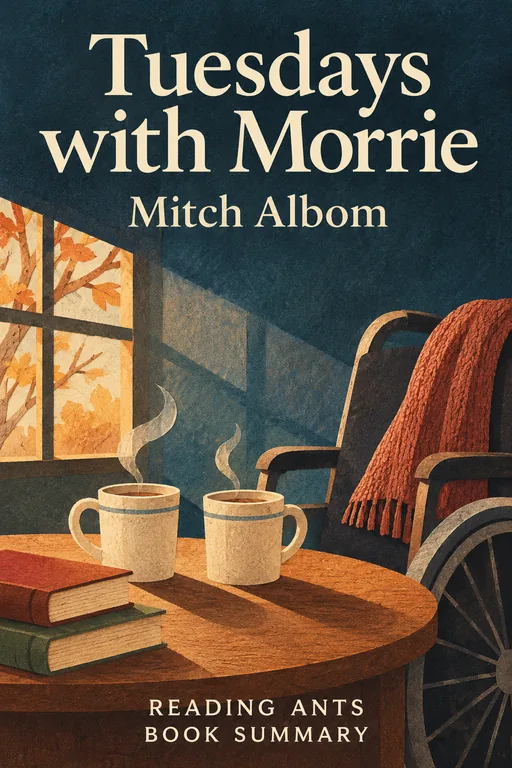
Tuesdays with Morrie
Mitch Albom
Sportswriter Mitch Albom visits his old college professor, Morrie Schwartz, every Tuesday as Morrie dies of ALS, and records the wisdom about life, love and death that Morrie shares in his last months.
🌱 Self-Improvement
The Lovely Bones
Alice Sebold
Fourteen-year-old Susie Salmon, murdered by a neighbor in 1973, narrates from heaven as she watches her family and friends deal with her death and the search for her killer.
✨ Modern Fiction
The Alchemist
Paulo Coelho
A young Spanish shepherd follows a recurring dream across the desert to the Egyptian pyramids in search of treasure, and learns that the journey toward one's dream is itself the greatest treasure.
🌍 World Literature
The Little Prince
Antoine de Saint-Exupery
A pilot stranded in the desert meets a small boy from a tiny planet, who teaches him that the most important things in life, like love and friendship, can only be seen with the heart.
🌍 World LiteratureWant something different?
Pick another topic and we will show you three books to start with.