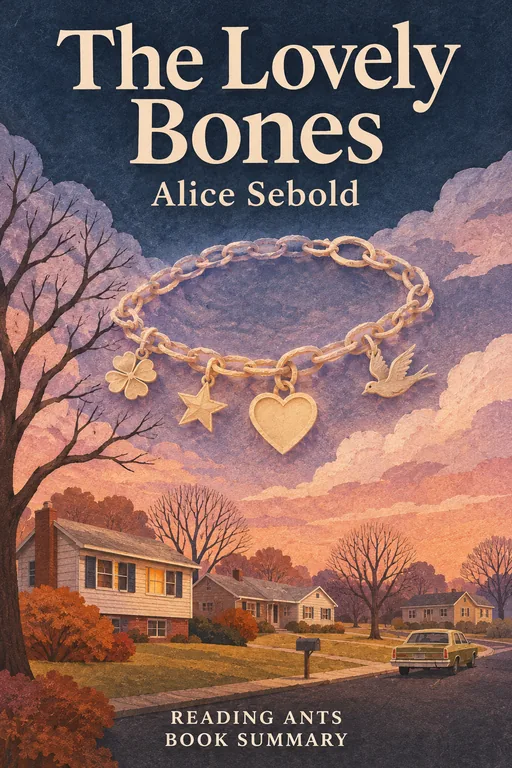
The Lovely Bones
Fourteen-year-old Susie Salmon, murdered by a neighbor in 1973, narrates from heaven as she watches her family and friends deal with her death and the search for her killer.
Overview
The Lovely Bones is a novel by Alice Sebold, published in 2002, and it became a huge bestseller. It begins with one of the most famous opening lines in recent fiction, in which the narrator announces that she was fourteen when she was murdered on December 6, 1973. Susie is in her own version of heaven, a place that changes to meet her desires, from which she can look down on Earth. The book is a story of grief and healing, and a crime story, told with a mixture of horror and tenderness. It was adapted into a 2009 film directed by Peter Jackson.
Main Characters
- Susie Salmon: the narrator, a fourteen-year-old girl who is murdered.
- Jack Salmon: her father, who is obsessed with finding her killer.
- Abigail Salmon: her mother, who retreats from the family.
- Lindsey and Buckley Salmon: her younger sister and brother.
- Mr. Harvey: the neighbor who kills her.
- Ray Singh: a boy who had a crush on her.
- Ruth Connors: a classmate who senses Susie’s presence.
- Grandma Lynn: Susie’s lively grandmother, who moves in to help.
Full Summary
The Murder
Susie Salmon, who lives in a suburb of Philadelphia, takes a shortcut through a cornfield on her way home from school, and is lured by a neighbor, George Harvey, into an underground hideout that he has built. He rapes and kills her. The description is told by Susie herself, with restraint, and the focus quickly shifts to what happens afterward. She finds herself in a heaven where her wishes take shape, and where she is joined by others who died young.
The book gives few details, and focuses on the horror of the act in a restrained way, preferring to show its effect on the people left behind. Susie’s account of the heaven she enters, where she can see a gazebo and fields, is a way for her to hold on to a sense of her own life.
The Family
On Earth, the police find Susie’s elbow, but not her body, and conclude that she is dead. Her father, Jack, becomes convinced that Harvey is the killer, and spends years trying to prove it. Her mother, Abigail, withdraws, and starts an affair with a detective, then leaves the family. Her sister Lindsey grows up quickly and takes on more adult roles, and the young brother Buckley grows up with an absent sister, a missing mother and an anxious father.
Harvey
The story of George Harvey, who is shown as a quiet man who builds dollhouses, is told in parallel. Susie watches him as he returns to his house and hides evidence, and as he continues his life. He has killed before, and he moves to avoid suspicion. Susie, who wants justice, can only watch, and sometimes tries to influence the living, by manifesting as a presence or stirring a thought.
Harvey is portrayed as a patient, careful man whose neighbors do not suspect him. The book shows how he keeps the trophies of his crimes, and how unremarkable he seems, which is part of the chill of the story.
Lindsey’s Search
Lindsey, who is spirited and clever, suspects Harvey and breaks into his house to find proof. She finds a diagram of the underground hideout, and when Harvey unexpectedly returns, she gets away. Her discovery makes Harvey flee, and the police do not manage to catch him. Meanwhile, Jack, who waits in the cornfield with a baseball bat hoping that Harvey will return, is mistaken for an attacker by a young couple who find him there, and he is badly beaten and has his knee broken. The family’s attempts to find justice seem to fail.
Ray and Ruth
At school, Ray Singh, who loved Susie, and Ruth Connors, a strange girl who felt her spirit as she passed through, become friends. Susie, who is drawn to them, is able to briefly enter Ruth’s body, and to be with Ray in a moment of intimacy in the living world. This moment, in which she says goodbye, is a high point of the book. Ray and Ruth later move on, to a life in which they carry her memory.
Letting Go
As years pass, the family begins to heal. Abigail returns, and the siblings grow up. Harvey, who escapes arrest, is later struck by a falling icicle while stalking a young woman, and he falls down a slope into a ravine, where he dies. Susie, who has been watching, finds that she no longer needs to hold on, and begins to let go of earth. She moves on to the next stage of heaven, saying that she misses the living but is at peace.
Why It Matters
The Lovely Bones sold millions of copies worldwide, and was one of the biggest literary phenomena of the early 2000s. It brought a child’s murder to a broad audience through the voice of the victim, which was new and moving for many readers. The book has been credited with starting conversations about grief and about how families cope with loss.
Sebold, who is a survivor of sexual assault, wrote a memoir, Lucky, before the novel, which informs its honesty. The film adaptation was criticized by some, but helped to maintain interest.
Key Takeaways
- Grief takes different forms. Each family member mourns differently.
- Healing is slow. The family needs years.
- Love continues after death. Susie remains present for them.
- Justice is not always complete. Harvey is not formally punished.
- Letting go is part of life. Susie moves on, and the family moves forward with her memory.
What We Can Learn
The novel invites us to think about how loss affects a whole family, and that people grieve in different ways, which can cause tension. Understanding this can help us be patient with those who mourn.
It also reminds us that those who die continue to live in the memories and actions of the living, and that love continues.
Finally, it suggests that while justice is important, healing may come in other ways, and that letting go is a part of that.
Criticism and Counterpoints
Some critics found the novel sentimental, and its image of heaven simplistic and saccharine, which could trivialize the pain of the crime. Others criticized the plot’s coincidences, such as Harvey’s sudden death, and its attitude toward justice. A few readers found the use of a murdered child as a narrator exploitative.
Some also noted that the treatment of the killer and of Susie’s afterlife is uneven in tone. The film adaptation divided audiences. Still, the book touched many readers.
Who Should Read It
This book is for mature readers. It deals with the rape and murder of a child, though the description is restrained, and with grief. It is a moving read for those prepared for the subject.
Want the whole book?
A summary is a taste, not the meal. Here is where to find the full book.
You reached the end 🎉
Nicely done. Mark this one as read, and we will suggest what to read next.
Read this next
Room
Emma Donoghue
Five-year-old Jack, who has never left the single small room where he and his mother are held captive, narrates his world and then the escape that opens a much larger and more frightening one.
✨ Modern Fiction
The Book Thief
Markus Zusak
Death narrates how a foster child in Nazi Germany steals books, learns the power of words and forms loving bonds that war eventually destroys.
🎒 Young Adult
A Monster Calls
Patrick Ness
A thirteen-year-old boy whose mother is dying is visited at night by a giant tree monster, who tells him three stories and demands that he tell a fourth: the truth.
🎒 Young Adult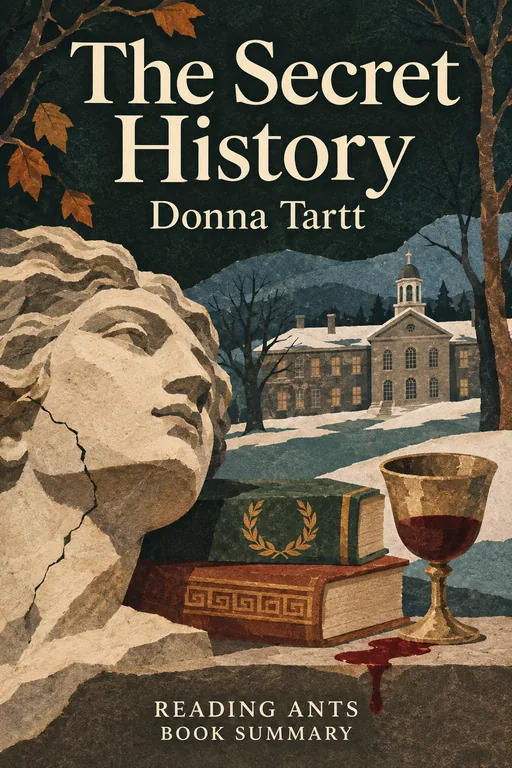
The Secret History
Donna Tartt
A California boy named Richard Papen, who transfers to a Vermont college and joins a small circle of classics students, is drawn into a murder, and the book follows how a group of brilliant friends destroy each other.
✨ Modern Fiction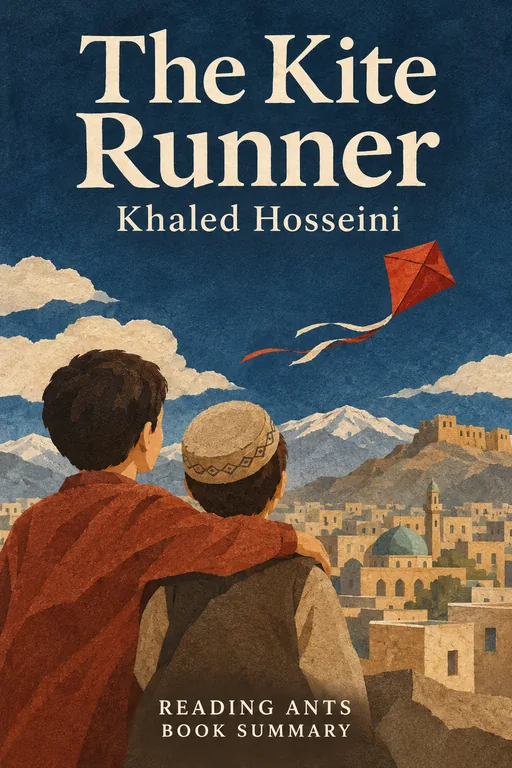
The Kite Runner
Khaled Hosseini
A wealthy boy in Kabul betrays his loyal best friend on the day of a kite tournament, and decades later, after fleeing to America, he returns to a Taliban-ruled Afghanistan to try to make things right.
✨ Modern Fiction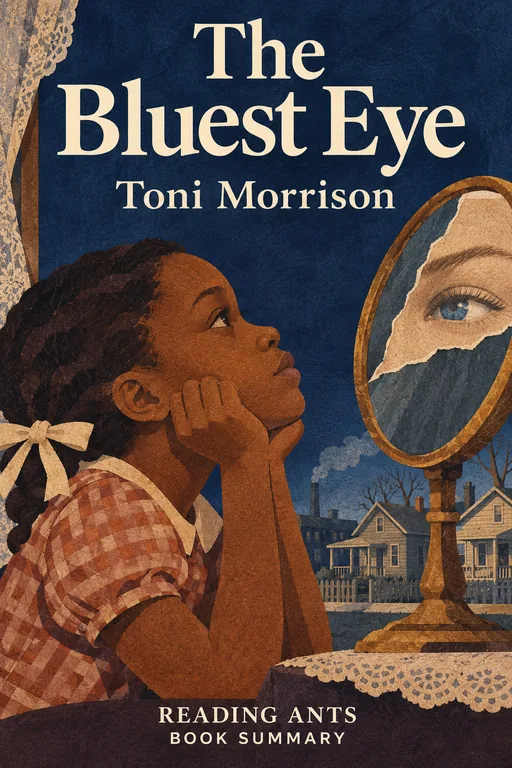
The Bluest Eye
Toni Morrison
In 1940s Ohio, a poor Black girl named Pecola Breedlove, who believes that she is ugly, prays for blue eyes, and the community's failure to protect her leads to tragedy.
✨ Modern FictionWant something different?
Pick another topic and we will show you three books to start with.