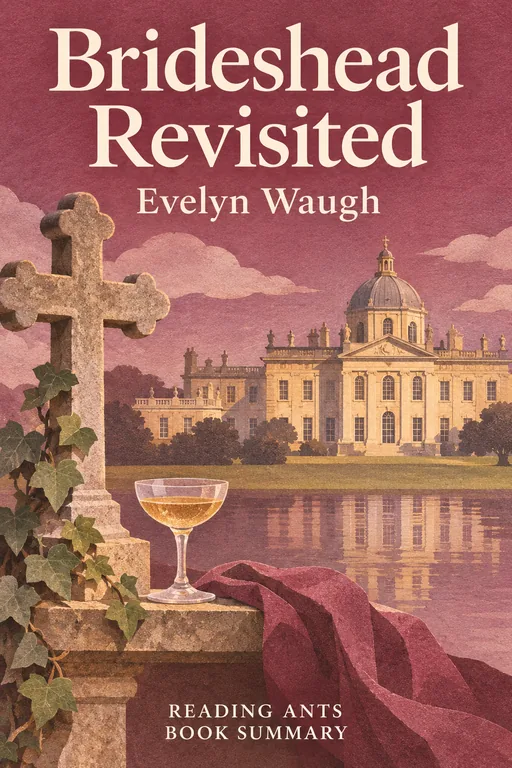
Brideshead Revisited
An army officer, Charles Ryder, returns during the Second World War to a great country house and remembers his friendship with the aristocratic Flyte family, and how love, faith and loss changed his life.
Overview
Brideshead Revisited: The Sacred and Profane Memories of Captain Charles Ryder is a novel by Evelyn Waugh, published in 1945. It is told in the first person by Charles, who looks back at the period between the two world wars, when, as a student at Oxford, he made friends with Sebastian Flyte, a charming and troubled young nobleman. Waugh, who was himself a convert to Catholicism, wrote the book as a story about how divine grace works in human lives. It is nostalgic, witty and sad, and was adapted into a famous 1981 television series.
Main Characters
- Charles Ryder: the narrator, a middle-class artist and later an army officer.
- Sebastian Flyte: a beautiful, charming young aristocrat, who slides into alcoholism.
- Julia Flyte: Sebastian’s sister, who is glamorous and unhappy.
- Lady Marchmain: Sebastian’s devout, controlling mother.
- Lord Marchmain: Sebastian’s father, who lives abroad with a mistress.
- Bridey (Lord Brideshead): the serious, awkward older brother.
- Anthony Blanche: a flamboyant, witty friend from Oxford.
Full Summary
The house in wartime
In the closing years of the Second World War, Captain Charles Ryder arrives with his unit at a large country house, which is to be used as a billet for troops. He realizes that it is Brideshead, a house that has been important in his past. The sight of it stirs memories of the years that he spent there, and, as he walks through the rooms, he begins to recall the story of his friendship with the Flyte family. The rest of the novel is his recollection, from his first days at Oxford to the end.
Oxford and Sebastian
At Oxford in the 1920s, Charles meets Sebastian Flyte, who carries around a teddy bear named Aloysius, and who invites him to lunch. They become close, drinking, laughing and enjoying a life of leisure. Sebastian takes him to Brideshead, a beautiful house, for the summer, and Charles falls in love with the house, with its art, its fountain and its history. He meets Sebastian’s family, who are Catholics, and he sees how their faith shapes their lives, though he is a skeptic.
The family and its troubles
Charles gets to know the family: Lady Marchmain, who is gracious but possessive, Bridey, who is stiff and religious, and Julia, who is vivacious. Lord Marchmain lives in Venice with his mistress, having left his wife. Sebastian, who feels trapped by his mother’s watchfulness and by religion, begins to drink heavily, and his charm gives way to misery. His family tries to control him, and Charles, who is torn between loyalty and concern, becomes part of the struggle. Sebastian flees abroad, to Morocco, and sinks into drink.
Charles becomes an artist
Charles leaves Oxford and trains as a painter, achieving some success in painting architecture. He marries Celia, the sister of a friend, but the marriage is cold, and she is unfaithful. Years later, on a ship returning from America, he meets Julia, who is married to a man she does not love. They begin an affair, and Charles realizes that he has been in love with Julia and the family all along. They plan to divorce their spouses and to marry.
Lord Marchmain’s death
Lord Marchmain, now old and dying, returns to Brideshead to die. He has long abandoned the faith, and when Bridey brings a priest to see him, he sends the priest away. Charles, who is an agnostic, is surprised at his own feelings. When Lord Marchmain lies dying and almost unconscious, Julia fetches the priest again, and, as the last rites are given, he makes the sign of the cross, which seems to show that he has returned to the faith. Julia, shaken, decides that she cannot go on living in sin with Charles.
Charles’s end
Julia leaves Charles, saying that she cannot marry him, and that she must live according to her faith, even if it costs her happiness. Charles is heartbroken, but, in time, he accepts the loss. Back in the wartime present with which the novel began, he stands in the house, which has been knocked about by the army. In the chapel, closed for years, he sees a small red lamp burning again, and he says a prayer. He thinks that something none of the builders or the family intended has come out of their work, and he walks back to camp in unusually good spirits.
Why It Matters
Brideshead Revisited is considered one of the major English novels of the twentieth century, and it presents a distinctive picture of the decline of the aristocracy and of the persistence of faith. Its elegant, nostalgic prose and its portrait of the beauty of the past have attracted many readers, while its theme of divine grace working through human failings is unusual in modern fiction. The 1981 television adaptation, with its lush style, brought it to a new audience. The book continues to be debated for its views on class and religion.
Key Takeaways
- Memory shapes meaning. Charles re-examines his past in the light of the present.
- Faith can challenge desire. Julia and her father are drawn back to belief.
- Beauty and decline go together. The house stands for a vanishing world.
- Love can lead in unexpected directions. Charles’s affections change over time.
- Grace works in mysterious ways. Waugh sees a pattern in apparent failures.
What We Can Learn
You can learn from Charles that experiences from youth, including friendships and places, can shape a person for life, and that looking back may reveal patterns that we did not see at the time. The book also invites you to think about how people balance personal happiness with moral or religious commitments, and about the cost of such choices. Whether or not you share the author’s faith, it offers a way to think about meaning. Notice how Waugh uses a house as a symbol of memory and change.
Criticism and Counterpoints
Some readers find the book snobbish, with a nostalgic love for the aristocracy that overlooks its privileges, and an attitude toward the middle class that can be condescending. Others find the religious message heavy-handed, with the conversion scenes unconvincing. Critics have also noted that Waugh himself later said that he found the book’s rich style a product of wartime privation and was no longer fond of it. The portrayal of Sebastian’s alcoholism and of Anthony Blanche has been interpreted in different ways. Yet many readers admire its beauty and its emotional power.
Who Should Read It
This book is for mature readers from about fifteen who enjoy literary fiction, historical atmosphere and stories about faith and loss. It is slower than Waugh’s comic novels, such as Scoop. Those who like it may enjoy the television series as a companion.
Want the whole book?
A summary is a taste, not the meal. Here is where to find the full book.
You reached the end 🎉
Nicely done. Mark this one as read, and we will suggest what to read next.
Read this next
The Great Gatsby
F. Scott Fitzgerald
A mysterious millionaire throws lavish parties on Long Island in the hope of winning back the woman he loved years ago, but his dream collides with the careless cruelty of the rich.
📜 Classics
The Remains of the Day
Kazuo Ishiguro
An elderly English butler on a road trip across the countryside looks back on his life of strict duty and gradually realizes how much he gave up, including love, in service of a master who may not have deserved his loyalty.
✨ Modern Fiction
A Room with a View
E. M. Forster
A well-brought-up young Englishwoman, Lucy Honeychurch, is torn between a conventional fiancé and a free-spirited young man whom she met in Italy, and must learn to trust her own feelings against the rules of polite society.
📜 Classics
The Power and the Glory
Graham Greene
In a Mexican state where the government is trying to wipe out the Catholic Church, the last priest, a flawed, frightened and sinful man, is hunted by a zealous lieutenant, and finds a kind of courage and grace as he is pursued.
📜 Classics
Howards End
E. M. Forster
Through the intertwined fortunes of two cultured sisters, a wealthy business family and a poor clerk, Forster asks who will inherit England, and argues that only connection between people of different classes can heal a divided society.
📜 Classics
Pride and Prejudice
Jane Austen
Quick-witted Elizabeth Bennet and the proud, wealthy Mr. Darcy badly misjudge each other, and only by facing their own faults do they find their way to love.
📜 ClassicsWant something different?
Pick another topic and we will show you three books to start with.