 Reading Ants
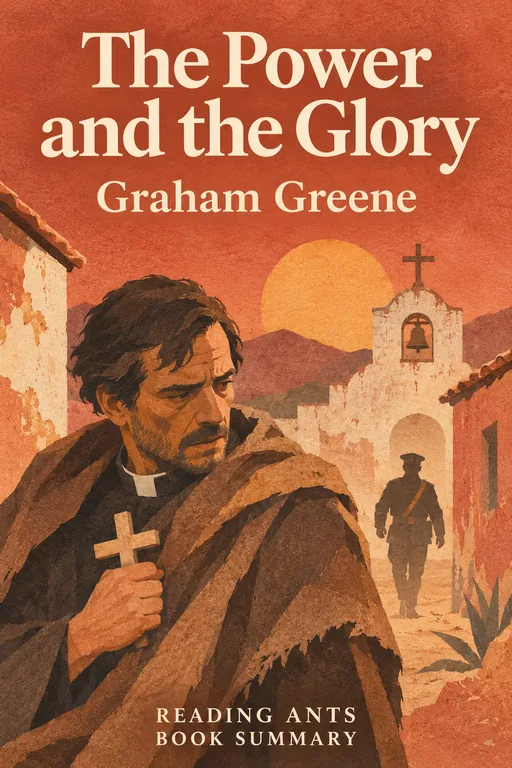
The Power and the Glory
In a Mexican state where the government is trying to wipe out the Catholic Church, the last priest, a flawed, frightened and sinful man, is hunted by a zealous lieutenant, and finds a kind of courage and grace as he is pursued.
Overview
The Power and the Glory is a novel by the English writer Graham Greene, published in 1940. It was inspired by his travels in Mexico in 1938, when he saw the persecution of Catholics in the state of Tabasco, where priests were forbidden or killed. Greene was a Catholic convert, but he wrote the book as a story about human weakness more than about institutions. The hero, who is known as the “whisky priest,” is not a saint, but an alcoholic with a child, and the novel asks how someone so imperfect can still do good. It is tense, bleak and humane.
Main Characters
- The whisky priest: the last priest left in the state who still defies the government, a heavy drinker, who is ashamed and afraid.
- The lieutenant: a stern, idealistic police officer who wants to destroy the church.
- The mestizo: a sly, half-starved informer who follows the priest.
- Maria: a woman in a village, who bore the priest’s daughter.
- Brigitta: the priest’s young daughter, who is hardened by her poor life.
- Mr. Tench: an English dentist, who lives in a small port town.
- Coral Fellows: a young girl on a banana plantation who meets the priest.
Full Summary
A hunted man
In the 1930s, in a state in southern Mexico, the government has outlawed religion, and has shot or driven out almost all the priests, and the few who remain have given up their vows. One priest, a small, disheveled man who has stayed too long, refuses to give up his, and drinks to forget his fear. A police lieutenant, who despises the church, is determined to find him. In a port town, an English dentist, Mr. Tench, meets a stranger who is hoping to get away by ship. The stranger is the priest. They talk and drink brandy at Tench’s house, but when a boy comes begging for help for his sick mother, the priest goes with him, misses the boat, and his chance to escape slips away.
In the villages
The priest wanders through villages, hiding and offering mass and confession, in secret. People hide him, even though the soldiers have taken hostages from villages that shelter him. He is aware that, by staying, he puts the poor at risk. In one village, he meets Maria, the mother of his child, and their daughter Brigitta, who looks at him with hostility. He is struck by a fierce, unexpected love for the child, and by fear for her future in a world that he has left to decay.
The mestizo and the lieutenant
A mestizo, a man who has noticed the priest, follows him with the hope of earning a reward. The lieutenant, who has taken hostages and shot some of them, believes that he is saving the people from superstition, and has a real, if narrow, desire to build a better world for the children. The priest and the lieutenant are opposites, and yet, in a late scene, when the priest is in prison, they speak as two human beings, and each sees something in the other.
Escape and return
The priest makes it across the mountains into a neighboring state, nearly dying on the way, and is nursed back to health by a kindly American family, the Lehrs, so that he is safe at last. There, he could begin a new life. But the mestizo turns up with a message: a dying man, an American criminal, has asked for a priest. The priest suspects that it may be a trap, but he cannot refuse a call to hear a man’s confession. He turns back, over the mountains, to the state where he will be caught.
Capture and the last night
The priest meets the dying man, who shows no desire to repent, and, as he comes out of the hut, the lieutenant is waiting. He is arrested and taken to the capital. In his last night in prison, he thinks about his failures, and his sense of being a bad priest, and he is afraid that his sins will condemn him. The lieutenant tries to bring a priest to hear his confession, but the effort comes to nothing, because the only priest he can find, who gave up his vows and married, is held back by his wife. In the morning, the priest is led out to be shot.
A new priest
The priest is shot by a firing squad, and the lieutenant carries out the orders, believing that he has won. But at the end of the story, in a house where a family is quietly teaching a child about the saints, a new priest arrives, in secret, at the door. The faith, therefore, has not died. The ending suggests that the whisky priest’s death, in spite of his flaws, has served as a kind of witness, and that grace can work through the weakest vessel.
Why It Matters
The Power and the Glory is widely regarded as one of Greene’s greatest works, and as a major novel of the twentieth century. It treats religious themes without sentimentality, and shows a hero who is deeply flawed, and who becomes heroic through persistent small acts, such as his refusal to abandon his duty. The book combines the style of a thriller, with its chase and betrayal, with a serious study of conscience. It was privately criticized by the Holy Office in 1953, though never publicly condemned, and it has since been widely praised, and it remains a key text on faith and doubt.
Key Takeaways
- Goodness can arise from imperfect people. The priest is a sinner who still helps others.
- Conscience can be costly. He returns to certain danger to hear a confession.
- Idealists can do harm. The lieutenant’s zeal leads to cruelty.
- Faith survives persecution. A new priest arrives at the end.
- Compassion matters more than status. The priest feels the humanity of others.
What We Can Learn
You can learn from the priest that a person does not have to be perfect to do something worthwhile, and that doing the right thing, even from fear, can still be meaningful. The novel also shows how well-meant plans, such as the lieutenant’s, can turn into cruelty when they ignore individual lives. If you read it, think about the idea of courage as continuing to act despite shame and fear. It also asks readers to look at those with whom they disagree, as the priest and the lieutenant come to understand one another.
Criticism and Counterpoints
Some readers find the novel’s religious focus alienating, or feel that its picture of Mexico, with its poverty, dirt and cruelty, is bleak and stereotyped. Others argue that Greene romanticizes the suffering and martyrdom of the priest, and gives the lieutenant too little sympathy. The Catholic Church at one time questioned the portrayal of a priest who is an alcoholic and a father. A few critics also find the ending, with the arrival of a new priest, too neat. But many consider the book morally profound.
Who Should Read It
This book is for mature readers from about sixteen, who enjoy serious literary fiction and stories about conscience. It is short and gripping. Readers who like it may go on to Greene’s The End of the Affair or The Quiet American.
Want the whole book?
A summary is a taste, not the meal. Here is where to find the full book.
You reached the end 🎉
Nicely done. Mark this one as read, and we will suggest what to read next.
Read this next

Brideshead Revisited
Evelyn Waugh
An army officer, Charles Ryder, returns during the Second World War to a great country house and remembers his friendship with the aristocratic Flyte family, and how love, faith and loss changed his life.
📜 Classics
Nineteen Eighty-Four
George Orwell
In a future Britain ruled by an all-seeing Party, one man secretly rebels by keeping a diary and falling in love, and discovers just how completely a totalitarian state can crush the human mind.
📜 Classics
The Stranger
Albert Camus
An emotionally detached office worker kills a man on an Algerian beach and discovers that society condemns him as much for refusing its expected feelings as for the murder itself.
🌍 World Literature
Heart of Darkness
Joseph Conrad
A sailor named Marlow tells his friends of a journey up the Congo River to find a mysterious ivory trader named Kurtz, and of the horror and moral darkness he finds at the end of it.
📜 Classics
Pride and Prejudice
Jane Austen
Quick-witted Elizabeth Bennet and the proud, wealthy Mr. Darcy badly misjudge each other, and only by facing their own faults do they find their way to love.
📜 Classics
To Kill a Mockingbird
Harper Lee
In a small Alabama town in the 1930s, young Scout Finch watches her father, a lawyer, defend a Black man falsely accused of a crime, and learns hard lessons about prejudice, courage and seeing the world through other people's eyes.
📜 ClassicsWant something different?
Pick another topic and we will show you three books to start with.