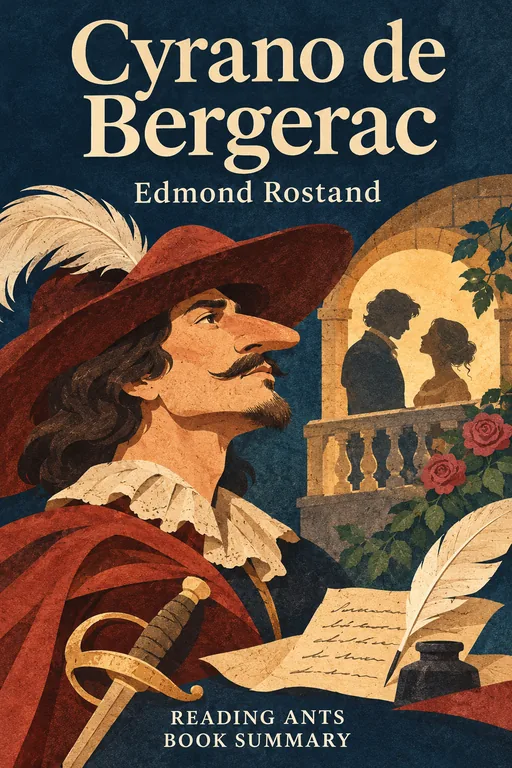
Cyrano de Bergerac
Cyrano, a brilliant poet and swordsman with an enormous nose, loves his cousin Roxane but helps the handsome, tongue-tied Christian win her by writing his love letters, and keeps his secret until it is almost too late.
Overview
Cyrano de Bergerac is a verse play in five acts by the French playwright Edmond Rostand, first performed in Paris in 1897 to enormous success. It is loosely based on a real seventeenth-century writer and soldier, Savinien de Cyrano de Bergerac, who was known for his wit and duels. In the play, Cyrano is an officer in the Gascon cadets, a poet and a fighter who is deeply self-conscious about his large nose. It is a romantic comedy and a tragedy, full of swordplay, poetry and heartbreak. It has been adapted countless times, including in the 1987 film Roxanne with Steve Martin.
Main Characters
- Cyrano de Bergerac: a swordsman, poet and philosopher with a huge nose and a larger heart.
- Roxane: Cyrano’s beautiful, intelligent cousin, who loves poetry and words.
- Christian de Neuvillette: a handsome young cadet who loves Roxane but cannot speak well.
- Comte de Guiche: a powerful nobleman who also wants Roxane.
- Ragueneau: a pastry cook and poet who is generous.
- Le Bret: Cyrano’s loyal friend.
Full Summary
The Theater and the Duel
The play opens in a Paris theater, where Cyrano interrupts a performance by an actor he dislikes, chasing him off the stage. When a man mocks his nose, Cyrano fights him in a duel while improvising a ballad, and wounds him with the last line. He then tells his friend Le Bret that he loves Roxane, but believes that she could never love a man with such a face. Roxane sends word that she wants to meet him.
Cyrano is a commanding presence, and his friends are proud of him, but the audience soon sees that he is also lonely. His long speech about all the clever insults a person could have made about his nose, compared with the dull ones he is offered, shows his wit, and also his pain.
Roxane’s Confession
Cyrano hopes that Roxane will confess love to him, but she says that she loves Christian, a young cadet, and asks Cyrano to look after him. Cyrano, crushed, agrees. He and Christian make a pact: Cyrano will supply the words that Christian lacks, and Christian will supply the handsome face. Together they form a perfect lover, though one that is split in two.
The Balcony
One evening, Christian tries to speak to Roxane under her balcony and fails miserably. Cyrano, hiding in the shadows, feeds him lines, and then takes over completely, speaking in the dark with passionate eloquence. Roxane, moved by the words, is won over. She tells Christian that she loves him, and they are secretly married by a monk. Cyrano watches, content to be loved by proxy.
The words that Cyrano speaks in the dark are among the most famous in French drama. He compares love to a flower, a star and a kiss, and Roxane is overcome. For one night, Cyrano gets to say what he feels, though he cannot say that it is his own.
The Siege
Count de Guiche, who is jealous, sends the Gascon cadets to the war at Arras. During the siege, Cyrano risks his life, crossing enemy lines each day to send letters to Roxane in Christian’s name. When Roxane unexpectedly arrives at the camp, bringing food, she tells Christian that she loves him not for his looks but for his soul, as revealed in his letters. Christian, who realizes that she loves Cyrano’s words, tells Cyrano to let Roxane choose between them. Before he can, Christian is killed in battle.
Years Later
Fifteen years later, Roxane is living in a convent, wearing mourning, and Cyrano visits her every week to tell her the news. One day, he comes late, mortally wounded by a falling log, an ambush by his enemies. Concealing his injury, he asks to read Christian’s last letter, and as the light fails, he reads from memory, in the dark. Roxane realizes that the voice is the one that she heard on the balcony.
Each Saturday, Cyrano brings Roxane the news of the court, and she embroiders, still wearing Christian’s last letter against her heart. He teases her gently about her loyalty to a dead man, though his own love is unspoken. This quiet scene is the emotional center of the final act.
The Truth
Roxane understands that she loved Cyrano all along. He denies it, but dies bravely, fighting against his enemies, such as lies and cowardice, and insisting that he keeps one thing, his panache, his style and spirit, which he takes with him. The play ends with Roxane’s grief, and the sense that love, as expressed in words, is real.
Why It Matters
Cyrano de Bergerac has remained one of the most loved plays in French and world theater. It has been performed countless times, adapted for opera, film and television, including the 1990 French film starring Gérard Depardieu and a 2021 musical film. The character of Cyrano is an archetype of the romantic who hides his love.
The play’s themes, the power of language, the difference between inner and outer beauty and the courage to be oneself, have made it timeless.
The word “panache” in English owes much to the play, which made the idea of a gallant, plumed style a symbol of French spirit. The role of Cyrano is one of the most coveted in theater, and the play has been revived by great actors in many languages.
Key Takeaways
- Words have power. Cyrano’s letters win Roxane’s heart.
- Inner beauty matters. Roxane comes to love the soul behind the face.
- Self-doubt can hide love. Cyrano’s insecurity keeps him silent.
- Honesty is a form of courage. The truth comes too late.
- Style and spirit endure. Cyrano’s panache is his legacy.
What We Can Learn
The play shows that we should not judge people by their appearance. Cyrano’s nose makes him ashamed, but his mind and courage make him admirable, and he is a model of integrity.
It also warns that hiding our feelings can cost years of happiness. Cyrano’s silence protects Roxane from pain but also denies them both a life together.
Finally, it suggests that love is based on the real person, not an image.
It also reminds us that our first impressions of people can be wrong, and that the most worthy people may be those who hide their gifts.
Criticism and Counterpoints
Some critics find the play’s plot, depending on a deception, sentimental or implausible, since Roxane does not notice that the writer and the speaker are different. Others find the portrayal of Roxane limited, because she is mainly a prize, and the play values her beauty. The rhymed verse is often hard to translate, and many English versions lose its music.
Some say that the play promotes a romantic idea of suffering in silence, which is not healthy. A few historians note that it little resembles the real Cyrano. Still, it is loved.
Who Should Read It
This play suits teenagers and adults. It is long, but exciting and moving, especially in performance. A good translation, such as Anthony Burgess’s or Brian Hooker’s, is recommended, and seeing a performance or a film adds to the pleasure.
Want the whole book?
A summary is a taste, not the meal. Here is where to find the full book.
You reached the end 🎉
Nicely done. Mark this one as read, and we will suggest what to read next.
Read this next
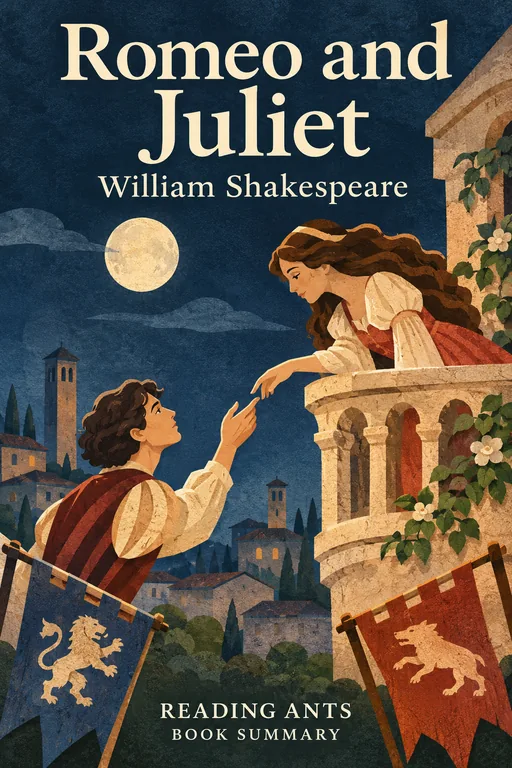
Romeo and Juliet
William Shakespeare
Two teenagers from feuding families in Verona fall in love at first sight and marry in secret, but hatred, haste and bad luck lead them to a tragic end that finally brings their families together.
🎭 Epics, Drama & Poetry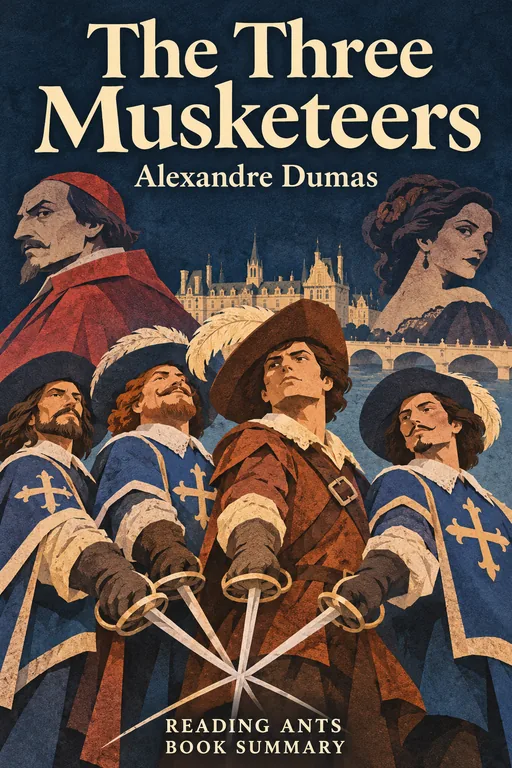
The Three Musketeers
Alexandre Dumas
A young Gascon swordsman travels to Paris in the 1620s to join the King's Musketeers, befriends three legendary soldiers, and together they fight to protect the Queen's honor against the scheming Cardinal Richelieu and the dangerous Milady.
🌍 World Literature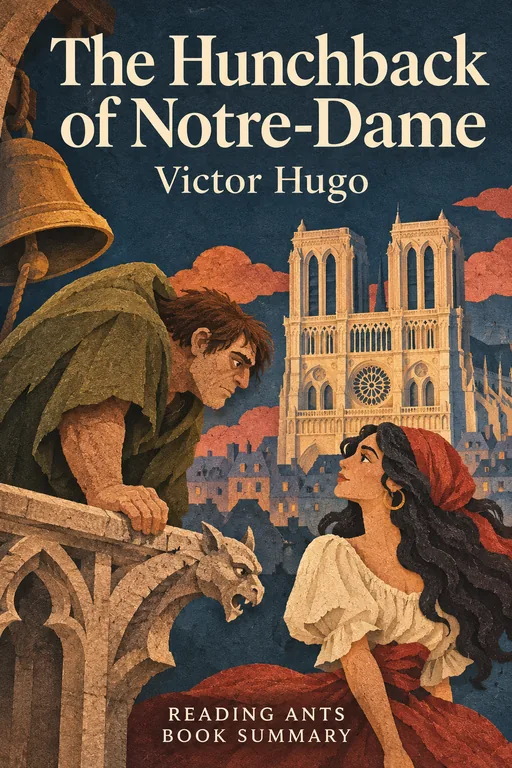
The Hunchback of Notre-Dame
Victor Hugo
In fifteenth-century Paris, the deformed bell-ringer Quasimodo, the cold archdeacon Frollo and the dashing captain Phoebus are all drawn into a deadly web of desire around the beautiful Gypsy dancer Esmeralda.
🌍 World Literature
Much Ado About Nothing
William Shakespeare
Two pairs of lovers in Messina, the witty rivals Beatrice and Benedick and the young couple Hero and Claudio, are tricked by their friends and enemies, in a comedy of wit, deception and reconciliation.
🎭 Epics, Drama & Poetry
Tartuffe
Moliere
A wealthy French father, Orgon, falls under the spell of Tartuffe, a pious-seeming con man who tries to take his house, his daughter and his wife, until the king himself intervenes.
🎭 Epics, Drama & Poetry
The Odyssey
Homer
After the Trojan War, the clever hero Odysseus struggles for ten years against monsters, gods and temptations to return home to his faithful wife and son, then must win back his house from the men trying to steal it.
🎭 Epics, Drama & PoetryWant something different?
Pick another topic and we will show you three books to start with.