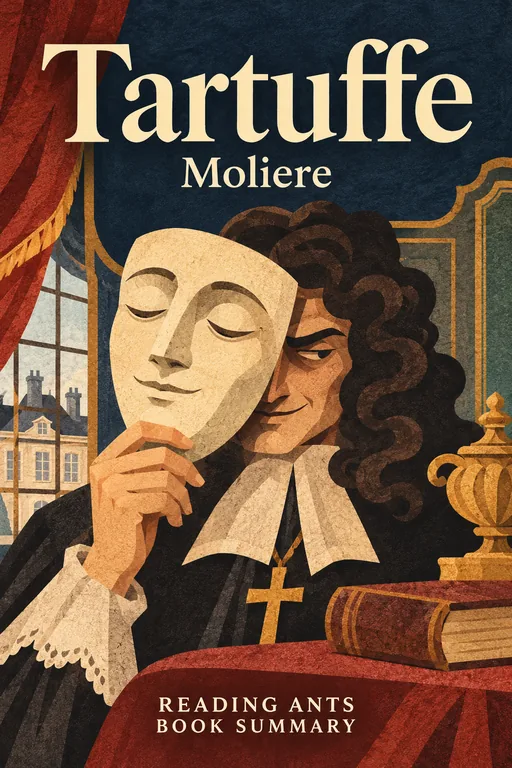
Tartuffe
Original title: Le Tartuffe
A wealthy French father, Orgon, falls under the spell of Tartuffe, a pious-seeming con man who tries to take his house, his daughter and his wife, until the king himself intervenes.
Overview
Tartuffe, or The Hypocrite is a comedy in five acts by the French playwright Molière, first performed in 1664 and revised before its public success in 1669. It was banned at first, because religious figures believed that it mocked true piety. Molière insisted that he was attacking hypocrites, not the faithful. The play is set in the home of Orgon in Paris, and focuses on the clash between a gullible head of the house and the rest of his family, who see Tartuffe’s true nature. It is one of the most famous French comedies, and the name “Tartuffe” has become a word for a religious fraud.
Main Characters
- Tartuffe: a hypocrite who pretends to be devout, in order to gain wealth and power.
- Orgon: the head of the household, naive and stubborn.
- Elmire: Orgon’s second wife, who is sensible and clever.
- Mariane and Damis: Orgon’s daughter and son from his first marriage.
- Dorine: Mariane’s outspoken, sharp-witted maid.
- Cléante: Orgon’s brother-in-law, the voice of reason.
- Valère: Mariane’s fiancé.
- Madame Pernelle: Orgon’s stern mother, who admires Tartuffe.
Full Summary
A Houseguest
The play opens with Madame Pernelle scolding the household, defending Tartuffe, whom her son Orgon has taken in. The family, especially the maid Dorine, mock Tartuffe as a fraud who eats and drinks well and lectures them about their sins. Orgon returns from a trip, and asks only about Tartuffe, brushing aside news of his wife’s illness, with the repeated words “Poor fellow.” He is devoted to Tartuffe and treats him as a spiritual guide.
Dorine speaks bluntly to Orgon about Tartuffe, and Cléante warns his brother-in-law that the world is full of false saints. But Orgon only grows angry, and says that with Tartuffe’s guidance, he feels that he could watch his whole family die without a pang.
The Marriage Plot
Orgon decides to break his daughter Mariane’s engagement to Valère and to marry her to Tartuffe, in order to bind the man to the family. Mariane is horrified but too timid to resist. Dorine urges her to fight, and reconciles her with Valère after a lovers’ quarrel. Cléante tries to reason with Orgon, arguing that true piety is quiet and kind, and not showy, but Orgon is not persuaded.
Dorine mocks the idea of the match, and imagines Mariane living in a provincial town with a man who thinks of himself as a holy man. Mariane and Valère, each too proud to give way, almost part for good, and Dorine has to show them how foolish they are being before they make up.
Elmire’s Trap
Tartuffe, meanwhile, has designs on Elmire, Orgon’s wife. When Damis overhears him declare his love to her, he tells his father, but Tartuffe cleverly turns the accusation around, humbly confessing that he is a terrible sinner. Orgon, impressed by this humility, disinherits his own son, and signs over all his property to Tartuffe. To prove the truth, Elmire arranges for Orgon to hide under a table while she pretends to respond to Tartuffe’s advances.
Elmire, who is no fool, first tries to discourage Tartuffe politely, and then, when her stepson is disinherited, decides on a bolder plan. She sends her husband under the table, and pretends to encourage Tartuffe, who is so eager that he talks himself into trouble.
The Exposure
Orgon, under the table, hears Tartuffe pursue his wife, and finally realizes that he has been fooled. He comes out and orders Tartuffe to leave. But Tartuffe is not dismayed. He tells Orgon that the house is now his and that he will make him pay. Orgon realizes that, besides the deed of gift, he once trusted Tartuffe with a box of papers belonging to a friend, which could prove treason, and the family is in danger of being thrown out and Orgon arrested. Damis has already been driven from the house, and Orgon has signed over everything he owns, so the family has no defense of its own left.
The Resolution
An officer of the king arrives, and the family fears the worst. But the officer arrests Tartuffe, announcing that the king, who is wise and sees through frauds, has discovered that Tartuffe is a notorious criminal. The king also pardons Orgon for his earlier mistake, and cancels the deed of gift. The play ends with Orgon thanking the king and the prospect of Mariane’s marriage to Valère.
Why It Matters
Tartuffe is one of the great comedies of world theater, regularly performed and studied. It was caught up in a famous battle with censors, which made Molière a symbol of artistic freedom. The play’s portrait of the hypocrite remains relevant in every age, and the name “Tartuffe” has become shorthand for a false saint.
It has also been adapted in many settings, from modern political satire to updated versions in English by Richard Wilbur, whose verse translation is widely praised.
Molière’s fight for the play, which lasted five years and involved appeals to the king, became a famous episode in the history of free expression, and the comedy is still read in schools as a model of satire.
Key Takeaways
- Hypocrites exploit trust. Tartuffe uses piety to take advantage.
- Blind devotion is dangerous. Orgon refuses to see the truth.
- Common sense can win. Dorine and Cléante see clearly.
- Authority can intervene. The king ends the crisis.
- Laughter can expose pretension. Comedy is a weapon against fraud.
What We Can Learn
The play warns that we should judge people by their deeds, not by their words or appearance. Tartuffe’s displays of devotion convince Orgon, while his actions show his greed.
It also shows how a strong attachment to one person or idea can make us ignore the pleas of those who love us. Orgon’s stubbornness is comic, but it also nearly ruins his family.
Finally, it teaches that humor and honesty, as in Dorine’s sharp remarks, are helpful in speaking truth to those in power.
Criticism and Counterpoints
Some critics say that the final scene, in which the king rescues the family, is a convenient, artificial ending, perhaps designed to flatter Louis XIV, who had supported Molière. Others point out that Orgon’s authority over his daughter’s marriage is treated as normal, and that women’s roles are limited. Religious critics at the time, and some since, found the play offensive.
Some find the language of the verse, in rhymed couplets, stiff in translation. Still, the play is cherished for its comic energy.
Who Should Read It
This play suits teenagers and adults. It is short, funny and easy to follow, though it is best in a rhymed translation, such as Richard Wilbur’s. It is a good first French classic.
Want the whole book?
A summary is a taste, not the meal. Here is where to find the full book.
You reached the end 🎉
Nicely done. Mark this one as read, and we will suggest what to read next.
Read this next
Much Ado About Nothing
William Shakespeare
Two pairs of lovers in Messina, the witty rivals Beatrice and Benedick and the young couple Hero and Claudio, are tricked by their friends and enemies, in a comedy of wit, deception and reconciliation.
🎭 Epics, Drama & Poetry
Pygmalion
George Bernard Shaw
A phonetics professor, Henry Higgins, bets that he can turn a poor London flower seller, Eliza Doolittle, into a lady by teaching her to speak properly, but Eliza shows that she already has a mind and a will of her own.
🎭 Epics, Drama & Poetry
The Canterbury Tales
Geoffrey Chaucer
A group of about thirty pilgrims on the road from London to Canterbury pass the time by telling stories, in a poem that paints a lively picture of English society in the late fourteenth century.
🎭 Epics, Drama & Poetry
The Odyssey
Homer
After the Trojan War, the clever hero Odysseus struggles for ten years against monsters, gods and temptations to return home to his faithful wife and son, then must win back his house from the men trying to steal it.
🎭 Epics, Drama & Poetry
Hamlet
William Shakespeare
A grieving prince of Denmark learns from his father's ghost that his uncle murdered the king to take the throne, and his struggle to decide whether and how to take revenge leads to madness and death.
🎭 Epics, Drama & Poetry
The Epic of Gilgamesh
Anonymous
A proud, powerful king of ancient Mesopotamia gains a true friend, loses him to death, and journeys to the edge of the world in search of eternal life, only to learn that what lasts is the life and legacy we leave behind.
🎭 Epics, Drama & PoetryWant something different?
Pick another topic and we will show you three books to start with.