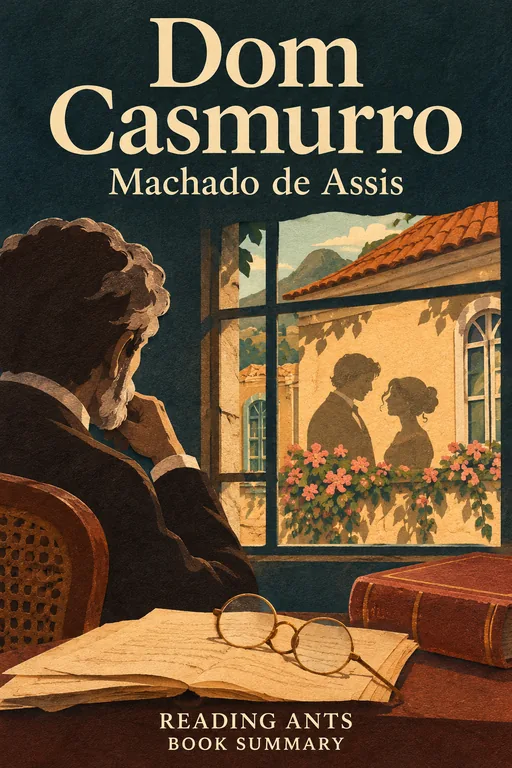
Dom Casmurro
An older man tells the story of his boyhood love for the girl next door and of his later, jealous belief that she betrayed him, but can we trust his version?
Overview
Dom Casmurro is a novel by the Brazilian writer Machado de Assis, published in 1899. It is set in Rio de Janeiro in the nineteenth century, in the time of the Brazilian Empire. The narrator is Bento Santiago, a lonely old lawyer, who is called “Dom Casmurro” by his neighbors, a nickname that means something like “Sir Withdrawn,” for a man who keeps to himself and broods. He decides to write his memoirs, to recapture his youth. The book is famous for its unreliable narrator: readers have debated for over a century whether his wife, Capitu, was really unfaithful.
Main Characters
- Bento Santiago (Bentinho): the narrator, a shy, sensitive boy who becomes a lawyer.
- Capitolina (Capitu): the girl next door, clever, bold and with eyes that people call mysterious.
- Dona Gloria: Bento’s pious mother, who has promised him to the Church.
- Jose Dias: a talkative dependent of the household, who gives opinions about everything.
- Escobar: Bento’s best friend from the seminary.
- Ezequiel: Bento and Capitu’s son.
Full Summary
The Old House
The narrator begins by explaining his nickname, Dom Casmurro, which a young poet he met on a train gave him, and how he has built a house that is an exact copy of the one where he grew up. The copy is not the same, however, and he realizes that he is trying to put together the two halves of his life, the one that has gone and the one that he has now.
He begins to write the story of his youth, to try and feel again what he once felt.
A Promise and a Love
When Bento is young, his mother, Dona Gloria, makes a promise, before he was born, that she will make him a priest. Bento is fifteen, and he is in love with Capitu, who lives next door, and who is a lively, practical girl. They exchange their first kiss and make promises to one another.
Jose Dias, the family friend, who has noticed the relationship, warns Dona Gloria. Bento and Capitu are terrified that they will be separated.
The Seminary
Bento is sent to the seminary, as promised. He is unhappy there, but he meets Escobar, a clever and charming young man, who becomes his best friend. With help from friends, a way is found to free him from his promise: his mother can keep her vow by sponsoring another boy, an orphan, who would become a priest in his place.
The plan works, and Bento is allowed to leave the seminary and to study law.
Marriage
Bento becomes a lawyer, and he marries Capitu. They are very happy for a time. They live in a comfortable house, and the narrator looks back on these years as the best of his life. Capitu is a loving wife and a clever manager of the household, and she is admired in their circle of friends. Escobar also marries Sancha, who becomes Capitu’s close friend, and the two families become close. Bento and Capitu have a son, whom they name Ezequiel, after Escobar, whose first name was the same.
Bento is proud, and he thinks that he has found everything he wanted.
Suspicion
One day, Escobar, who is a strong swimmer, drowns in the sea. At his funeral, Bento sees Capitu looking at the dead man with an intense gaze, and he becomes suspicious. Then he notices that Ezequiel, who is growing up, has begun to look like Escobar, and has similar gestures.
Bento is consumed by jealousy. He believes that Capitu and Escobar were lovers, and that Ezequiel is not his son. He thinks about killing himself and the boy, but he does not do it. He becomes cold and cruel.
Separation
Bento sends Capitu and Ezequiel to Europe, where they live apart, and he stays in Brazil. Capitu dies there. Years later, Ezequiel visits him, and Bento sees how much he resembles Escobar. Ezequiel then travels to the Middle East, where he dies of a fever.
Bento is alone and bitter. He ends his story with the thought that nothing is left of the people of his youth, except for a few memories.
Why It Matters
Dom Casmurro is generally considered one of the greatest novels in the Portuguese language, and Machado de Assis is seen as the most important writer in Brazilian literature. The book is a model of the unreliable narrator, and the debate on Capitu’s guilt is one of the best-known in world literature. Machado was the grandson of freed slaves, and he rose from poverty to be a founder of the Brazilian Academy of Letters. His work has been translated into many languages, and has been admired by writers such as Susan Sontag and Salman Rushdie.
Key Takeaways
- Memory is not reliable. Bento shapes the past to fit his feelings.
- Jealousy distorts. His suspicion can turn small signs into proof.
- We cannot be sure of other people’s hearts. Capitu remains a mystery.
- Telling a story is an act of power. The narrator controls what we see.
- Time changes everything. The old man tries in vain to rebuild his youth.
What We Can Learn
The book teaches us to be careful about our certainty. When we feel suspicious or jealous, we might ask whether we have real evidence or whether we are building a story in our heads. It also shows the damage that mistrust can do to a relationship.
It encourages us to read critically, and to ask whose side of the story we are hearing. Finally, it reminds us that the past cannot be rebuilt, and that it is better to understand it than to try to recreate it.
Criticism and Counterpoints
Some readers find the narrator tiresome, with his constant addresses to the reader and his digressions. Others think that Capitu is unfairly judged, and that the book has been misunderstood as proof of her guilt. A few feminist critics point out that she is the most intelligent character in the book, and yet she is the one who is punished. The pace is slow, and the humor and irony can be hard to follow in translation.
Who Should Read It
This book is for readers who enjoy classic novels with a psychological twist, and who like to debate. It is short and elegant. Those who want a clear answer to the question of Capitu’s guilt will not find one, but this is the book’s greatest charm.
Want the whole book?
A summary is a taste, not the meal. Here is where to find the full book.
You reached the end 🎉
Nicely done. Mark this one as read, and we will suggest what to read next.
Read this next

Madame Bovary
Gustave Flaubert
A romantic young woman, bored by her provincial marriage to a kind but dull doctor, seeks excitement in love affairs and luxury, and is crushed by debt and disillusion.
🌍 World Literature
Anna Karenina
Leo Tolstoy
In imperial Russia, a married aristocrat falls passionately in love with a dashing officer and loses her place in society, while a thoughtful landowner seeks a meaningful life through love, work and faith.
🌍 World Literature
The Sorrows of Young Werther
Johann Wolfgang von Goethe
A sensitive young man falls in love with a woman who is promised to another, and his passion leads him to despair.
🌍 World Literature
Othello
William Shakespeare
A noble Black general in the Venetian army is manipulated by his trusted officer Iago into believing that his loving wife is unfaithful, and his jealousy leads him to destroy her and himself.
🎭 Epics, Drama & Poetry
The Remains of the Day
Kazuo Ishiguro
An elderly English butler on a road trip across the countryside looks back on his life of strict duty and gradually realizes how much he gave up, including love, in service of a master who may not have deserved his loyalty.
✨ Modern Fiction
The Little Prince
Antoine de Saint-Exupery
A pilot stranded in the desert meets a small boy from a tiny planet, who teaches him that the most important things in life, like love and friendship, can only be seen with the heart.
🌍 World LiteratureWant something different?
Pick another topic and we will show you three books to start with.