 Reading Ants
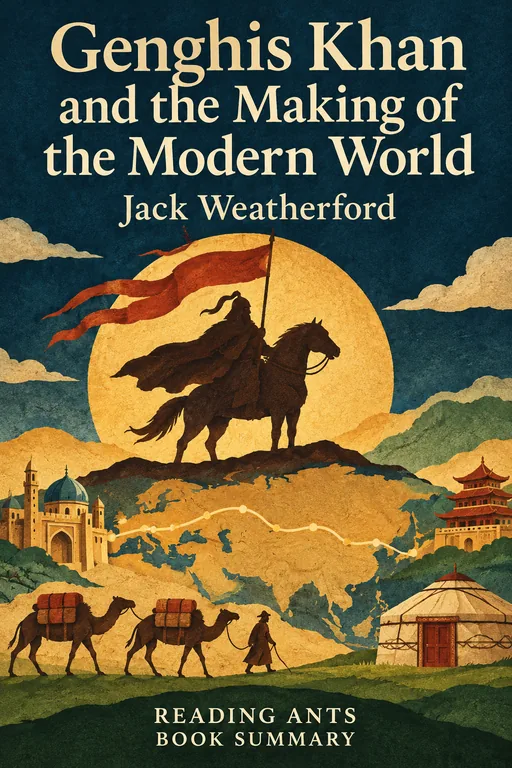
Genghis Khan and the Making of the Modern World
Anthropologist Jack Weatherford presents Genghis Khan as an innovative leader who founded an empire that, with his heirs, conquered more than any other man in history and helped to link Europe and Asia, and argues that his reputation as only a destroyer is unfair.
Overview
Genghis Khan and the Making of the Modern World was published in 2004 by Jack Weatherford, an American anthropologist who traveled in Mongolia. The book draws on a thirteenth-century Mongolian text, the Secret History of the Mongols, and on other sources. Weatherford’s main argument is that the Mongol conquests, though brutal, also led to an era of trade, new ideas, religious tolerance and communication that shaped the modern world. He portrays Genghis Khan as a political genius, and not just a warlord, and also follows his successors, including his grandson Kublai Khan.
Full Summary
1. From outcast to ruler
The idea: Genghis Khan was born with the name Temujin in 1162, into a small and poor Mongol band living in the wooded hills by the Onon River, at the northern edge of the steppe. His father was poisoned by enemies when Temujin was a boy, and the clan then abandoned the family, who nearly starved. He survived, and as a young man his wife Börte was kidnapped by raiders from the Merkid tribe and rescued with the help of allies. With loyalty, courage and an eye for talent, he built alliances and defeated enemies, one after another.
In real life: A person who starts with nothing may learn to value loyalty and skill more than family name.
2. A new kind of army and society
The idea: In 1206, after he had defeated his rivals, a great assembly of the tribes confirmed him as ruler, and he took the title Genghis Khan, which Weatherford links to Mongolian words for strong and unshakable. Weatherford says that he changed the old tribal order. Instead of rewarding people for their birth, he promoted them for their ability and loyalty, and he mixed people from different tribes in his military units. He built a highly disciplined cavalry, made rules for fair distribution of loot and set laws that applied to all, including punishments for stealing and a ban on kidnapping women.
In real life: A team that picks players by skill, and not by who their parents are, will usually do better.
3. The conquests
The idea: The Mongols attacked the Jurched (Jin) dynasty of northern China, then moved west and destroyed the empire of Khwarazm in Central Asia, after one of its governors had killed a Mongol trading caravan and its sultan had then killed some of the envoys sent to protest. They conquered great cities, often through terror and through the use of engineers who knew how to besiege walled towns. Weatherford acknowledges the killing and destruction, but he says that the Mongols often spared those who surrendered, put craftsmen and scholars to work, and that the huge death tolls given by medieval chroniclers are wildly exaggerated.
In real life: A reputation for harshness can make an enemy surrender faster, but it also leaves bitter memories.
4. Trade, law and tolerance
The idea: Once an area was conquered, the Mongols tried to secure order and trade. Weatherford says that they protected merchants, created a relay system of messengers on horseback that moved news across the empire, used paper money (which worked in China but was withdrawn in Persia) and respected the freedom of different religions, which was unusual at that time. Diplomats were generally treated with respect. He argues that this encouraged the exchange of goods and ideas across Asia and Europe.
In real life: A marketplace that is safe and fair draws more buyers and sellers.
5. Spreading ideas and technology
The idea: The Mongol era saw the movement of many inventions and ideas. Weatherford suggests that goods, foods, crafts and technologies, from carpets, noodles and tea to playing cards, lemons and carrots, passed more easily between East and West during that time, and he links it to the changes that followed in Europe. He says that the empire’s rulers also welcomed advice from many cultures, and encouraged scholars and scientific progress.
In real life: When roads are open, ideas travel with the traders.
6. The sons, the grandsons and the decline
The idea: After Genghis Khan died in 1227, his sons and grandsons, led by a Great Khan chosen by assembly, carried on the conquests, reaching Russia, Eastern Europe and the Middle East. Kublai Khan, his grandson, founded the Yuan dynasty in China. In time, the empire broke into separate states, often at odds. In Persia the Mongols were killed or absorbed into the larger population, the Golden Horde in Russia split into smaller hordes that declined over the following centuries, and in China the Mongols were driven out by the Ming in 1368. Weatherford argues that the Black Death, which spread along the Mongol roads, cut the links between the branches of the family, and that quarrels, including over religion, widened the rifts.
In real life: A large organization may be strong under a great founder, and then fragment when the leaders quarrel.
Why It Matters
Weatherford’s book set out to change the popular image of Genghis Khan. In Mongolia, where he had been officially disapproved of during the Soviet era, he had already been restored as a national hero before the book appeared. By focusing on the Mongol achievements in law, trade and communication, Weatherford asks readers to see the other side of the story. The book also draws attention to the role of Central Asia in world history, which is often overlooked. While it has been criticized, it has encouraged many readers to take a fresh look at a figure who changed the shape of Eurasia.
Key Takeaways
- Merit can beat birth. Genghis rewarded ability and loyalty.
- Connection spreads ideas. The Mongol empire linked East and West.
- Tolerance supported trade. Respect for religions helped to keep order.
- Conquest had a terrible cost. The campaigns involved massacres and destruction.
- Reputation is complex. A figure can be both a destroyer and a builder.
What We Can Learn
The book teaches us to look at history from more than one angle. Ask why a figure is remembered as he is, and who wrote the story. Think of how rules that treat people fairly can unite a diverse group. At the same time, remember that building an empire involved great suffering, and that a favorable view should not excuse cruelty. Compare different accounts of the same events, including those from the peoples who were conquered, to get a fuller picture.
Criticism and Counterpoints
Historians have criticized the book. Some say that Weatherford goes too far in presenting the Mongols as a positive force, and underplays the scale of the killing and the damage to the societies of Central Asia, Persia and elsewhere. Others argue that his claims about the Mongols having introduced many technologies or having brought on the Renaissance are overstated, since some inventions traveled by other routes. Specialists also note that the sources for Genghis Khan’s life are limited and sometimes biased. Still, many appreciate the book as a lively challenge to the stereotype of the barbarian.
Who Should Read It
This book is for readers interested in world history, Asia and big biographies. It is easy to read and has a strong point of view. Those who want a more cautious or scholarly treatment of the Mongols may prefer a specialist history, and readers should be aware that the book discusses violence in war.
Want the whole book?
A summary is a taste, not the meal. Here is where to find the full book.
You reached the end 🎉
Nicely done. Mark this one as read, and we will suggest what to read next.
Read this next
The Travels of Marco Polo
Marco Polo and Rustichello da Pisa
A Venetian merchant's account of his long journey to Asia and his years in the service of the Mongol emperor Kublai Khan, which opened the eyes of medieval Europeans to the wealth, cities and customs of the East.
🏛️ History
The Muqaddimah
Ibn Khaldun
Ibn Khaldun, a North African scholar of the fourteenth century, sets out a pioneering theory of how societies are organized, how states rise and fall, and how economies work, as an introduction to a larger history of the world.
🏛️ History
Guns, Germs, and Steel
Jared Diamond
Some societies came to conquer others not because their people were smarter or better, but because geography gave them a head start in farming, animals, germs and technology.
🏛️ History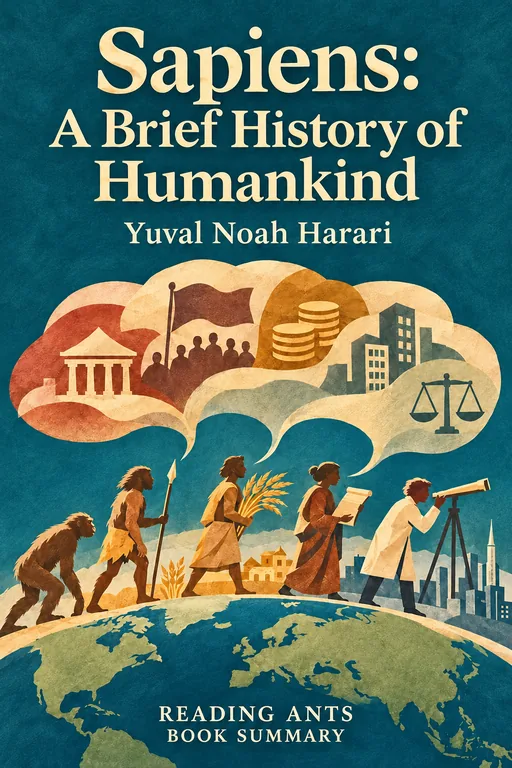
Sapiens: A Brief History of Humankind
Yuval Noah Harari
Humans came to rule the planet not because we are the strongest animals but because we can believe in shared stories (gods, nations, money, companies) that let millions of strangers cooperate.
🏛️ History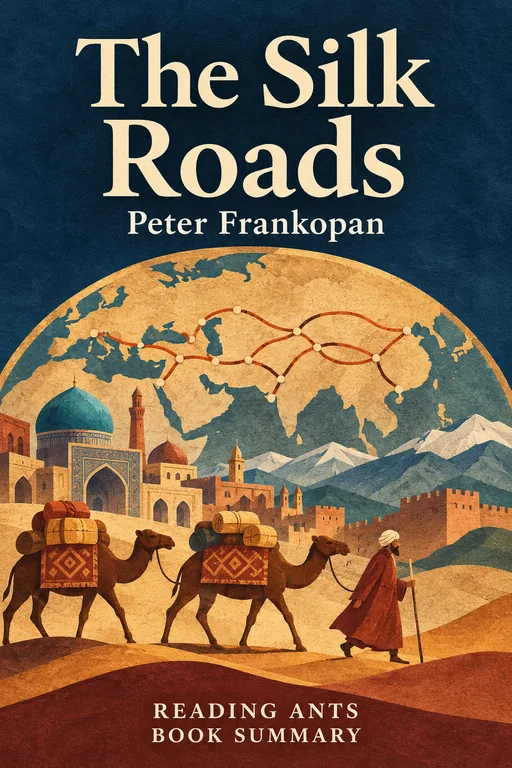
The Silk Roads
Peter Frankopan
Instead of seeing history as centered on Europe, this book argues that the regions linking East and West, Central Asia and the Middle East, were the true center of the world, where trade, religion, empire and ideas met.
🏛️ History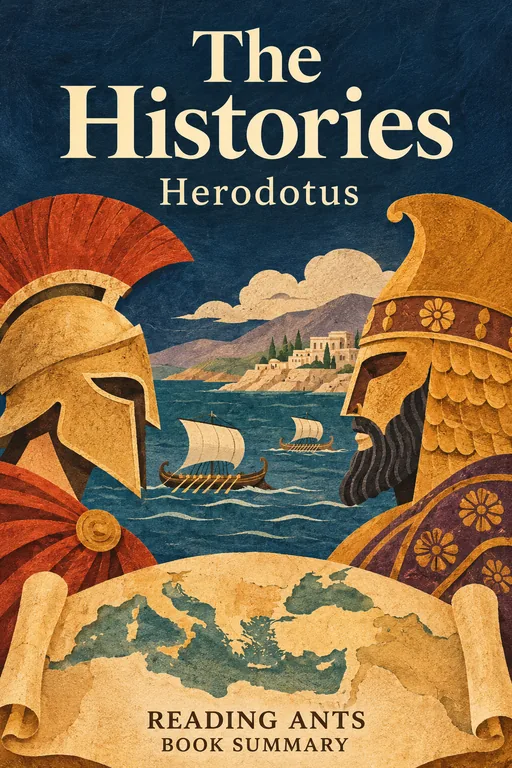
The Histories
Herodotus
Herodotus, often called the father of history, tells how the Greeks and the Persians came into conflict and fought the great wars of the early fifth century BCE, with long, colorful detours into the lands, customs and legends of the known world.
🏛️ HistoryWant something different?
Pick another topic and we will show you three books to start with.